The Romantic Vision of Jotunheimen
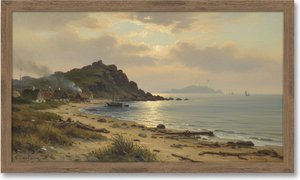
Andreas Edvard Disen stands as a profound witness to the untamed majesty of the Norwegian wilderness, a painter whose brush captured the very soul of the Scandinavian landscape. Born on August 4, 1845, in Modum, Disen dedicated his life to translating the sublime scale of the Jotunheimen and Hardangervidda mountain ranges into evocative oil paintings. His artistic journey was one of meticulous observation and deep emotional resonance, rooted in a style that epitomized the Romantic movement. Through his work, the rugged peaks and serene valleys of Norway were transformed from mere geographical features into poetic expressions of nature's enduring power and quiet solitude.
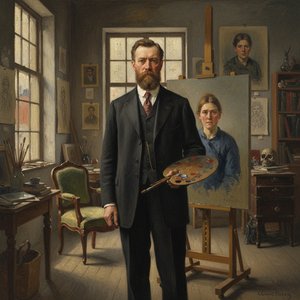
The foundation of Disen’s technical mastery was laid during his formative years at the Royal Drawing School. Under the guidance of Johan Fredrik Eckersberg, he developed a keen eye for realism and a disciplined approach to light and form. This period of study was not limited to the canvas; Disen also honed his sculptural skills alongside Julius Middelthun, an experience that undoubtedly deepened his understanding of spatial representation and the physical weight of the mountains he so loved to depict. A legendary moment in his early career occurred when King Charles IV visited Eckersberg’s studio. The King, struck by Disen's burgeoning talent, purchased a completed work and granted him a prestigious scholarship, an act of royal patronage that would alter the trajectory of his life forever.
Artistic Evolution and the Karlsruhe Influence
With the support of his scholarship, Disen traveled to the Academy of Fine Arts in Karlsruhe, a pivotal chapter that expanded his aesthetic horizons. It was here, between 1871 and 1876, that he studied under the renowned Hans Fredrik Gude. Serving as Gude’s assistant during the latter years of his studies, Disen immersed himself in the sophisticated landscape traditions of Europe. This period allowed him to blend his Norwegian roots with a broader, more refined European sensibility, learning to manipulate atmosphere and light to create the dramatic, sweeping vistas that would become his hallmark. While he eventually returned to Norway to establish his life and family, the creative spirit he nurtured in Germany often led him to seek inspiration in the Swiss Alps during the warmer months, further enriching his repertoire of mountain scenery.
Disen’s oeuvre is characterized by a remarkable ability to balance the monumental with the intimate. Whether depicting a vast, snow-capped peak or a quiet farmstead nestled in a valley, such as in Gårdstun i aftenstemning, his work possesses an atmospheric depth that invites the viewer into the scene. His technique often utilized warm, evocative hues to capture the fleeting moments of twilight or the crisp clarity of a summer morning, making the landscape feel alive and breathing. This mastery of light allowed him to portray the ruggedness of the Norwegian terrain not just as a subject, but as an emotional experience.
Legacy Amidst Controversy
Despite his undeniable talent, Disen’s career was not without its shadows. He became a central figure in a significant controversy involving the Christiania Kunstforening (Oslo Kunstforening), an influential art society that held immense power over the Norwegian art market. Prominent contemporaries such as Christian Krohg, Erik Werenskiold, and Frist Thaulow criticized the society for being dominated by civil servants rather than artists, and they specifically targeted Disen’s compensation. They argued that he was receiving disproportionately high payments for works they deemed inferior to those of their peers. This period of public scrutiny and the subsequent boycott of the society marked a turbulent era in Norwegian art history, positioning Disen as a symbol of the tensions between traditional patronage and the emerging modern art movement.
Yet, through the critiques and the shifting tides of artistic fashion, Disen remained steadfast in his devotion to his subject matter. His historical significance lies not only in his technical contributions to Norwegian landscape painting but also in his role as a chronicler of a specific, romanticized era of national identity. His paintings remain enduring tributes to the grandeur of the North, preserving the memory of a landscape that continues to inspire awe and reverence long after the artist's passing in 1923.
问答详情
如何浏览 Andreas Edvard Disen 的全部作品?
您可以在 Andreas Edvard Disen 的 全部作品 页面上浏览其在 本站 上的所有作品。
如何按特定色调查找 Andreas Edvard Disen 的作品?
若要按特定色调查找 Andreas Edvard Disen 的作品,请访问艺术家的 按色调浏览 页面。
Andreas Edvard Disen 来自哪里?
Andreas Edvard Disen 出生于 Norway。
我可以在虚拟博物馆中参观Andreas Edvard Disen的作品吗?
Andreas Edvard Disen 的 3D 艺术展厅 可以在虚拟三维展厅中欣赏到艺术家的作品。