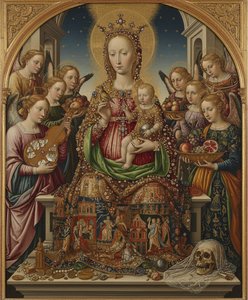
The Venetian Soul of a Dalmatian Master
In the vibrant, sun-drenched tapestry of the sixteenth-century Venetian Republic, few names evoke as much intrigue and stylistic complexity as Andrea Schiavone. Born Andrea Meldolla, his very moniker—meaning "Andrew the Slav"—serves as a poetic testament to his dual identity. Though his roots lay in the Dalmatian city of Zara, now Zadar, Croatia, his artistic spirit was forged in the heart of Venice. This unique heritage allowed him to bridge the gap between the rugged landscapes of his birth and the sophisticated, luminous traditions of the Venetian school. As a painter and etcher, Schiav_avone emerged as a vital force during the transition from the High Renaissance to the more stylized, intellectually charged era of Mannerism.
The early life of Meldolla was marked by a profound connection to the shifting tides of Italian and Adriatic culture. Descended from families in Emilia-Romagna, he arrived in Venice around 1530, bringing with him a fresh perspective that would soon captivate the city's most prestigious patrons. His formative years were deeply influenced by the giants of his era; while he drew heavily from the atmospheric color and light perfected by Titian, he also looked toward the elegant, often distorted grace of Parmigianino. This synthesis of influences allowed him to create works that felt both grounded in Venetian tradition and daringly modern for his time.
A Mastery of Mannerist Grace and Motion
Schiavone’s artistic development is best understood through his embrace of Mannerism, a movement that sought to move beyond the balanced harmony of the Renaissance toward something more dynamic and emotive. He became a master of the figura serpentinata—the spiral pose—where figures appear to twist and flow with an almost supernatural energy. This technique is nowhere more evident than in his religious compositions, such as The Adoration of the Magi, where the arrangement of bodies creates a sense of rhythmic movement and spiritual intensity that draws the viewer into a state of contemplation.
His ability to manipulate light and shadow, much like his contemporaries, was tempered by a specific interest in the intellectual abstraction of form. While many Venetian painters focused on the sensory richness of oil paint, Schiavone utilized it to explore more complex psychological depths. His works often feature:
- Dynamic Compositions: A deliberate use of exaggerated poses and crowded, energetic scenes that challenge the eye.
- Luminous Color Palettes: A lingering devotion to the Venetian tradition of using color to define space and atmosphere.
- Emotional Depth: An ability to imbue even mythological or biblical subjects with a palpable sense of human vulnerability and spiritual longing.
Legacy and Historical Significance
The career of Andrea Schiavone was one of prolific achievement, leaving behind a body of work that includes everything from intimate etchings to monumental religious narratives. His patronage by influential Venetian families, such as the Mocenigo and Grimani, ensured that his influence permeated the very fabric of the city's cultural life. Through his mastery of both painting and printmaking, he helped define a specific subset of Venetian art that was less about static perfection and more about the beautiful, restless energy of the human condition.
Today, Schiavone is remembered not merely as a follower of Titian, but as an innovator who dared to inject Mannerist tension into the Venetian landscape. His legacy lives on in the museums of the world, where his ability to blend the classical with the experimental continues to inspire awe. He remains a pivotal figure whose work captures the precise moment when the stability of the Renaissance began to dissolve into the dramatic, emotive splendor of the approaching Baroque era.
问答详情
Andrea Schiavone 还有哪些别名?
Andrea Schiavone 也被称为 Schiavone, Andrea Shiavoni, Andrea Meldolla, Andrea Meldolla Schiavone, Andrea Schiavoni。
在哪里可以按时间顺序欣赏 Andrea Schiavone 的作品?
您可以在Andrea Schiavone的作品时间轴页面上按时间顺序查看其作品。
我可以在虚拟博物馆中参观Andrea Schiavone的作品吗?
您可以进行虚拟参观:在 Andrea Schiavone 的 3D 艺术展厅 页面中,您可以在三维画廊里欣赏艺术家的作品。
Andrea Schiavone 的艺术生涯是如何划分为不同时期的?
Andrea Schiavone 的艺术生涯在 艺术历程 页面上按时期逐一展开:以横向时间轴的形式呈现作品,并按创作时期划分为不同的篇章。