A Life Captured in Portraiture: The Story of Alfred Priest
Alfred Priest, born in Harborne, West Midlands, in 1874, was a British artist whose career unfolded against the backdrop of Victorian society and the looming shadow of World War I. While his name may not be as instantly recognizable as some of his contemporaries, Priest carved out a significant niche for himself as a skilled portrait painter, capturing the likenesses of prominent figures and offering glimpses into the lives of the era. His journey began with formal training at Cope and Nicol's art school in Kensington before he gained admission to the prestigious Royal Academy Schools. It was here, under the tutelage of masters like John S. Sargent, W. Q. Orchardson, and George Clausen, that Priest honed his technical abilities and developed a distinctive style characterized by rich detail and dramatic lighting. The 1897 Turner Fund gold medal and scholarship were early indicators of his talent and promise, setting him on a path toward recognition within the art world.
From Academy Walls to Parisian Studios
Priest’s artistic development wasn't confined to the walls of the Royal Academy. A period spent in Paris proved formative, allowing him to immerse himself in different artistic traditions and explore new approaches to his craft. He occasionally studied at the Académie Julian, broadening his perspective and refining his skills through exposure to diverse influences. This time abroad instilled a sense of cosmopolitanism that would later manifest in his work, particularly in his landscape paintings inspired by travels across Europe – Spain, Holland, Switzerland, and Italy all left their mark on his artistic vision. However, Priest’s connection to Britain remained strong; he wasn't an artist who sought complete detachment from his homeland. A significant chapter of his life involved a commission as a celebrity sketch artist for the Daily Chronicle in 1904, bringing him into contact with a wide range of notable personalities and providing valuable experience in capturing fleeting expressions and individual character. Further travels to Australia and India, where his brother served in the Indian Army, added another layer of richness to his experiences and informed his artistic sensibilities.
A Portraitist of Prominence: Subjects and Style
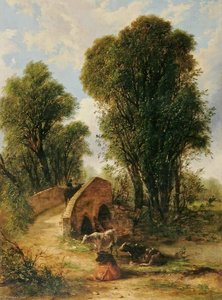
Alfred Priest’s reputation rested primarily on his ability as a portrait painter. His subjects were often individuals of standing – civic leaders like Alderman George Thomas Tuby, Mayor of Doncaster in 1921-1922; literary figures such as Max Pemberton; and members of the burgeoning industrial elite, including Henry Mitchell of Mitchell’s Brewery. He wasn't merely a recorder of appearances, however. Priest sought to capture something deeper – the personality, status, and inner life of his sitters. His portraits are notable for their meticulous attention to detail, particularly in the rendering of clothing, accessories, and facial features. The dramatic lighting he employed added depth and dimension, enhancing the sense of realism and psychological insight. Beyond portraiture, Priest also ventured into landscape painting, creating evocative scenes that reflected his travels and observations. Two paintings, *Mother! Mother!* and *Got 'im.*, stand out as poignant depictions of soldiers in action during World War I, offering a glimpse into the realities of conflict and the emotional toll it took on individuals.
Exhibitions, Recognition, and Lasting Legacy
Throughout his career, Priest exhibited his work at prestigious venues including the Salon, Sunderland Art Gallery, and, importantly, the Royal Academy. These exhibitions provided a platform for showcasing his talent to a wider audience and establishing his reputation within the art world. While he may not have achieved widespread fame during his lifetime, his paintings were appreciated for their technical skill, realism, and ability to capture the spirit of the age. The sudden death in 1929, just nine days after suffering a stroke, brought an abrupt end to a promising career. However, Priest’s legacy lives on through his surviving works, which offer valuable insights into Victorian society, the era surrounding World War I, and the art of portraiture itself. His paintings continue to be admired for their meticulous detail, dramatic lighting, and ability to capture the likenesses – and perhaps even the souls – of those he portrayed. The enduring appeal of his work lies in its combination of technical mastery and psychological depth, making him a noteworthy figure in British art history.
Explore the captivating world of Oswald Birley, Britain’s premier society portraitist. Discover his iconic paintings of royalty & leaders. Expert insights for collectors and art enthusiasts.