切换至版画销售渠道
 展开全文
展开全文







































 对于任何边长超过 105 厘米(约 41 英寸)的艺术品或复制品,画框将以拆解后的组件形式发货。此方法可确保安全送达并防止运输过程中的损坏。


A Glimpse Behind the Brush: William Hogarth's Introspective Masterpiece
William Hogarth’s 1745 self-portrait isn’t merely a likeness; it’s a meticulously crafted window into the mind of one of England’s most astute and satirical observers. Painted during a period of profound social and artistic transformation, this work transcends the conventional portraiture of its time, offering a rare and intimate glimpse into the life and sensibility of the artist himself. The painting immediately draws the eye with Hogarth's direct gaze – a shrewd, almost challenging look that speaks volumes about his intellectual curiosity and unwavering commitment to documenting the realities of London society.

The scene is deceptively simple, yet brimming with carefully orchestrated details. Hogarth, clad in a vibrant red coat – a bold choice that immediately commands attention – sits amidst a clutter of books and artistic paraphernalia: a palette smeared with paint, scattered sketches, and open volumes hinting at his scholarly pursuits. Beside him rests a loyal pug dog, Trump, a constant companion depicted with an air of quiet contemplation, mirroring perhaps the artist’s own thoughtful disposition. This inclusion isn't arbitrary; it speaks to Hogarth’s deep affection for animals and subtly reinforces the theme of domesticity within his broader social commentary.
The Satirical Eye: Hogarth’s Social Commentary
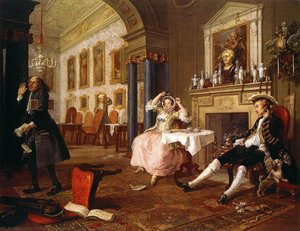
Hogarth was far more than a painter; he was a visual chronicler of 18th-century London. His earlier works, such as *Marriage A-la-Mode* and *Gin Lane*, exposed the hypocrisy and moral decay lurking beneath the veneer of polite society. This self-portrait, however, offers a different perspective – one of introspection and artistic engagement. It’s a moment captured before the storm of his satirical campaigns, suggesting a quiet contemplation on his role as an artist and observer. The books surrounding him are not simply props; they represent Hogarth's deep engagement with classical literature and philosophy, informing his approach to art and his critical analysis of human behavior.
The inclusion of the palette is particularly significant. It’s a visual declaration of Hogarth’s profession, but also a subtle reminder of the labor involved in creating art – a labor that demanded both skill and relentless observation. The arrangement of objects around him isn't random; it’s carefully constructed to create a sense of domestic comfort and intellectual stimulation, reflecting Hogarth’s own values and priorities.
Neoclassical Roots & Artistic Legacy
Painted in the wake of the Neoclassical movement, this self-portrait reflects the influence of classical ideals – particularly in its emphasis on order, clarity, and rational composition. Hogarth's meticulous attention to detail, his use of realistic rendering, and his carefully balanced arrangement of elements are all hallmarks of the Neoclassical style. However, unlike many of his contemporaries who slavishly imitated ancient models, Hogarth infused his work with a distinctly English sensibility, using satire and social commentary to critique contemporary society.
Furthermore, this painting anticipates Hogarth’s later works, particularly *The Rake's Progress* and *The Harlot’s Progress*, which continued his exploration of moral decay and social injustice. It serves as a crucial bridge between his early, more observational work and his later, more overtly satirical output. The self-portrait offers a rare insight into the evolution of Hogarth’s artistic vision – from a keen observer of human nature to a powerful voice of social critique.
A Reproduction for Your Space
OriginalUniqueArt is proud to offer high-quality, hand-painted reproductions of William Hogarth's Self-Portrait. Each reproduction captures the painting’s rich detail, vibrant colors, and evocative atmosphere with exceptional accuracy. Whether you are a seasoned art collector or simply seeking to add a touch of historical elegance to your home, this reproduction is a stunning addition to any collection. It’s more than just an image; it's a tangible connection to one of England’s most influential artists and a captivating window into the world of 18th-century London.
常见问题与解答
“Self portrait”的创作者是谁?创作于哪一年?
"Self portrait" 是由 威廉·霍加斯特 于 1745 年创作的。
哪里可以买到威廉·霍加斯特 的《Self portrait》的手绘复制品?
您可以在威廉·霍加斯特 的《Self portrait》的手工油画复刻页面直接订购其手绘复制品:亚麻画布手工油画复制品,按需定制。
考虑到其色调,建议将"Self portrait"陈列在哪个房间?
凭借其Earthy的色调,威廉·霍加斯特 的《Self portrait》非常适合布置在Living Room中。其色彩搭配正是这一推荐的核心原因。
 实景预览
实景预览
 分享
分享 分享
分享
 详情
详情 指南
指南

 下载作品
下载作品
 相似作品
相似作品 X射线
X射线 幻灯片播放
幻灯片播放 Q&A
Q&A 统计数据
统计数据