 切换至版画销售渠道
 展开全文
展开全文







































 对于任何边长超过 105 厘米(约 41 英寸)的艺术品或复制品,画框将以拆解后的组件形式发货。此方法可确保安全送达并防止运输过程中的损坏。


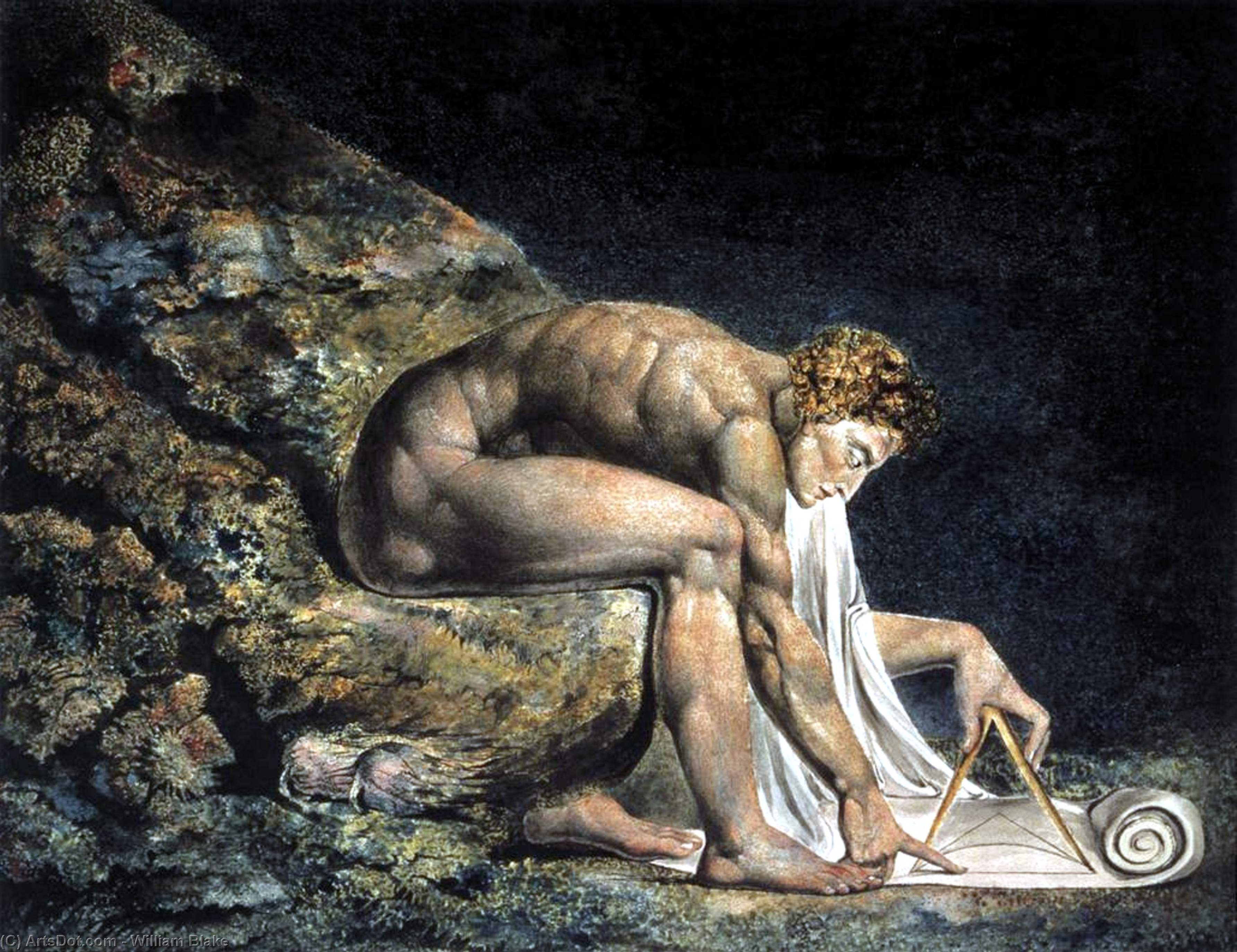
Isaac Newton
William Blake's Isaac Newton, created in 1795, is a captivating and thought-provoking engraving that showcases the artist's unique blend of mysticism and critique of scientific rationalism. This piece is part of the esteemed collection at the Tate Gallery in London, United Kingdom.Blake’s depiction of Newton is not a traditional portrait but rather an allegorical representation. The figure of Newton is shown sitting on a rock, his back turned to the viewer, engrossed in his work. He is surrounded by elements that symbolize his scientific endeavors, such as a compass and a piece of cloth. The bird perched atop the rock adds a touch of mysticism, suggesting a connection between the natural world and human knowledge.
Blake's use of symbolism in Isaac Newton is multifaceted. The rock upon which he sits can be seen as a symbol of solidity and permanence, contrasting with the fluid, ever-changing nature of human understanding. Blake's work often explores the tension between reason and imagination, and Isaac Newton is no exception. By depicting Newton in this manner, Blake questions the dominance of scientific thought over other forms of knowledge and experience.
The engraving technique used by Blake adds a layer of depth and texture to the piece. The intricate details and the play of light and shadow create a sense of dimensionality, drawing the viewer into the world of the painting. This style is characteristic of Romanticism, emphasizing emotion, imagination, and individualism.
Blake's work was influenced by various artistic movements, including Romanticism and Neoclassicism. His unique blend of mysticism and critique of scientific rationalism places him at the forefront of innovative artists who challenged conventional norms. For those interested in exploring more of Blake’s works, William Blake:Isaac Newton and William Blake:Newton are available on OriginalUniqueArt. Additionally, the museum where this piece is housed, Tate Gallery, is discussed in detail at Discovering the Masterpieces of Tate Britain, United Kingdom.
This engraving captures a profound dichotomy—Newton’s unwavering focus on scientific observation juxtaposed against the ethereal presence of the bird and the rock. Blake deliberately avoids portraying Newton as merely a man of intellect; instead, he presents him as an embodiment of humanity's struggle to reconcile reason with intuition. The artist’s masterful use of chiaroscuro enhances this dramatic effect, highlighting Newton’s solitary posture and emphasizing the symbolic significance of his surroundings.
Considered alongside Blake’s broader philosophical concerns regarding the role of imagination in shaping human understanding, Isaac Newton stands as a powerful emblem of Romantic artistic vision. Its enduring appeal lies in its ability to provoke contemplation on the fundamental questions concerning human consciousness and our relationship with the natural world.
OriginalUniqueArt offers exceptional reproductions of William Blake’s Isaac Newton, meticulously crafted to preserve the artist's original aesthetic and technical brilliance. Explore high-quality prints that bring this iconic artwork into your home or office.
常见问题与解答
在“Isaac Newton”中,哪种颜色最为醒目?
威廉·布莱克 的《Isaac Newton》 的主色调为 黑色 (#101115)。
“Isaac Newton”的作者是谁?
"Isaac Newton" 的创作者是 威廉·布莱克。该作品以 威廉·布莱克 的名义编入目录。
是否有关于 威廉·布莱克 的《Isaac Newton》 的幻灯片展示?
您可以在作品的 幻灯片展示 页面上以幻灯片形式浏览 威廉·布莱克 的《Isaac Newton》。
 实景预览
实景预览
 分享
分享 分享
分享
 详情
详情 指南
指南

 下载作品
下载作品
 相似作品
相似作品 X射线
X射线 幻灯片播放
幻灯片播放 问答
问答 统计数据
统计数据