
 实景预览
实景预览
 分享
分享 分享
分享
 详情
详情 指南
指南

 下载作品
下载作品
 相似作品
相似作品 X射线
X射线 幻灯片播放
幻灯片播放 问答
问答 统计数据
统计数据Breakfast Piece

- 49.0 x 41.0 cm


 展开全文
展开全文
艺术微喷/版画
博物馆级艺术微喷或帆布版画,制作高效,并提供多种饰面选择。 ( 订购纯手工绘制画作 切换至数字图像销售渠道)




P118B ¥10

P118H ¥10

P118W ¥10

P438Z ¥10

P508JH ¥12

P508YH ¥12

P805H ¥10

P805Z ¥10

P919BZ ¥10

P919G ¥10

P919XJ ¥10

P959ZH ¥10

P968JZ ¥12

W106C ¥8

W218G ¥10

W218JH ¥8

W218Y ¥10

W307PJ ¥10

W316G ¥10

W316PJ ¥8

W316Y ¥10

W398PJ ¥8

W4111J ¥10

W500HY ¥15

W500JH ¥15

W692G ¥12

W849H ¥8

W940BG ¥15

W953PJ ¥8




您可以从与原作比例一致的预设尺寸中进行选择。

请输入您所需的宽度和高度,以适配您的画框或墙面。由于印刷品只能进行裁剪,无法超出原图尺寸,因此若比例不一致,画面的一部分将会被裁切。在正式印刷之前,我们会为您发送一份数字效果图供您确认。本页面显示的图片并非最终裁剪后的效果——只有效果图才能展示真实的裁剪情况。


 玻璃选项仅适用于110厘米以下的尺寸。

Breakfast Piece
艺术微喷/版画
复刻品尺寸
-


最终结算价
¥ 543
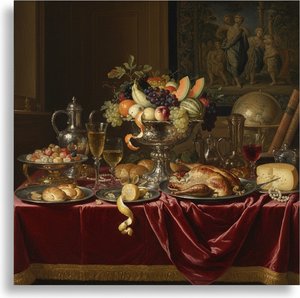
A Window into Dutch Domesticity: Willem van Aelst’s *Breakfast Piece*
Willem van Aelst's *Breakfast Piece*, painted in 1671, is more than just a still life; it’s a meticulously crafted snapshot of 17th-century Dutch life, brimming with the quiet luxury and observant detail that defined the Golden Age. Measuring a modest 49 x 41 cm, this oil on canvas work, currently housed in the Academy of Fine Arts Vienna, offers a captivating glimpse into a world where even the most commonplace objects – a bowl of fruit, a loaf of bread, onions, and a glass vase – were elevated to subjects of profound artistic consideration. Van Aelst’s mastery lies not merely in his technical skill but in his ability to imbue these everyday items with a sense of palpable presence, inviting the viewer into an intimate moment of domestic tranquility.
Chiaroscuro and the Illusion of Depth
The painting's impact is immediately drawn from Van Aelst’s masterful use of chiaroscuro – the dramatic interplay of light and shadow. This technique isn’t simply decorative; it’s fundamental to creating a convincing illusion of three-dimensionality, allowing each object to appear almost tangible. The artist meticulously renders textures with astonishing accuracy: the rough skin of the onions contrasts sharply with the smooth surface of the glass vase, while the glistening fish reflects light in a way that suggests freshness and vitality. The dark tablecloth, acting as a stage backdrop, further emphasizes the luminous quality of the food items, drawing the eye towards their intricate details.
A Reflection of Dutch Society – Symbolism and Context
*Breakfast Piece* provides a valuable window into the social and cultural values of 17th-century Holland. The abundance of food—a symbol of prosperity and good fortune—reflects the economic strength of the Dutch Republic at the time. The composition, with its triangular arrangement, echoes classical principles of harmony and balance, reflecting the influence of Renaissance art on the Dutch Golden Age. While seemingly a simple still life, it subtly engages with the *vanitas* theme – a reminder of mortality and the fleeting nature of earthly pleasures – a common motif in Dutch Baroque painting. The artist’s meticulous attention to detail speaks to the importance placed on material possessions and the appreciation for beauty within the domestic sphere.
The Artistry of Willem van Aelst
Willem van Aelst was a true innovator in the field of still life painting. Born in Delft in 1626, he dedicated his career to capturing the nuances of everyday objects with unparalleled precision and artistry. His work exemplifies the meticulous realism that characterized the Dutch Golden Age, showcasing a deep understanding of light, texture, and composition. Van Aelst’s legacy rests on his ability to transform ordinary subjects into extraordinary works of art, solidifying his place as one of the most important still life painters of his era. This piece is a testament to his dedication to detail and his profound appreciation for the beauty found in the simplest of things.
常见问题与解答
建议为 威廉·范·艾尔斯特 的《Breakfast Piece》 选择哪种复刻尺寸?
建议将“Breakfast Piece”打印为 Large 尺寸。其他尺寸亦可按相同比例进行制作。
这幅 威廉·范·艾尔斯特 的《Breakfast Piece》 的复制品会为房间增添怎样的氛围?
威廉·范·艾尔斯特 的《Breakfast Piece》 营造出一种 Classic 的氛围,推荐用于 Dining Room。作品的情绪感即是其为周围空间带来的意境。
"Breakfast Piece" 创作于哪个时代?
威廉·范·艾尔斯特 的《Breakfast Piece》 创作于 Renaissance 时期,这一时期为作品提供了深厚的历史背景。
相关文章

Willem van de Velde the Elder: Master of Maritime Painting & Chronicler of the Dutch Golden Age
Discover the captivating maritime paintings of Willem van de Velde the Elder, a master chronicler of the Dutch Golden Age. Explore his unparalleled realism and lasting influence on naval art history.
Abraham Hendricksz van Beyeren: Pioneering Dutch Still Life & the Banquet Tradition
Explore the captivating world of Dutch Golden Age still life with Abraham van Beyeren. Discover his innovative techniques, symbolic banquet scenes & lasting influence on art history. Learn about collecting these masterpieces.

Golden Light & Dutch Skies: The Timeless Magic of Dutch Golden Age Landscapes
Discover the breathtaking beauty of Dutch Golden Age landscapes. Explore the mastery of light, chiaroscuro, and 17th-century realism through an expert art history lens, celebrating the enduring legacy of the Dutch Masters for discerning collectors and art lovers.

伦勃朗25幅杰作:光影大师的艺术传奇与家居臻选
探索伦勃朗25幅杰作,领略荷兰黄金时代光影大师的艺术传奇!从《夜巡》到自画像,深入了解巴洛克艺术、历史绘画与人物肖像背后的故事。OriginalUniqueArt.com提供高清艺术复制品及家居装饰灵感。立即探索完整系列!

荷兰黄金时代:十幅定义艺术史的巨作 | OriginalUniqueArt
探索荷兰黄金时代的艺术巅峰! 伦勃朗、维米尔等大师名作,带您领略巴洛克艺术的辉煌。高清画作、博物馆级品质,点亮您的家居空间。OriginalUniqueArt.com 提供精选艺术复制品和定制装饰方案。立即在线探索全系列!