切换至版画销售渠道
 展开全文
展开全文







































 对于任何边长超过 105 厘米(约 41 英寸)的艺术品或复制品,画框将以拆解后的组件形式发货。此方法可确保安全送达并防止运输过程中的损坏。


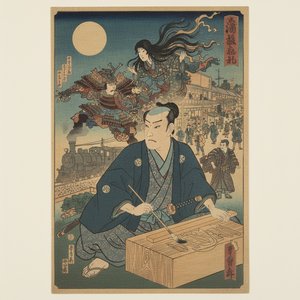
A Clash of Titans: Tsukioka Yoshitoshi’s *Nihon ryakushi*
This dramatic woodblock print, *Nihon ryakushi*, by the celebrated Japanese Ukiyo-e artist Tsukioka Yoshitoshi (1839-1892), is a powerful testament to his mastery of the medium and his fascination with themes of heroism and conflict. The artwork depicts a fierce battle between a lone warrior and an immense sea serpent, rendered in a dynamic composition that immediately captures the viewer’s attention.Visual Narrative & Artistic Style
The scene is dominated by swirling blues and blacks, evoking a turbulent ocean and stormy atmosphere. This dark backdrop dramatically contrasts with the stark white figure of the warrior, instantly focusing our gaze on the central struggle. Yoshitoshi employs bold, expressive lines to define both figures – sharp edges for the warrior’s form suggesting strength and determination, while flowing curves delineate the serpent's body, emphasizing its chaotic energy. The style is distinctly *Ukiyo-e* (“pictures of the floating world”), characterized by simplified forms, flattened perspective, and a focus on movement. Notice how Yoshitoshi uses overlapping shapes to create a sense of depth despite the lack of traditional Western perspective.Technique & Materials
*Nihon ryakushi* is a woodblock print, created using the meticulous *Ukiyo-e* technique. This involved carving the design into a wooden block (typically cherry wood), applying ink – in this case, shades of blue and black – and then pressing it onto paper, traditionally Japanese mulberry paper known for its strength and ability to absorb ink beautifully. The visible grain and slight variations in ink density are hallmarks of this process, lending the print a unique tactile quality.Historical Context & Yoshitoshi’s Legacy
Tsukioka Yoshitoshi was one of the last great masters of *Ukiyo-e*, working during the late Edo and early Meiji periods – a time of significant social and political upheaval in Japan. He initially studied under Kuniyoshi, another prominent *Ukiyo-e* artist, but quickly developed his own distinctive style. Yoshitoshi is renowned for revitalizing the woodblock print tradition, often depicting historical scenes, portraits of warriors, and dramatic narratives. His work bridged the gap between traditional Japanese art and modern influences.Symbolism & Emotional Impact
The subject matter itself carries significant symbolic weight. The warrior embodies human courage, resilience, and the fight against overwhelming odds. Conversely, the colossal sea serpent represents the untamed forces of nature – chaos, destruction, and the unpredictable power of the ocean. This struggle can be interpreted as a metaphor for humanity’s ongoing battle with the natural world or internal struggles against adversity. The print evokes feelings of awe, tension, and perhaps even a sense of vulnerability in the face of immense power.Collecting & Interior Design
A reproduction of *Nihon ryakushi* would be a striking addition to any art collection. Its dramatic composition and bold color palette make it a captivating focal point. The print’s themes resonate universally, making it suitable for various interior design styles – from minimalist spaces where its graphic quality can shine, to more eclectic settings where it adds a touch of historical intrigue. Consider framing this piece with a simple mat and frame to allow the artwork itself to take center stage. The print’s dark tones also make it an excellent choice for rooms seeking a sense of drama and sophistication.常见问题与解答
在 月岡芳年 的《Nihon ryakushi》 中,艺术流派与时代背景是如何交汇的?
月岡芳年 的《Nihon ryakushi》 属于 Ukiyo-e 流派,创作于其作者的 19世纪 时期。
在购买之前,我可以在自己的墙上预览 月岡芳年 的《Nihon ryakushi》 吗?
通过作品的 AR 效果预览 页面,您可以在兼容设备上使用增强现实技术,在自己的墙面上预览 月岡芳年 的《Nihon ryakushi》。
是否有关于 月岡芳年 的《Nihon ryakushi》 的导览页?
月岡芳年 的《Nihon ryakushi》 的 指南 页面提供了一份可打印的两页式学生资料单:包含作品及其基本信息表、将其置于艺术家生平中的年代轴、艺术家的其他作品、经测量的色板,以及四种格式的即用型引用文献。
 实景预览
实景预览
 分享
分享 分享
分享
 详情
详情 指南
指南

 下载作品
下载作品
 相似作品
相似作品 X射线
X射线 幻灯片播放
幻灯片播放 Q&A
Q&A 统计数据
统计数据