切换至版画销售渠道
 展开全文
展开全文







































 对于任何边长超过 105 厘米(约 41 英寸)的艺术品或复制品,画框将以拆解后的组件形式发货。此方法可确保安全送达并防止运输过程中的损坏。


A Portrait Steeped in Seventeenth Century Elegance: Gainsborough’s Reverie for Van Dyck
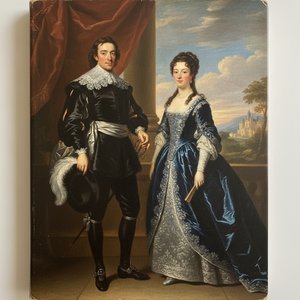
Thomas Gainsborough's “The Hon. Frances Duncombe” isn’t merely a depiction of a woman; it’s an embodiment of artistic aspiration and a masterful distillation of stylistic influences—a testament to Gainsborough’s profound admiration for the celebrated Flemish painter Anthony van Dyck. Completed in 1777, this portrait captures Frances Duncombe, daughter of Anthony Duncombe and Frances Bathurst, with remarkable grace and poise, establishing her within an aristocratic milieu that reflects the grandeur of the era. The Earl of Radnor commissioned Gainsborough to produce a series of portraits mirroring Old Masters’ traditions, cementing Gainsborough's reputation as a champion of classical ideals.- Subject Matter & Composition: Duncombe stands confidently on one leg, suggesting an effortless elegance and perhaps hinting at the performance inherent in aristocratic social rituals. The setting—a tranquil garden bathed in diffused light—echoes Van Dyck’s penchant for idealized landscapes, prioritizing atmosphere over detailed topographical accuracy. This deliberate choice underscores Gainsborough's desire to elevate his subject beyond mere physicality, presenting her as an emblem of refined virtue.
- Style & Technique: Gainsborough meticulously employs chiaroscuro—the dramatic interplay of light and shadow—a technique perfected by Van Dyck himself. This masterful manipulation creates depth and dimensionality, drawing the viewer’s eye to Duncombe's face and highlighting her luminous complexion. The artist skillfully renders textures with subtle brushstrokes, capturing the delicate sheen of the lace adorning her dress and conveying a palpable sense of softness.
Costume & Symbolism: A Nod to Artistic Legacy
The Duncombe’s attire is deliberately reminiscent of seventeenth-century fashions—a conscious homage to Van Dyck's stylistic preferences. The flowing gown, embellished with white lace, speaks to notions of purity and refinement, aligning perfectly with the aristocratic ideals prevalent during Gainsborough’s time. Furthermore, the pearl necklace symbolizes wealth and status, reinforcing Duncombe’s position within the upper echelons of society. These sartorial choices aren't accidental; they serve as visual cues communicating a deeper understanding of artistic conventions.
Historical Context & Artistic Influence
Painted during Duncombe’s residency with the Earl of Radnor, “The Hon. Frances Duncombe” exemplifies the prevailing trend toward commissioning portraits in the grand style—a stylistic movement championed by influential patrons like Radnor who sought to enrich their collections with masterpieces of Old Masters. Gainsborough's unwavering devotion to Van Dyck’s aesthetic principles demonstrates his commitment to upholding artistic traditions and elevating portraiture beyond mere likeness, transforming it into a vehicle for conveying moral virtue and aristocratic prestige.
Emotional Impact & Artistic Resonance
Ultimately, Gainsborough succeeds in capturing not just Duncombe's appearance but also her inner grace—a quality that transcends time. The serene expression on her face conveys composure and dignity, inviting contemplation about beauty, virtue, and the enduring power of artistic inspiration. “The Hon. Frances Duncombe” remains a captivating artwork because it embodies Gainsborough’s profound respect for his predecessors while simultaneously establishing himself as a singular voice within British art history.
常见问题与解答
托马斯·盖恩斯博罗 的《The Hon. Frances Duncombe》 传达了怎样的情感?
托马斯·盖恩斯博罗 的《The Hon. Frances Duncombe》 传达出一种 Reflective 的情感基调。
托马斯·盖恩斯博罗 的《The Hon. Frances Duncombe》 的图像可以自由转载吗?
托马斯·盖恩斯博罗 的《The Hon. Frances Duncombe》 属于 属于公有领域 —— 其版权已过期。此版权状态决定了该作品图像的复制方式。
“The Hon. Frances Duncombe”整体色调是偏明亮还是偏暗?
托马斯·盖恩斯博罗 的《The Hon. Frances Duncombe》 的亮度记录为 deep_shadow,亮度值为 Dark。
 实景预览
实景预览
 分享
分享 分享
分享
 详情
详情 指南
指南

 下载作品
下载作品
 相似作品
相似作品 X射线
X射线 幻灯片播放
幻灯片播放 Q&A
Q&A 统计数据
统计数据