切换至版画销售渠道
 展开全文
展开全文







































 对于任何边长超过 105 厘米(约 41 英寸)的艺术品或复制品,画框将以拆解后的组件形式发货。此方法可确保安全送达并防止运输过程中的损坏。


A Vision of Architectural Grandeur
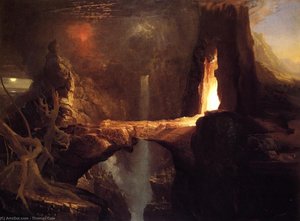
Thomas Cole's “The Architect’s Dream,” painted in 1840, isn’t merely a landscape; it’s an immersive architectural fantasy—a testament to the artist’s profound understanding of Western artistic history and his own creative vision. This monumental oil on canvas, now residing within the Toledo Museum of Art, immediately captivates with its sheer scale and meticulously rendered details, transporting the viewer into a realm where classical temples, Roman arches, and Gothic cathedrals coexist in an improbable yet strangely harmonious tableau.
At first glance, the painting appears to depict a serene vista—a tranquil harbor dotted with boats. However, closer inspection reveals a complex layering of architectural styles spanning millennia. Egyptian pyramids rise majestically alongside Doric Greek temples, Roman aqueducts stretch across the landscape, and Gothic arches frame the scene. This deliberate juxtaposition wasn’t simply an artistic flourish; it reflected the 19th-century fascination with classical antiquity and the revival of interest in ancient building techniques that was sweeping through Europe and America.
The Romantic Spirit and Cole's Artistic Journey
“The Architect’s Dream” is a quintessential example of the Hudson River School, an artistic movement characterized by its romanticized depictions of American landscapes. Unlike earlier European landscape painting, which often focused on historical or mythological subjects, the Hudson River School sought to capture the sublime beauty and spiritual essence of the American wilderness. Cole, deeply influenced by his travels in Europe—particularly Italy—brought this sensibility back to America, infusing it with a uniquely American perspective.
Cole’s artistic journey was marked by a deliberate rejection of academic conventions. He eschewed the polished techniques favored by established artists and instead developed a distinctive style characterized by loose brushwork, vibrant colors, and an emphasis on capturing atmospheric effects. This approach, combined with his deep knowledge of architecture and history, allowed him to create a painting that is both visually stunning and intellectually stimulating.
Symbolism and the Architect’s Dream
The central figure in “The Architect’s Dream”—a young man reclining on a stack of books—represents the architect himself. He embodies not just the profession but also the pursuit of knowledge, imagination, and artistic creation. His pose suggests contemplation and a deep connection to the past, while his hand holding a blueprint symbolizes the act of design and construction. The setting itself is laden with symbolism; the ruins evoke the decline of empires, while the vibrant colors and dynamic composition suggest the potential for renewal and rebirth.
The painting’s title—“The Architect’s Dream”—hints at its underlying theme: the power of imagination to transcend time and create enduring works of art. Cole wasn't simply depicting a collection of buildings; he was exploring the very nature of architectural history, questioning how past styles could inform and inspire future designs. The inclusion of Gothic elements, often associated with spiritual aspiration, subtly contrasts with the more secular grandeur of classical architecture, suggesting a broader vision of human creativity.
A Legacy of Vision
“The Architect’s Dream” remains one of Thomas Cole's most ambitious and captivating works. It is a testament to his artistic skill, intellectual curiosity, and profound understanding of the relationship between art, architecture, and history. More than just a beautiful painting, it offers a glimpse into the mind of an artist who dared to dream beyond the confines of his time—a dream that continues to resonate with viewers today.
常见问题与解答
“The Architect's Dream (detail)”的作者是谁?
《The Architect's Dream (detail)》被归为托马斯·柯尔的作品。
托马斯·柯尔 的作品《The Architect's Dream (detail)》知名度如何?
托马斯·柯尔 的《The Architect's Dream (detail)》 的记录热度为 Iconic。
托马斯·柯尔 的《The Architect's Dream (detail)》 的创作年份是哪一年?
托马斯·柯尔 的《The Architect's Dream (detail)》创作于1840年。
 实景预览
实景预览
 分享
分享 分享
分享
 详情
详情 指南
指南

 下载作品
下载作品
 相似作品
相似作品 X射线
X射线 幻灯片播放
幻灯片播放 问答
问答 统计数据
统计数据