
 实景预览
实景预览
 分享
分享 分享
分享
 详情
详情 指南
指南

 下载作品
下载作品
 相似作品
相似作品 X射线
X射线 幻灯片播放
幻灯片播放 问答
问答 统计数据
统计数据In Arcadia

- 197.0 x 290.0 cm

 展开全文
展开全文
艺术微喷/版画
博物馆级艺术微喷或帆布版画,制作高效,并提供多种饰面选择。 ( 订购纯手工绘制画作 切换至数字图像销售渠道)




































您可以从与原作比例一致的预设尺寸中进行选择。

请输入您所需的宽度和高度,以适配您的画框或墙面。由于印刷品只能进行裁剪,无法超出原图尺寸,因此若比例不一致,画面的一部分将会被裁切。在正式印刷之前,我们会为您发送一份数字效果图供您确认。本页面显示的图片并非最终裁剪后的效果——只有效果图才能展示真实的裁剪情况。


 玻璃选项仅适用于110厘米以下的尺寸。

In Arcadia
艺术微喷/版画
复刻品尺寸
-


最终结算价
¥ 543
艺术家简介
Early Life and Artistic Foundations
Thomas Alexander Harrison, born in Philadelphia in 1853, emerged as a significant figure in the landscape and marine painting traditions of his time. While details surrounding his early childhood remain somewhat elusive, it is known that he received initial artistic training at the prestigious Pennsylvania Academy of Fine Arts. However, his path wasn’t immediately dedicated to pure artistry; for nearly six years, Harrison worked as a draftsman for a United States government survey expedition meticulously mapping the Pacific coast. This experience, from 1872-1877, proved formative, instilling in him a deep appreciation for the vastness of nature and an analytical eye honed by precise observation—qualities that would later define his artistic style.
In 1879, Harrison embarked on a pivotal journey to Paris, a decision that irrevocably shaped his career. He enrolled at the École nationale supérieure des Beaux-Arts, studying under the renowned academic painter Jean-Léon Gérôme and briefly with Jules Bastien-Lepage. While benefiting from their instruction, Harrison soon found himself chafing against the constraints of traditional academic methods. This dissatisfaction led him to seek inspiration elsewhere, specifically in the coastal regions of Brittany, France.
Brittany and the Luminosity of Impressionism
The rugged coastline of Brittany became Harrison’s artistic sanctuary. In towns like Pont-Aven and Concarneau, he immersed himself in capturing the poetic light and ever-changing moods of the sea. It was here that his signature style began to blossom—a luminous naturalism infused with impressionistic sensibilities. Unlike many of his contemporaries who rigidly adhered to academic conventions, Harrison embraced a more fluid approach, prioritizing the direct observation of nature and the evocative power of color and atmosphere.
His early success at the Paris Salon in 1882 with *Châteaux en Espagne* (Castles in Spain), depicting a daydreaming boy on the beach, signaled his growing recognition. However, it was his large canvas *En Arcadie*, exhibited in 1885, that truly established his reputation. This work, a remarkable study of flesh tones and light, resonated with younger artists and demonstrated Harrison’s mastery of plein-air painting—painting outdoors directly from nature.
Influences and Artistic Development
Harrison's artistic development was influenced by several key factors. His brother, Birge Harrison, also a successful artist, provided both companionship and encouragement. The French Impressionists, with their focus on capturing fleeting moments of light and color, undoubtedly played a role in shaping his aesthetic vision. However, Harrison’s work distinguishes itself through its unique blend of analytical precision—a legacy of his surveying experience—and emotional sensitivity.
He became an integral part of the artist colony at Concarneau, where he shared ideas and techniques with fellow painters like Cecilia Beaux. Her observations suggest that Harrison's engineering background contributed to his methodical approach to painting, allowing him to dissect and reconstruct natural forms with remarkable accuracy. This analytical foundation, combined with his passion for capturing atmospheric effects, resulted in seascapes of exceptional depth and luminosity.
Major Achievements and Recognition
Throughout his career, Harrison consistently garnered critical acclaim and numerous awards for his paintings. His serial depictions of gently breaking waves, such as *The Wave* (circa 1885), became iconic representations of the Breton coastline. This particular work, now held in the collection of the Pennsylvania Academy of the Fine Arts, exemplifies his ability to convey both the power and serenity of the ocean.
Harrison’s paintings were not merely technical exercises; they were imbued with a sense of poetic emotion. He sought to capture the essence of nature—its light, its movement, and its inherent beauty. His work resonated with audiences who appreciated his ability to evoke a feeling of tranquility and wonder. The influence of his art extended beyond the canvas, even capturing the attention of literary figures like Marcel Proust, whose writings suggest an appreciation for Harrison’s evocative depictions of coastal scenes.
Historical Significance and Legacy
Thomas Alexander Harrison occupies a unique position in American art history as a bridge between traditional academic painting and the emerging Impressionist movement. He successfully synthesized these seemingly disparate styles, creating a body of work that is both technically masterful and emotionally resonant. His dedication to plein-air painting helped to popularize this technique among American artists, paving the way for future generations of landscape painters.
Although he spent most of his career in France, Harrison remained deeply connected to his American roots. He exhibited his work widely in both Europe and the United States, contributing significantly to the cross-cultural exchange of artistic ideas. Today, his paintings are held in prominent museum collections around the world, serving as a testament to his enduring legacy as a luminous interpreter of nature’s beauty.

Thomas Alexander Harrison
1853 - 1930 , United States
艺术家简介
- Full Name: Vincent Willem van Gogh
- Nationality: Dutch
- Date Of Birth: 1853
- Date Of Death: 1930
- Place Of Birth: Philadelphia, United States of America
- Notable Artworks:
- Sunflowers
- Bedroom in Arles
- Starry Night
- Wheatfield with Crows
- Artistic Movement Or Style: Post-Impressionism
- Artists Who Influenced This Artist:
- Jean-François Millet
- Charles Bargue
- Artists Or Movements Influenced By This Artist:
- Fauves
- Expressionism
相关文章

The Arcadian Ideal: Tracing the History and Mythic Roots of Pastoral Landscape Painting
Trace the mythic evolution of pastoral landscapes from Arcadia to Romanticism. Explore this masterclass in art history now.
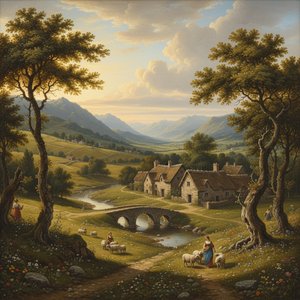
Evoking Arcadia: A Historical & Aesthetic Exploration of Rural Landscape Art
Explore the rich history of pastoral landscape art, from classical Arcadia to Impressionism & beyond. Discover key artists, movements, and how to collect serene rural scenes for your home. Expert insights at OriginalUniqueArt.
Academic Realism's Finest: 10 Masterpieces for Art Lovers & Home Decor
Explore 10 defining Academic Realism masterpieces by Bouguereau, Gérôme & Cabanel. Discover the stories behind these iconic paintings and bring timeless art into your home with museum-quality reproductions from OriginalUniqueArt.com. Explore the full collection online!

The Arcadian Ideal: Exploring the Enduring Allure of Pastoral Landscape Art
Explore the history of pastoral art from Patinir to Constable. Discover the enduring allure of the Arcadian ideal today.

The Arcadian Archetype: Examining the Shepherd within the Landscape Tradition
Explore the evolution of pastoral landscapes from Greek myth to Thomas Cole. Trace this timeless art tradition with us.