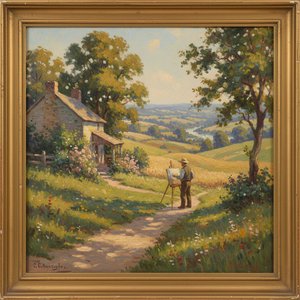
油画原件
 关于 Small Landscape with Weir 的一切







































 对于任何边长超过 105 厘米(约 41 英寸)的艺术品或复制品,画框将以拆解后的组件形式发货。此方法可确保安全送达并防止运输过程中的损坏。


Identification of the Landscape Painting
Small Landscape with Weir is a 19th Century genre work by the German painter Albert Lang. Created about 1873, the piece captures a quiet moment of rural stillness. The artist, born in Karlsruhe, brings a sense of structured observation to this intimate scene.
The painting focuses on a specific intersection of nature and human utility. It depicts a weir, a structure designed to manage the flow of water, set within a tranquil landscape. This work belongs to a period when the artist was refining his ability to translate the physical world into a language of light and shadow.
The scale of the work is modest, offering a private view of the water's edge. It remains a quiet fragment of the artist's early development. A single wooden beam anchors the composition against the mist.
Visual Composition and Subject Matter
A long wooden beam cuts through the space, creating a sharp diagonal from the upper left toward the center-right. This structural line anchors the eye against the soft, organic forms of the landscape. Below this beam, a dark foreground structure meets the middle-ground body of water. The water flows quietly, framed by the weight of man-made elements integrated into the earth. In the distance, hills recede into a pale horizon, layering the depth of the rural scene.
The subject is a quiet, rural landscape centered on a weir. This water management structure sits within the natural terrain, a silent intersection of human utility and the wild. The composition relies on these layers—the heavy timber, the moving water, and the distant slopes—to establish a sense of perspective. Everything remains still. The scene captures a moment of solitude where the only movement is the implied flow of the stream.
Artistic Style and Technical Details
The work is an Impressionistic study executed in oil on a small support, likely board or canvas. A strictly grayscale palette governs the surface, relying on a precise arrangement of black, white, and gray to define the scene. This monochromatic approach strips away the distraction of color to focus entirely on the weight of the air and the subtle shifts in light. The artist uses these tones to build a sense of mist and overcast stillness.
Visible, textured brushstrokes define the physical presence of the paint. These marks are loose and expressive, capturing the rhythmic movement of water as it passes through the weir. The paint is applied with a tactile quality that suggests the organic, irregular forms of the surrounding foliage. Every stroke works to translate the specific atmosphere of a quiet, rural moment into a tangible layer of pigment. The light does not merely sit upon the landscape; it seems to emerge from the interplay of gray and white.
The composition relies on the interplay of light and shadow to establish depth. Through the layering of dark foreground elements against the receding, lighter hills, a sense of space is carved out of the grayscale. The brushwork remains unhurried, prioritizing the sensation of the environment over fine, sharp detail. It is a quiet study of light and shadow.
常见问题与解答
Small Landscape with Weir是手绘的还是印刷的?
手工绘制:由受过专业训练的画家在亚麻画布上,以油画形式临摹 Small Landscape with Weir。
Small Landscape with Weir 我该选择什么尺寸?
原作尺寸为 14.5 x 10.0cm。 尺寸范围从 38.2 x 26.1 cm (¥1337) 到 243.9 x 166.7 cm (¥10162);本页表格列出了主要步骤及其价格。
物流需要多长时间?
送货时间为 4 至 5 周,并提供全球免费快递服务;本页面还提供加急制作选项。您可以在 100 天内无条件退货并获得全额退款。
《Small Landscape with Weir》的原作在哪里?
原作收藏于慕尼黑的巴伐利亚州绘画收藏馆。
阿尔伯特·朗 在创作《Small Landscape with Weir》时使用了什么媒介?
Oil On Board
 实景预览

 分享
 分享
 详情
 详情页


 下载作品
 相似作品
 X射线
 幻灯片播放
 问答

 统计数据