切换至版画销售渠道
 展开全文
展开全文







































 对于任何边长超过 105 厘米(约 41 英寸)的艺术品或复制品,画框将以拆解后的组件形式发货。此方法可确保安全送达并防止运输过程中的损坏。


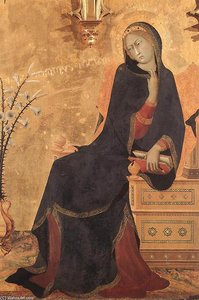
A Testament to Scholarly Reverence: Simone Martini’s Petrarch's Virgil
Simone Martini’s “Petrarch’s Virgil,” created in 1336, transcends mere depiction; it embodies the spirit of its time—a confluence of piety, intellect, and artistic sophistication that cemented Martini’s legacy as one of Siena’s most celebrated masters. Executed during a period marked by burgeoning humanist thought and papal patronage, this title page serves not only as an announcement of Virgil's epic poem “Aeneid” but also as a profound meditation on the relationship between faith and reason, virtues central to Petrarch’s philosophical worldview. Martini skillfully captures this duality through meticulous observation and masterful execution—a hallmark of Sienese painting during the Trecento period.- Subject Matter & Composition: The scene portrays Petrarch, a renowned humanist scholar and poet, seated upon a bench beneath a canopy adorned with foliage, accompanied by Virgil, the Roman poet whose “Aeneid” served as inspiration for Petrarch’s own literary endeavors. The inclusion of a sheep—a symbol of innocence and pastoral virtue—further underscores the poem's themes of moral contemplation and spiritual renewal.
- Style & Technique: Martini’s style is characterized by its exquisite delicacy and luminous color palette, reflecting the influence of Giotto di Bondone and Florentine proto-Renaissance aesthetics. He employs tempera paint on ivory panel—a technique favored for its ability to achieve unparalleled brilliance and tonal subtlety—resulting in a surface that glows with ethereal light. The artist’s meticulous attention to detail is evident in every brushstroke, capturing the textures of fabric, foliage, and skin with remarkable accuracy.
Historical Context: Siena Under Papal Influence
Siena during Martini's lifetime experienced a significant resurgence under papal patronage following Gregory XI’s relocation of the papacy from Avignon to Rome. This period witnessed an unprecedented flourishing of artistic activity, fueled by papal commissions aimed at glorifying God and reaffirming papal authority. Martini’s “Petrarch’s Virgil” exemplifies this cultural dynamism—a product of a milieu where intellectual curiosity intersected with religious devotion, shaping artistic sensibilities and elevating the visual arts to new heights.- Symbolism: Beyond its immediate depiction of Petrarch and Virgil, the artwork resonates with broader symbolic meanings. The canopy represents divine protection and contemplation, mirroring Petrarch’s pursuit of spiritual enlightenment. Similarly, the sheep symbolizes purity and pastoral ideals—values championed by Petrarch as reflections of Christian morality.
- Emotional Impact: Martini's masterful rendering evokes a sense of serene solemnity, inviting viewers to contemplate the profound connection between literature and faith. The luminous colors and delicate brushwork convey an atmosphere of tranquility and intellectual reverence—capturing the essence of Petrarch’s humanist spirit.
Legacy & Artistic Significance
“Petrarch’s Virgil” stands as a cornerstone of Sienese painting, demonstrating Martini's unparalleled ability to synthesize stylistic influences from Giotto and Florence into a uniquely expressive idiom. It represents the apex of Trecento elegance—a testament to Martini’s artistic genius and his contribution to the burgeoning Renaissance movement. Today, reproductions of this masterpiece offer art lovers and collectors alike an opportunity to experience firsthand the beauty and intellectual depth of Siena's artistic heritage.常见问题与解答
西蒙·马丁尼 的《Petrarch's Virgil, title page》 的复制品适合悬挂在什么位置?
凭借其Portrait的形态,建议将《Petrarch's Virgil, title page》复制品用于装饰Living Room。
鉴于创作日期,"Petrarch's Virgil, title page" 属于 西蒙·马丁尼 艺术生涯中的哪个阶段?
1336 年的创作日期将《Petrarch's Virgil, title page》置于 西蒙·马丁尼 艺术发展的 Mature Period 时期。
西蒙·马丁尼 的《Petrarch's Virgil, title page》 的创作媒介是什么?
西蒙·马丁尼 的《Petrarch's Virgil, title page》 的媒介为 Acrylic On Canvas。复制品旨在呈现该技法的视觉效果。
 实景预览
实景预览
 分享
分享 分享
分享
 详情
详情 指南
指南

 下载作品
下载作品
 相似作品
相似作品 X射线
X射线 幻灯片播放
幻灯片播放 问答
问答 统计数据
统计数据