切换至版画销售渠道
 展开全文
展开全文







































 对于任何边长超过 105 厘米(约 41 英寸)的艺术品或复制品,画框将以拆解后的组件形式发货。此方法可确保安全送达并防止运输过程中的损坏。


A Moment Frozen in Tuscan Tranquility
In the quiet corners of art history, few works capture the essence of peaceful companionship as tenderly as Silvestro Lega’s 1880 masterpiece, “In the Villa.” The painting invites the viewer into a serene tableau, where a man and a woman sit closely together on a bench, nestled beneath the dappled shade of mature, protective trees. This is not merely a depiction of a garden scene; it is an intimate study of connection. Lega meticulously arranges his subjects against a lush backdrop of foliage, creating a harmonious balance that draws the eye inward, toward the silent, shared language between the two figures. The atmosphere is one of profound stillness, as if the very air of the Tuscan landscape has paused to honor this private moment of togetherness.
The technical brilliance of the piece lies in Lega’s mastery of the Macchiaioli technique. Moving away from the polished, often artificial perfection of academic idealism, Lega embraced the concept of “macchia”—the use of distinct spots or patches of color to build form and light. Rather than relying on smooth, seamless transitions, he applied pigment in irregular, textured strokes that capture the flickering interplay of sunlight and shadow. This method lends an incredible immediacy to the work, making the textures of the leaves and the soft light filtering through the canopy feel palpable. For the discerning collector or interior designer, this technique provides a rich, tactile quality that brings a sense of organic life and movement to any space.
Symbolism and the Spirit of the Belle Époque
Beyond its surface beauty, “In the Villa” is layered with subtle symbolic resonances that elevate it from a simple genre painting to a work of deep contemplation. The sturdy trees framing the couple serve as metaphors for stability and longevity, mirroring the enduring nature of the bond they share. Even a small detail, such as a bird soaring in the distant sky, adds a layer of poetic aspiration and freedom to the composition. Through a palette of muted greens, earthy browns, and soft ochres, Lega achieves a tonal harmony that evokes a sense of timelessness, grounding the fleeting moment in something much more permanent.
Historically, this work emerged during the Belle Époque, a period of significant cultural and political transformation in Italy. As a leading figure of the Macchiaioli movement, Lega’s art was deeply rooted in social realism and a commitment to observing the truth of everyday life. His involvement in the political currents of his era—including his support for Italian unification—infused his landscapes with a sense of grounded reality and emotional honesty. To possess a reproduction of this work is to hold a piece of Italian heritage, capturing a period where art sought to find beauty in the authentic, unadorned moments of human existence.
For those looking to infuse their homes or galleries with a sense of calm and sophistication, “In the Villa” offers an unparalleled emotional impact. It is a painting that does not demand attention through loud colors or dramatic action, but rather earns it through its quiet, soulful presence. Whether placed in a sunlit study or a contemporary living space, this work serves as a window into a world of grace, reminding us of the beauty found in simplicity and the enduring strength of human connection.
常见问题与解答
"In the villa" 创作于哪一年?
"In the villa"创作于1880年。这一时期将该作品置于西尔维斯特罗·莱加的艺术生涯及其所处时代之中。
原件 西尔维斯特罗·莱加 的《In the villa》 的尺寸是多少?
西尔维斯特罗·莱加 的《In the villa》 的记录尺寸为 48 x 68 cm。您也可以按比例定制其他尺寸的复制品。
"In the villa" 的色彩之间是如何相互关联的?
西尔维斯特罗·莱加 的《In the villa》 的色彩呈现出一种 Strong Color Unity 的和谐感。这种和谐感描述了色彩之间的相互关系。
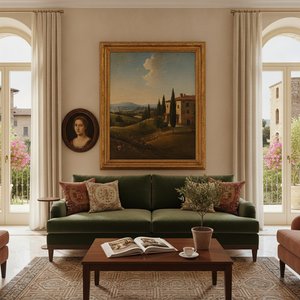
 实景预览
实景预览
 分享
分享 分享
分享
 详情
详情 指南
指南

 下载作品
下载作品
 相似作品
相似作品 X射线
X射线 幻灯片播放
幻灯片播放 问答
问答 统计数据
统计数据