切换至版画销售渠道
 展开全文
展开全文







































 对于任何边长超过 105 厘米(约 41 英寸)的艺术品或复制品,画框将以拆解后的组件形式发货。此方法可确保安全送达并防止运输过程中的损坏。


A Poignant Encounter in the American Landscape
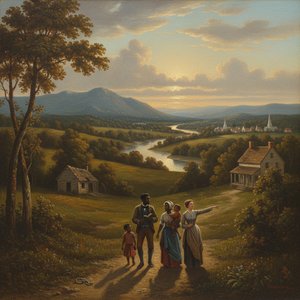
In the tender brushstrokes of Robert Seldon Duncanson’s 1853 masterpiece, Uncle Tom and Little Eva, we are invited into a moment of profound stillness and quiet connection. The painting presents a scene of serene companionship, where a man and a young girl sit nestled beneath the protective canopy of a sprawling tree. Clad in luminous white garments that seem to catch the soft, filtered light of the afternoon, they exist in a world seemingly removed from the turbulence of their era. As the woman—or perhaps the youthful figure representing Eva—points toward a distant horizon, her gesture draws our eyes across the tranquil water where a solitary boat rests near the shore. This delicate interaction between the figures and the vastness of the landscape creates a sense of longing and wonder, capturing a fleeting instance of peace amidst the shifting tides of history.
Duncanson, a pioneer of the American landscape tradition, utilizes his mastery of light and atmosphere to elevate this narrative scene into something much more than a mere portrait. The composition is enriched by the presence of birds in flight, scattered throughout the sky like living notes of music, adding a layer of kinetic energy to an otherwise motionless tableau. Through his expert use of color and texture, Duncanson achieves a luminous quality that breathes life into the natural elements, from the verdant foliage of the sheltering tree to the shimmering reflections on the water's surface. For the discerning collector or interior designer, this piece offers a sophisticated interplay of light and shadow, making it an ideal centerpiece for spaces that value tranquility, depth, and historical resonance.
Historical Resonance and Symbolic Depth
To understand the emotional weight of Uncle Tom and Little Eva, one must look through the lens of its mid-19th-century context. Created in 1853, a period of intense social upheaval in the United States, the painting subtly engages with the cultural zeitgeist of the time. The figures, evocative of characters from Harriet Beecher Stowe’s influential literature, represent much more than a simple pastoral scene; they embody themes of innocence, resilience, and the enduring human spirit. The choice of white clothing serves as a powerful symbol of purity and spiritual light, contrasting beautifully with the earthy, grounded tones of the American landscape that Duncanson so loved to depict.
The artistry lies in how Duncanson weaves these heavy historical themes into a soft, romanticized aesthetic. He does not rely on overt political statements but instead uses the harmony of nature—the calm water, the steady tree, and the rhythmic flight of birds—to suggest a yearning for peace and justice. This subtle approach allows the artwork to resonate on multiple levels: as a beautiful landscape, a touching character study, and a profound historical document. For those seeking to adorn their homes with art that inspires contemplation, this reproduction offers an unparalleled opportunity to possess a piece that is as intellectually stimulating as it is visually breathtaking.
A Timeless Addition to the Refined Interior
For the art enthusiast or the professional decorator, a high-quality reproduction of this work serves as more than just decoration; it acts as a window into a pivotal moment in American art history. The painting’s palette—a sophisticated blend of soft whites, deep greens, and tranquil blues—complements a wide array of interior styles, from classic traditionalism to modern organic aesthetics. Its ability to evoke a sense of calm and nostalgia makes it a transformative element in any room, providing a focal point that invites guests to linger and reflect.
Owning a piece that celebrates the legacy of Robert Seldon Duncanson means bringing into one's environment a testament to perseverance and artistic brilliance. The meticulous detail captured in every leaf and every ripple of water ensures that this reproduction maintains the soul of the original 1853 masterpiece. Whether placed in a sunlit library or a quiet study, Uncle Tom and Little Eva continues to tell a story of connection, beauty, and the enduring power of the natural world.
常见问题与解答
"Uncle Tom and LIttle Eva" 属于哪种艺术风格?
罗伯特·塞尔登·邓坎森 的《Uncle Tom and LIttle Eva》 属于 Hudson River School 流派,该流派为这件作品提供了风格背景。
罗伯特·塞尔登·邓坎森 的《Uncle Tom and LIttle Eva》 适合悬挂在哪个房间?
罗伯特·塞尔登·邓坎森 的《Uncle Tom and LIttle Eva》 的推荐陈列空间为 Living Room。当然,该建议也可根据您的室内装饰进行灵活调整。
《Uncle Tom and LIttle Eva》属于 罗伯特·塞尔登·邓坎森 艺术生涯中的哪个时期?
"Uncle Tom and LIttle Eva" 展现了 罗伯特·塞尔登·邓坎森 在 Mature Period 时期的艺术风格。
 实景预览
实景预览
 分享
分享 分享
分享
 详情
详情 指南
指南

 下载作品
下载作品
 相似作品
相似作品 X射线
X射线 幻灯片播放
幻灯片播放 问答
问答 统计数据
统计数据