切换至版画销售渠道
 展开全文
展开全文







































 对于任何边长超过 105 厘米(约 41 英寸)的艺术品或复制品,画框将以拆解后的组件形式发货。此方法可确保安全送达并防止运输过程中的损坏。


A Symphony of Abundance: The Artistry of Duncanson’s Still Life
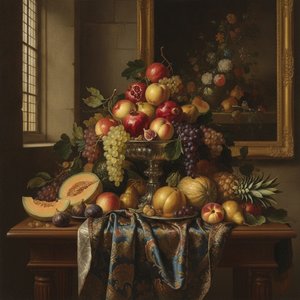
In the quiet intimacy of Still Life with Fruit and Nuts, painted in 1848, we are invited into a world of tactile richness and sensory delight. Robert Seldon Duncanson, an artist often celebrated for his sweeping, romanticized landscapes, demonstrates here a masterful command over the miniature stage of the tabletop. The composition is a lush, horizontal arrangement where nature’s bounty is presented with both precision and poetic grace. A golden yellow pear sits as a central anchor, flanked by the deep, rubicund glow of red apples and the delicate, pale hues of quinces. As the eye wanders across the putty-brown ledge, it encounters the intricate textures of a bountiful harvest: the translucent skin of green grapes that drape elegantly over the fruit, the wrinkled sweetness of raisins, and a scattered mosaic of walnuts, peanuts, almonds, and hazelnuts. It is a painting that does not merely depict food, but celebrates the very essence of ripeness and the fleeting beauty of the natural world.
The technique employed in this work speaks to a profound understanding of light and shadow, a hallmark of mid-19th-century academic excellence. Duncanson utilizes a dramatic chiaroscuro effect, where the foreground elements are bathed in a bright, frontal light that makes the textures pop with lifelike vitality. The sheen on an apple’s skin or the rugged, earthy shell of a walnut is rendered with such care that one can almost feel the weight and grit of the objects. This luminosity stands in stark contrast to the background, which dissolves into a deep, mysterious darkness. As the tabletop recedes, it is swallowed by soft shadows, creating an atmospheric depth that pushes the brightly lit fruit toward the viewer. This interplay of light creates a sense of three-dimensional presence, making the still life feel less like a flat image and more like a physical arrangement resting just within reach.
Beyond its aesthetic splendor, the painting carries a quiet emotional resonance that makes it an enduring piece for any collection. In the mid-1800s, still life paintings often served as meditations on memento mori—reminders of the passage of time and the ephemeral nature of life. The perfection of the ripe fruit represents the peak of vitality, yet the presence of dried raisins and hard-shelled nuts hints at the inevitable cycles of decay and preservation. For the modern collector or interior designer, this work offers a sophisticated balance of warmth and drama. Its earthy palette of browns, golds, and deep reds provides a grounding element to a room, while its classical composition brings an air of timeless elegance. Whether placed in a sunlit breakfast nook or a moody, library-style study, Duncanson’s masterpiece serves as a window into a moment of quiet, bountiful reflection.
常见问题与解答
“Still Life with Fruit and Nuts”的浏览量是多少?
关于 罗伯特·塞尔登·邓坎森 的《Still Life with Fruit and Nuts》 的统计数据可在该作品的 访问统计 页面查看:包括作品的每月访问量、艺术家其他作品的访问量,以及近期访客的国家和语言分布情况。
罗伯特·塞尔登·邓坎森 的《Still Life with Fruit and Nuts》 的色彩是鲜艳夺目还是柔和低调?
罗伯特·塞尔登·邓坎森 的《Still Life with Fruit and Nuts》 的色彩呈现出 Balanced Soft 的饱和度。饱和度描述了色彩的鲜艳或柔和程度。
《Still Life with Fruit and Nuts》这一Realism风格的作品传达了怎样的情感基调?
在Realism运动中,"Still Life with Fruit and Nuts"以Calm的基调被记录下来。
 实景预览
实景预览
 分享
分享 分享
分享
 详情
详情 指南
指南

 下载作品
下载作品
 相似作品
相似作品 X射线
X射线 幻灯片播放
幻灯片播放 问答
问答 统计数据
统计数据