
 效果预览
效果预览
 购买印刷品
购买印刷品 分享
分享 分享
分享
 详情
详情

 下载
下载
 相似作品
相似作品 X射线
X射线 幻灯片播放
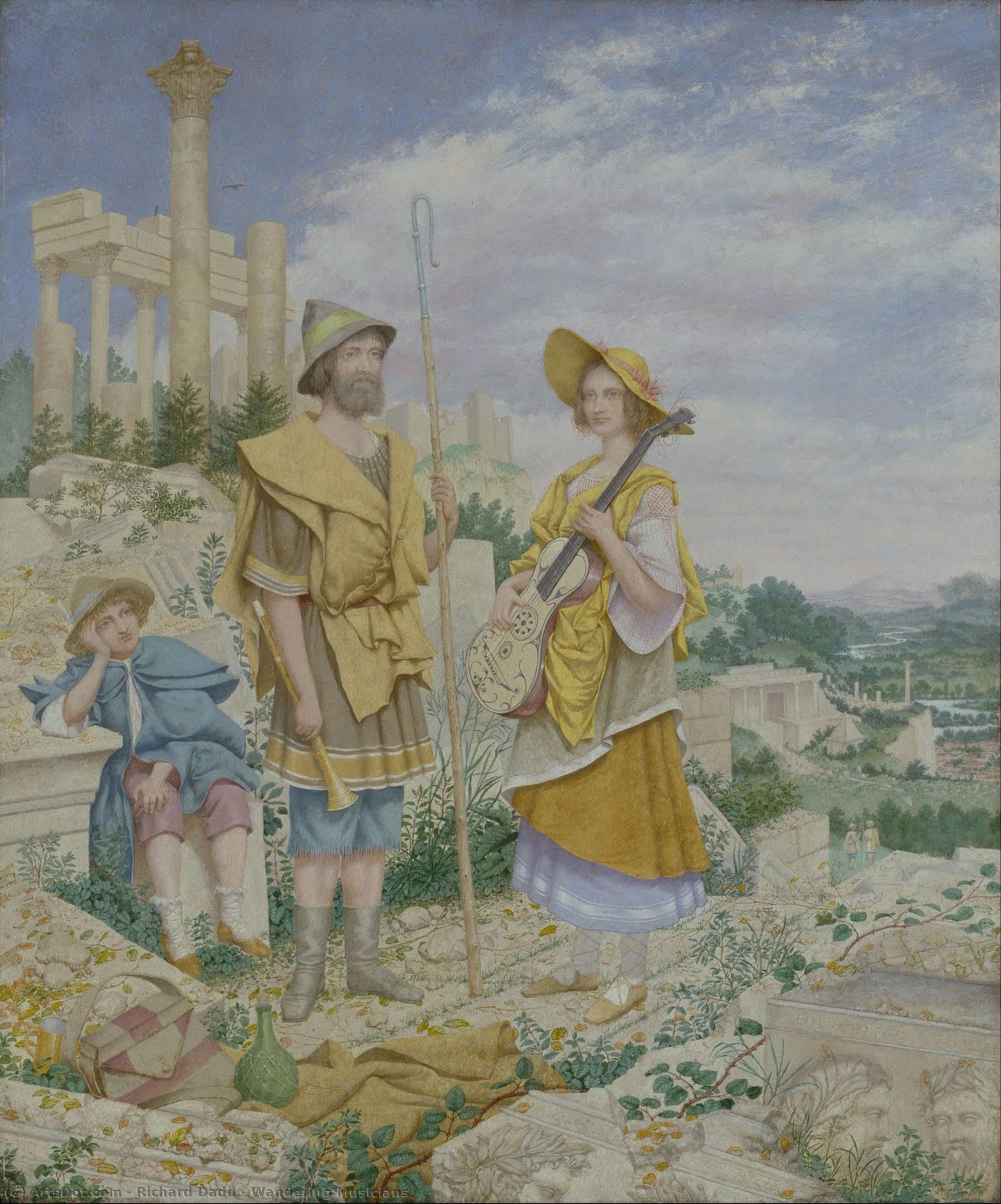
幻灯片播放Wandering Musicians
 Oil On Canvas
- WallArt
- Victorian Romanticism
 1878
1878 5.0 x 6.0 cm
 泰特不列顛美术馆
 展开详情
展开详情




P118B $10

P118H $10

P118W $10

P438Z $10

P508JH $12

P508YH $12

P805H $10

P805Z $10

P919BZ $10

P919G $10

P919XJ $10

P959ZH $10

P968JZ $12

W106C $8

W218G $10

W218JH $8

W218Y $10

W307PJ $10

W316G $10

W316PJ $8

W316Y $10

W398PJ $8

W4111J $10

W500HY $15

W500JH $15

W692G $12

W849H $8

W940BG $15

W953PJ $8




从与原作比例一致的预设尺寸中进行选择。

您可以输入自定义尺寸,以适配特定的画框或空间。如果所选尺寸与原图比例不符,我们将通过裁剪作品或添加手绘元素来扩展画面。数字样稿将在制作开始前发送给您确认。
请注意,屏幕预览无法准确反映实际的裁剪或扩展效果,只有样稿才能真实呈现最终的构图。
虽然我们提供定制尺寸服务,但为了保留原作比例,建议您从预设列表中选择尺寸。
下单后,OriginalUniqueArt.com 团队将通过电子邮件联系客户获取具体要求,并提供效果预览图。


 玻璃选项仅适用于110厘米以下的尺寸。

Wandering Musicians
复制材质
复制品尺寸
-


最终总价
$ 300
作品详情
A Visionary’s Descent: Richard Dadd's "Wandering Musicians"
Richard Dadd’s “Wandering Musicians,” painted circa 1878, is not merely a pastoral scene; it’s a poignant window into the mind of an artist grappling with profound psychological turmoil. Created during his extended confinement within the walls of Bethlem and Broadmoor Hospitals – institutions then considered pioneering in the treatment of mental illness – the painting transcends simple representation, becoming a deeply layered exploration of memory, delusion, and the enduring power of artistic creation amidst suffering. The work’s genesis lies in Dadd's 1842 tour of the Levant, an experience that ignited his imagination but ultimately contributed to his descent into madness. He meticulously recreated this journey on canvas, blending recollections with fevered dreams and unsettling visions – a testament to the way memory itself can be reshaped by mental instability.A Symphony of Detail: Technique and Style
Dadd’s technical mastery is immediately apparent in “Wandering Musicians.” Executed in rich, luminous oil paint on canvas, the scene unfolds with an astonishing level of detail. Every instrument – a lute, a flute, a drum – is rendered with painstaking accuracy, reflecting Dadd's lifelong passion for music and his meticulous observation skills honed during his early artistic training at the Royal Academy. The figures themselves are imbued with a quiet dignity, their postures suggesting a shared moment of contemplation amidst the idyllic landscape. However, closer inspection reveals subtle distortions—a slightly elongated hand, an unnaturally wide-eyed gaze – hinting at the artist’s fractured perception and the unsettling influence of his mental state. The use of color is particularly noteworthy; vibrant greens and blues dominate the scene, creating a sense of serenity and warmth, yet these are punctuated by darker hues that subtly suggest underlying unease and foreboding.Symbolism and Narrative Echoes
The painting’s narrative is rich with symbolic resonance. The open landscape, bathed in golden light, evokes the classical ideal of Arcadia – a pastoral paradise representing harmony, innocence, and escape from worldly concerns. Yet, this idyllic setting is subtly undermined by the presence of the musicians themselves, their faces obscured and their movements suggesting a detached, almost spectral quality. Some art historians have linked the scene to fragments of Greek mythology, specifically references to shepherds and wandering minstrels, drawing parallels with Theocritus’ pastoral poems – a connection Dadd himself likely appreciated given his interest in classical literature. The broken frieze at the foreground, bearing traces of ancient writing, further reinforces this symbolic link, suggesting a yearning for lost traditions and a sense of timelessness. The inclusion of the bottle hints at a possible reflection on the artist's own struggles with addiction and self-medication during his confinement.A Portrait of Turmoil: Context and Legacy
Richard Dadd’s life is inextricably intertwined with “Wandering Musicians.” His descent into mental illness, marked by periods of lucidity interspersed with violent outbursts and delusional episodes, profoundly shaped his artistic output. The painting was created during a particularly challenging period in his confinement at Broadmoor Hospital, where he endured isolation and limited access to creative outlets. Despite these circumstances, Dadd continued to produce works of extraordinary beauty and complexity – a testament to the indomitable spirit of an artist driven by an inner compulsion. “Wandering Musicians” stands as both a poignant self-portrait—a glimpse into the mind of a man struggling with his demons—and a remarkable achievement of artistic skill and emotional depth. It’s a haunting reminder that even in the darkest corners of human experience, creativity can flourish, offering solace, expression, and ultimately, a fragile connection to beauty and meaning. Today, reproductions of this evocative work continue to captivate viewers, inviting contemplation on the complexities of the human psyche and the enduring power of art to transcend suffering.艺术家简介
笼罩在幻想与动荡中的生命
理查德·达德(Richard Dadd),这个名字既象征着艺术的辉煌,也伴随着深刻的心理痛苦,至今仍是维多利亚时代艺术中最引人入胜的人物之一。他于1817年出生于肯特郡的查塔姆,其一生是一段迷人却又充满悲剧色彩的叙事——从一名极具潜力的皇家艺术学院学生,转变为贝特莱姆(Bethlem)与布罗德摩尔(Broad моор)精神病院的长期住院者,而在此期间,他创作出了细节惊人且带有忧郁美感的杰作。自幼年起,达德便在罗切斯特国王学校求学期间展现出卓越的绘画天赋。这份才华将他推向了声名显赫的皇家艺术学院,他在二十岁时被录取,并于1840年获得了人体写生奖章。他迅速融入了伦敦充满活力的艺术圈,成为“小圈子”(The Clique)的创始成员之一,与威廉·鲍威尔·弗里特(William Powell Frith)和奥古斯都·艾格(Augustus Egg)等艺术家并肩,该团体以叙事技巧和严谨的写实主义闻名。他早期的成功作品包括为《英国民谣集》绘制插图以及为《肯特冠冕》(Kentish Coronal)创作扉页,这些作品展示了他日渐成熟的叙事绘画能力,也预示了那些后来定义了他最负盛名、却也最为私人化的幻想式创作倾向。尼罗河上的阴影
1842年,一个关键时刻——也是命运悲剧性的转折点——出现了,当时达德随同托马斯·菲利普斯爵士(Sir Thomas Phillips)前往中东进行考察。这段穿越欧洲、希腊、土耳骗、叙利亚和埃及的旅程,最初看起来是一次宏大的艺术探索契机。然而,随着船队溯尼罗河而上,一种令人不安的转变开始侵蚀达德的心智。他的性格发生了剧烈的变化,陷入了围绕埃及神奥西里斯(Osiris)展开的妄想,并伴随着日益加剧的被害妄想感。1843年回到英国后,他的病情迅速恶化,最终酿成了一场惨剧:在深信自己正在与邪恶化身搏斗的执念驱使下,他杀害了自己的父亲。这一事件导致达德被捕,在经历了一次短暂的逃亡尝试后,最终被送入了贝特莱姆精神病院——即当时臭名昭著的“疯人院”(Bedlam)。现代医学研究表明,达德患有偏执型精神分裂症,这种病症在他家族的其他成员身上也留下了悲剧性的印记。围墙之内的艺术
尽管身处囚禁与监禁之中,达德的艺术灵魂并未熄灭。令人欣慰的是,像威廉·伍德(William Wood)和W·查尔斯·胡德爵士(Sir W. Charles Hood)这样开明的医生意识到了艺术的疗愈价值,并积极鼓励他继续绘画。正是在贝特莱清洗及后来的布罗德摩尔医院度过的数十年间,他创作了许多最具标志性的作品。《仙女掘土者的神来之笔》(The Fairy Feller's Master-Stroke)是一幅规模宏大、细节极其繁复的仙女领域描绘,它成为了他的巅峰之作——既是其艺术造诣的见证,也是其破碎精神世界的写照。这幅画作连同其他众多作品,展现了一个充满了幻想生物、细致入微的植被以及一种令人不安的焦虑感的奇异世界。除了仙女题材,达德还继续探索其他主题:如亚历山大·莫里森博士(Dr. Alexander Morison)的肖像;如《情感插图素描》(Sketches to Illustrate the Passions)系列,提供了对人类情感的深刻洞察;以及精细的海运场景与风景画——例如《斯特拉格林港》(Port Stragglin)——这些作品展示了他以微型画师般的精准度捕捉想象力与记忆的卓越能力。这些作品并非仅仅是消遣,而是他在机构化生活束缚下,对内心世界进行的深刻表达。重获发现的遗产
理查德·达德的艺术视野曾是、且现在依然是独一无二的。他的作品因其痴迷般的细节、幻想性的题材以及心理深度而脱颖而出。他不仅仅是在描绘仙女或东方主义场景;他是在构建整个世界,这些世界充满了令人心碎的美感和潜在的忧郁情绪。虽然在1886年去世后的许多年里,达德的艺术很大程度上被世人忽视,但近几十年来,他的艺术经历了一场显著的复兴。他的影响力可见于众多艺术家、作家和音乐家的作品中——最著名的莫过于摇滚乐队皇后乐队(Queen),其歌曲《仙女掘土者的神来之笔》便是直接受他的画作启发。特里·普拉切特(Terry Pratchett)也承认达德对他自身幻想创作的影响。今天,理查德·达德被公认为维多利亚艺术史上的关键人物——这是对即便在面对深重个人苦难时,创造力依然具有持久力量的明证。他的画作持续地吸引着观众,同时也带给人震撼与不安,让观者得以窥见一个既拥有灿烂想象力又经历过悲剧性破碎的心灵。他的故事是一个深刻的提醒:艺术天才往往能与内心的动荡并存。
理查德·达德
1817 - 1886 , 英国
艺术家简介
- Artistic Movement Or Style: 维多利亚风格, 幻想风格
- Artists Or Movements Influenced By This Artist:
- Queen乐队
- 特里·普拉切特
- Date Of Birth: 1817年
- Date Of Death: 1886年
- Full Name: 理查德·达德
- Nationality: 英国
- Notable Artworks:
- 《理查德二世之死》
- 《戴亚多诺斯》
- 《仙女伐木工的神来之笔》
- 《斯特拉格林港》
- Place Of Birth: 英国,查塔姆
相关文章

The Enduring Legacy of Oil on Canvas: Technique, History & Aesthetic Impact
Explore the rich history & techniques of oil painting – from Renaissance masters to Impressionism. Discover pigments, layering methods, and why this timeless medium endures. Expert insights for artists & art enthusiasts.

Oil on Canvas: A Historical & Technical Exploration of a Timeless Artistic Medium
Explore the rich history & enduring techniques of oil painting on canvas. Discover the science behind its longevity, conservation practices, and contemporary relevance. Expert insights for art enthusiasts.

Idyllic Visions: Exploring the Pastoral Tradition in Western Art – Themes, Techniques & Enduring Appeal
Explore the rich history of pastoral art from classical Arcadia to contemporary interpretations. Discover key artists, themes & collecting tips at OriginalUniqueArt.

The Enduring Power of Painting: A Historical & Contemporary Exploration of Form and Emotion
Explore the rich history & enduring techniques of oil painting with OriginalUniqueArt. Discover masterpieces, learn about art collecting, and find authentic handmade reproductions crafted by skilled artists.
The Soul of Impressionism: Why Oil on Canvas Captures Eternal Light and Timeless Emotion
Discover the enchanting alchemy of Impressionism. Explore how the mastery of oil on canvas, through glazing and impasto, captures eternal light and emotion. Perfect for lovers of Monet and Van Gogh seeking the profound depth of hand-painted fine art.

