
 切换至版画销售渠道
 展开全文
展开全文







































 对于任何边长超过 105 厘米(约 41 英寸)的艺术品或复制品,画框将以拆解后的组件形式发货。此方法可确保安全送达并防止运输过程中的损坏。


A Divine Vision: Unveiling Raphael’s *Study of God the Father*
Raphael's *Study of God the Father*, created in 1515, is more than a preparatory sketch; it’s a profoundly moving exploration of paternal love and divine grace. Executed in delicate chalk on paper (measuring 214 x 209 cm), this work offers an intimate glimpse into Raphael's creative process while standing as a masterpiece in its own right – a testament to the High Renaissance ideals of beauty, harmony, and emotional depth.Compositional Harmony & Narrative Depth
The drawing centers on a powerfully built male figure, undeniably embodying God the Father, tenderly cradling two infants—symbols of humanity’s innocence and dependence. The figures are arranged in a dynamic pyramidal composition, with the central figure providing stability and strength. Each child gazes upwards at their father, radiating adoration and trust. This upward gaze isn't merely anatomical; it suggests a spiritual yearning, a reaching for divine connection. A partially visible third figure in the background subtly hints at a broader narrative context – perhaps representing humanity observing this sacred interaction or other celestial beings witnessing the scene. The arrangement is not static but imbued with movement and emotional resonance.Mastery of Technique & Renaissance Style
Raphael’s skill with chalk is breathtakingly evident in *Study of God the Father*. He employs a masterful range of tonal values, creating a sense of volume and three-dimensionality despite working on a two-dimensional surface. The delicate lines define musculature and drapery with remarkable precision, while subtle shading evokes softness and warmth. This technique exemplifies the High Renaissance emphasis on naturalism and anatomical accuracy. The overall effect is one of serene beauty – a hallmark of Raphael’s style. It's a study in contrasts: strength and tenderness, divinity and humanity.Historical Context & Papal Commissions
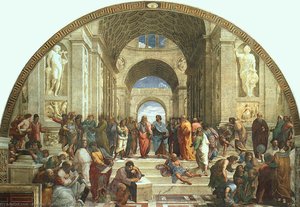
Raphael was at the height of his career when he created this work, deeply involved with prestigious commissions for the Vatican under Popes Julius II and Leo X. He was transforming the papal apartments, adorning them with frescoes that celebrated classical learning and Christian faith. *Study of God the Father* likely served as a preparatory drawing for larger compositions intended for these spaces – potentially related to altarpieces or decorative schemes exploring theological themes. His involvement in projects like The School of Athens demonstrates his commitment to synthesizing classical ideals with religious subject matter, a characteristic also present here.Symbolism & Emotional Resonance
Beyond its immediate depiction of familial love, the drawing is rich in symbolism. God the Father’s protective embrace represents divine providence and unwavering care for humanity. The infants symbolize not only innocence but also the potential for spiritual growth. The composition evokes a sense of peace, security, and profound emotional connection. It's a visual prayer, an expression of faith rendered with unparalleled artistic sensitivity.Legacy & Enduring Appeal
*Study of God the Father* stands as a powerful example of Raphael’s genius – his ability to imbue religious subjects with human emotion and classical beauty. It continues to inspire artists, collectors, and art enthusiasts alike. Its enduring appeal lies in its universal themes of love, faith, and the search for meaning. This work, alongside masterpieces like Self Portrait and Study for St. Paul Preaching in Athens, solidifies Raphael’s place as one of history's most celebrated artists.- Style: High Renaissance
- Technique: Chalk on paper
- Dimensions: 214 x 209 cm
- Date: 1515
- Current Location: (Information not provided in source material)
常见问题与解答
拉斐尔 的《Study of God the Father》 的构图以什么颜色为主导?
在“Study of God the Father”中,最引人注目的颜色是玫瑰棕 (#cca881)。了解作品的主色调有助于将其与室内装饰进行搭配。
在“Study of God the Father”中,融合了怎样的心境与情感?
在“Study of God the Father”中,宁静 的氛围伴随着 神圣感 的情感。
拉斐尔 的《Study of God the Father》 的色彩饱和度如何?
拉斐尔 的《Study of God the Father》 的色彩呈现出 色彩鲜明 的饱和度。饱和度描述了色彩的鲜艳或柔和程度。
 实景预览
实景预览
 分享
分享 分享
分享
 详情
详情 指南
指南

 下载作品
下载作品
 相似作品
相似作品 X射线
X射线 幻灯片播放
幻灯片播放 问答
问答 统计数据
统计数据








![梵蒂冈宫殿:博尔戈之火(细节)[01]](/media/artworks/images-thumb/76/f6/76f6220ba33c4e1d9790e47ace4c7148.jpg)

