
 效果预览
效果预览
 切换至印刷版
 分享
分享 分享
分享
 详情
详情

 下载
下载
 相似作品
相似作品 X射线
X射线 幻灯片播放
幻灯片播放St. Margaret
 Oil On Canvas
- WallArt
- Renaissance mannerism
 1518
1518- Renaissance
 192.0 x 122.0 cm
 Kunsthistorisches Museum
 展开详情
展开详情




P118B $10

P118H $10

P118W $10

P438Z $10

P508JH $12

P508YH $12

P805H $10

P805Z $10

P919BZ $10

P919G $10

P919XJ $10

P959ZH $10

P968JZ $12

W106C $8

W218G $10

W218JH $8

W218Y $10

W307PJ $10

W316G $10

W316PJ $8

W316Y $10

W398PJ $8

W4111J $10

W500HY $15

W500JH $15

W692G $12

W849H $8

W940BG $15

W953PJ $8




从与原作比例一致的预设尺寸中进行选择。

您可以输入自定义尺寸,以适配特定的画框或空间。如果所选尺寸与原图比例不符,我们将通过裁剪作品或添加手绘元素来扩展画面。数字样稿将在制作开始前发送给您确认。
请注意,屏幕预览无法准确反映实际的裁剪或扩展效果,只有样稿才能真实呈现最终的构图。
虽然我们提供定制尺寸服务,但为了保留原作比例,建议您从预设列表中选择尺寸。
下单后,OriginalUniqueArt.com 团队将通过电子邮件联系客户获取具体要求,并提供效果预览图。


 玻璃选项仅适用于110厘米以下的尺寸。

St. Margaret
复制材质
复制品尺寸
-


最终总价
$ 325
作品详情
The Triumph of Faith Over Adversity
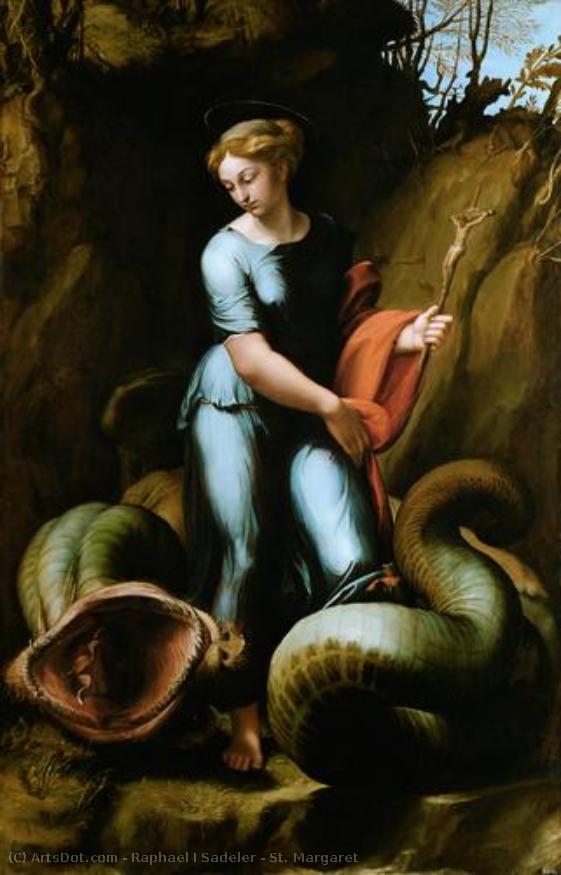
To gaze upon Raphael I Sadeler's "St. Margaret" is to encounter a moment suspended between divine grace and primal struggle. The painting immediately draws the viewer into its richly textured, dramatically lit world. At its heart kneels St. Margaret, an embodiment of unwavering piety, positioned on a rugged outcrop that seems carved from the very earth. Her posture is one of profound resilience; she does not merely stand, but actively confronts the serpentine threat coiled around her. The composition itself guides the eye upward and inward, emphasizing the saint's luminous presence against the darker, more chaotic elements surrounding her. It is a narrative rendered with such palpable tension that one can almost hear the struggle between virtue and temptation.
Mastery of Renaissance Drama and Texture
Sadeler’s technique here showcases a sophisticated understanding of dramatic visual storytelling, leaning into the heightened emotionalism characteristic of Mannerist echoes within the broader Renaissance framework. Observe the handling of light; it is not merely illumination but an active participant in the drama, employing a masterful chiaroscuro that sculpts St. Margaret's form. Strong highlights catch the pale blue of her robe and the folds of her crimson cloak, making them seem almost ethereal against the deep shadows pooling within the grotto-like setting. The artist pays meticulous attention to contrasting textures: the smooth, idealized skin of the saint contrasts sharply with the rough, scaled menace of the serpent and the jagged permanence of the rock formations. This textural dialogue elevates the piece beyond mere portraiture into a study of material opposition.
Symbolism Woven in Earth Tones
The symbolism inherent in "St. Margaret" is both deeply personal and universally resonant. The legend itself speaks to miraculous protection, making the saint a potent symbol of courage and steadfast faith against overwhelming odds. The serpent, an ancient motif representing sin or chaos, is held at bay by the staff—a clear visual metaphor for spiritual fortitude conquering earthly temptation. Furthermore, the palette itself contributes to this symbolic weight. Dominated by warm, earthy browns, ochres, and deep greens, these tones ground the scene in a tangible reality, while the cool blue of her garments offers a celestial counterpoint, suggesting divine favor guiding her through the wilderness.
An Echo for the Modern Collector
For those seeking an artwork that transcends simple decoration to become a focal point of contemplation, this piece offers profound depth. The vertical orientation and the contained drama make it exceptionally suited for intimate gallery settings or grand reception rooms where narrative weight is desired. Owning a reproduction of "St. Margaret" allows one to bring home not just paint on canvas, but a carefully preserved moment of spiritual triumph. It serves as an enduring visual reminder that even in moments of perceived vulnerability, the strength of conviction can illuminate the deepest shadows.
艺术家简介
Raphael I Sadeler: The Harmonious Echo of Florentine Genius
Raphael I Sadeler (b. ca. 1560, Antwerp, d. ca. 1628, Venezia) stands as a testament to the enduring power of artistic collaboration and the reverberations of Renaissance ideals across Europe. Born into a prominent Flemish family steeped in artistic tradition – his father, Jan Sadeler I., was himself a celebrated sculptor and architect – Raphael’s early life foreshadowed a destiny inextricably linked with the glories of Florence and Venice. He honed his skills alongside his brother, Jan Sadeler II., establishing a workshop that quickly became synonymous with excellence in printmaking and fresco painting, cementing their family's reputation as leading artists of their time.- Early Training & Florentine Influence: Raphael’s formative years were spent studying under Pietro Perugino in Perugia, absorbing the serene beauty and compositional mastery characteristic of Umbrian Renaissance art. Perugino instilled in him a profound appreciation for balance, clarity, and idealized forms – principles that would profoundly shape Raphael's artistic vision.
- The Workshop & Artistic Partnerships: Returning to Antwerp, Raphael established a prolific workshop where he collaborated extensively with Giovanni Battista Pinturicchio and Federico Bartolomeo Amerighi. These partnerships fostered innovation and broadened their stylistic horizons, resulting in stunning frescoes for churches and palaces across Europe – notably the Palazzo Vecchio in Florence and St Mary’s Church in Antwerp.
- Technical Virtuosity & Printmaking Mastery: Sadeler's reputation as a printmaker was unparalleled. He possessed an extraordinary ability to reproduce paintings with breathtaking accuracy, elevating engraving to new heights of artistic sophistication. His prints served not only as decorative objects but also as crucial conduits for disseminating Renaissance ideas and imagery throughout the continent.
- Notable Works & Artistic Legacy: Raphael’s oeuvre encompasses a remarkable range of subjects – biblical narratives, mythological scenes, portraits, and landscapes – all executed with meticulous detail and imbued with humanist ideals. His frescoes in St Mary's Church in Antwerp exemplify his mastery of perspective and color theory, establishing him as one of the foremost artists of the High Renaissance.
The Ionian School & Venetian Patronage
Raphael’s artistic trajectory intersected decisively with the burgeoning Ionian school of painting, centered on Corfu Island during the Habsburg reign. This distinctive style emerged from the ashes of Cretan Byzantine art following Ottoman conquest and blended Venetian influences with traditional Byzantine techniques. Sadeler's involvement in this movement resulted in captivating depictions of religious subjects – notably “The Liberation of Saint Peter”—that showcased his ability to adapt to evolving artistic tastes while upholding the highest standards of craftsmanship. Venetian patronage provided crucial support for Sadeler’s creative endeavors, fostering a vibrant artistic environment and propelling him to international acclaim.Exploring Raphael's Artistic Vision
At its core, Raphael’s art embodies the humanist spirit of the Renaissance – an unwavering belief in human reason, beauty, and moral virtue. He sought to capture idealized representations of humanity, reflecting philosophical concepts prevalent during his era. His meticulous attention to detail, combined with masterful use of color and perspective, created images that captivated audiences and continue to inspire admiration centuries later. Raphael’s influence extended far beyond his own lifetime, shaping the artistic sensibilities of subsequent generations and securing his place as one of history's most revered painters.Concluding Reflections: A Lasting Impression
Raphael I Sadeler’s legacy transcends mere technical skill; it resides in his profound contribution to the dissemination of Renaissance ideals and his unwavering commitment to artistic excellence. His workshop produced masterpieces that adorn churches and palaces across Europe, ensuring that his vision—a harmonious blend of Florentine grace and Venetian dynamism—would endure for centuries to come. As a symbol of artistic collaboration and innovation, Raphael Sadeler remains an enduring emblem of the High Renaissance’s transformative power.
raphael i sadeler
1560 - 1628 , Belgium
艺术家简介
- Artistic Movement Or Style: High Renaissance
- Artists Or Movements Influenced By This Artist: ['Ionian school']
- Artists Who Influenced This Artist: ['Pietro Perugino']
- Date Of Birth: ca. 1560
- Date Of Death: ca. 1628
- Full Name: Raphael I Sadeler
- Nationality: Flemish
- Notable Artworks:
- St Peter Escapes with the Angel
- School of Athens
- Place Of Birth: Antwerp, Belgium
相关文章
拉斐尔大师25幅杰作:艺术、历史与家居装饰灵感 | OriginalUniqueArt
探索拉斐尔大师的25幅杰作!深入了解文艺复兴艺术、意大利绘画和经典油画背后的故事。OriginalUniqueArt.com提供博物馆品质的拉斐尔作品复制品,为您的家居装饰带来永恒之美。立即在线探索完整系列。

Oil on Canvas: A Historical & Technical Exploration of a Timeless Artistic Medium
Explore the rich history & enduring techniques of oil painting on canvas. Discover the science behind its longevity, conservation practices, and contemporary relevance. Expert insights for art enthusiasts.

The Enduring Legacy of Oil on Canvas: Technique, History & Aesthetic Impact
Explore the rich history & techniques of oil painting – from Renaissance masters to Impressionism. Discover pigments, layering methods, and why this timeless medium endures. Expert insights for artists & art enthusiasts.

The Enduring Power of Painting: A Historical & Contemporary Exploration of Form and Emotion
Explore the rich history & enduring techniques of oil painting with OriginalUniqueArt. Discover masterpieces, learn about art collecting, and find authentic handmade reproductions crafted by skilled artists.
The Timeless Charm of Oil on Board: Reimagining Texture and Light through the Impressionist Lens
Discover the profound intimacy of oil on panel. Explore how Impressionist masters used rigid supports to capture light, texture, and impasto depth through exquisite, handmade oil reproductions for discerning collectors.

