切换至版画销售渠道
 展开全文
展开全文







































 对于任何边长超过 105 厘米(约 41 英寸)的艺术品或复制品,画框将以拆解后的组件形式发货。此方法可确保安全送达并防止运输过程中的损坏。


A Poetic Tapestry of Script and Spirit
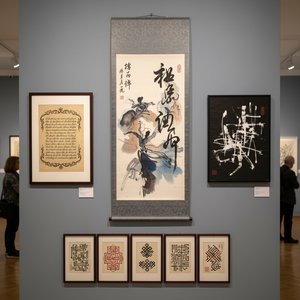
In the delicate interplay of ink and emerald, Geetāshtak emerges as more than a mere visual artifact; it is a profound meditation on the written word and its rhythmic soul. Created in 1926 by the legendary Bengali polymath Rabindranath Tagore, this piece serves as a bridge between the literary and the visual, where the boundaries of poetry and painting dissolve into one another. The artwork presents an intricate oriental script, flowing across the surface with a grace that suggests the very cadence of a song. Set against a lush, deep green background, the composition achieves a striking balance, allowing the fine details of the calligraphy to breathe while enveloping the viewer in a sense of tranquil, verdant depth.
The technique employed here reflects Tagore’s unique position as a pioneer of contextual modernism. Rather than focusing on representational imagery, the artist utilizes the aesthetic power of the script itself to evoke emotion. The meticulous attention to detail in each stroke suggests a rhythmic, almost musical quality—fitting for a work titled Geetāshtak, which hints at a collection of songs or verses. This approach invites the observer to look beyond the literal meaning of the characters and instead feel the movement, the weight, and the spiritual resonance of the ink as it dances upon the page.
Historical Resonance and Modern Elegance
To understand Geetāshtak is to understand the cultural renaissance of early 20th-century India. During a period when artists were seeking to reclaim their heritage while embracing modern sensibilities, Tagore stood at the forefront, blending traditional Indian aesthetics with a global, modernist vision. This piece captures that precise historical tension—the reverence for ancient script and spiritual tradition paired with a minimalist, almost abstract focus on form and color. It is a testament to an era where art was used to express a profound sense of identity and cosmic connection.
For the discerning collector or interior designer, this reproduction offers a sophisticated focal point that transcends mere decoration. The emerald tones provide a calming, organic energy, making it an ideal addition to spaces designed for contemplation, such as libraries, study alcoves, or serene living areas. Because the work relies on the evocative power of texture and tone rather than overt subject matter, it integrates seamlessly into both classical and contemporary interiors. It serves as a conversation piece that whispers of ancient wisdom and poetic beauty, bringing a touch of timeless, scholarly elegance to any curated environment.
常见问题与解答
"Geetāshtak\n\n" 的创作年份 1926 对应于 Rabindranath Thakur 艺术生涯中的哪个阶段?
1926 年的创作日期将《Geetāshtak\n\n》置于 Rabindranath Thakur 艺术发展的 Late Period 时期。
Rabindranath Thakur 的《Geetāshtak\n\n》 这件作品的色调是明亮的还是深沉的?
Rabindranath Thakur 的《Geetāshtak\n\n》 的视觉亮度为 brilliant,能够与目标空间的灯光完美融合。
下单前可以预览 Rabindranath Thakur 的《Geetāshtak\n\n》 吗?
您可以在作品的效果预览页面查看Rabindranath Thakur 的《Geetāshtak\n\n》的预览。
 实景预览
实景预览
 分享
分享 分享
分享
 详情
详情 指南
指南

 下载作品
下载作品
 相似作品
相似作品 X射线
X射线 幻灯片播放
幻灯片播放 问答
问答 统计数据
统计数据