切换至版画销售渠道
 展开全文
展开全文







































 对于任何边长超过 105 厘米(约 41 英寸)的艺术品或复制品,画框将以拆解后的组件形式发货。此方法可确保安全送达并防止运输过程中的损坏。


A Glimpse of Baroque Grandeur: Self-Portrait by Pierre Mignard
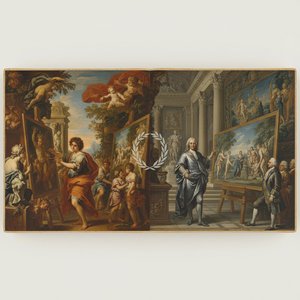
Pierre Mignard’s 1690 “Self-Portrait” is more than just a likeness; it's a meticulously crafted tableau vivant, a window into the world of a prominent figure in 17th-century French art. This painting, measuring a substantial 235 x 188 cm, immediately commands attention with its opulent details and carefully orchestrated composition. It’s a testament to Mignard's skill as a portraitist and his deep understanding of Baroque aesthetics – a style characterized by dramatic lighting, rich textures, and an emphasis on theatricality.
The subject himself is presented in a pose of studied elegance, seated within a richly appointed interior. He’s dressed in a flamboyant gown, complete with a sweeping cape and a gleaming gold sash, indicative of the status and wealth he commanded. A carefully styled wig frames his face, while a meticulously groomed mustache adds to the air of sophistication. The details are exquisite: the velvet of the chair, the sheen of the fabrics, the subtle play of light on polished surfaces – all contribute to an overwhelming sense of luxury and refinement. Notably, Mignard’s gaze is direct and engaging, inviting the viewer into his world.
The Setting: A Stage for Self-Representation
Beyond the central figure, the background subtly enhances the portrait's narrative. Two chairs – one occupied by Mignard himself, the other positioned to his left – create a sense of intimacy and contemplation. A dining table, adorned with a simple bowl, suggests an appreciation for the finer things in life, while three scattered vases introduce a touch of decorative flourish, echoing the Baroque love of ornamentation. These elements aren’t merely decorative; they contribute to a carefully constructed atmosphere that reinforces Mignard's position as a man of taste and refinement.
The painting’s palette is rich and warm, dominated by deep reds, golds, and browns – colors associated with wealth, power, and religious devotion. Mignard masterfully employs chiaroscuro, the dramatic contrast between light and shadow, to sculpt the forms of his subject and create a sense of depth and volume. This technique, characteristic of the Baroque period, draws attention to key features and adds an element of theatricality to the scene.
A Master’s Hand: Technique and Influences
Mignard's style is a fascinating blend of influences. His early training under Jean Boucher instilled in him a foundational understanding of Mannerist principles, particularly his sensitivity to form and composition. However, his subsequent studies with Simon Vouet exposed him to the classical ideals championed by the Venetian master, influencing his use of perspective and idealized forms. Crucially, his time in Rome allowed him to absorb the grandeur of Italianate art, which he then skillfully integrated into his own distinctive style.
The painting’s resemblance to Largillère's portrait of Charles Le Brun is particularly noteworthy. This suggests a conscious effort on Mignard’s part to establish himself within the Parisian artistic circles and perhaps even subtly engage in a rivalry with his contemporary. It’s a deliberate gesture, highlighting both his technical skill and his awareness of the prevailing artistic landscape.
A Legacy of Elegance: Historical Context
Created in 1690, “Self-Portrait” reflects the flourishing Baroque period in France – an era marked by royal patronage, religious fervor, and a fascination with luxury. Mignard’s success as a portraitist was directly linked to his ability to capture the status and personality of his subjects, often members of the aristocracy and clergy. His work served not only as a visual record but also as a powerful statement of social standing.
As an art historian, it's important to note that Mignard’s life was intertwined with political intrigue and artistic competition. His rivalry with Charles Le Brun, the Premier Peintre du Roi, shaped his career and ultimately led to his appointment as director of the Académie royale de peinture et de sculpture. This painting, therefore, offers a glimpse into not only the artist's personal ambitions but also the complex dynamics of the French art world during this pivotal period.
OriginalUniqueArt is proud to offer high-quality hand-painted reproductions of Pierre Mignard’s “Self-Portrait,” allowing you to experience the beauty and artistry of this remarkable masterpiece in your own home or studio. Explore our collection today and bring a touch of Baroque grandeur into your space.
常见问题与解答
"Self-Portrait" 的明暗对比是否强烈?
皮埃尔·米尼亚尔 的《Self-Portrait》 在明暗区域之间呈现出 Serene 的对比度。
皮埃尔·米尼亚尔 的《Self-Portrait》 的创作媒介是什么?
皮埃尔·米尼亚尔 的《Self-Portrait》 的媒介为 Oil On Canvas。复制品旨在呈现该技法的视觉效果。
皮埃尔·米尼亚尔 的《Self-Portrait》 是哪种类型的艺术品?
“Self-Portrait”是一件WallArt作品。
 实景预览
实景预览
 分享
分享 分享
分享
 详情
详情 指南
指南

 下载作品
下载作品
 相似作品
相似作品 X射线
X射线 幻灯片播放
幻灯片播放 Q&A
Q&A 统计数据
统计数据