 实景预览
实景预览
 分享
分享 分享
分享
 详情
详情 指南
指南

 下载作品
下载作品
 相似作品
相似作品 X射线
X射线 幻灯片播放
幻灯片播放 Q&A
Q&A 统计数据
统计数据Color


 展开全文
展开全文
艺术微喷/版画
博物馆级艺术微喷或帆布版画,制作高效,并提供多种饰面选择。 ( 订购纯手工绘制画作 切换至数字图像销售渠道)




P118B ¥10

P118H ¥10

P118W ¥10

P438Z ¥10

P508JH ¥12

P508YH ¥12

P805H ¥10

P805Z ¥10

P919BZ ¥10

P919G ¥10

P919XJ ¥10

P959ZH ¥10

P968JZ ¥12

W106C ¥8

W218G ¥10

W218JH ¥8

W218Y ¥10

W307PJ ¥10

W316G ¥10

W316PJ ¥8

W316Y ¥10

W398PJ ¥8

W4111J ¥10

W500HY ¥15

W500JH ¥15

W692G ¥12

W849H ¥8

W940BG ¥15

W953PJ ¥8




您可以从与原作比例一致的预设尺寸中进行选择。

请输入您所需的宽度和高度,以适配您的画框或墙面。由于印刷品只能进行裁剪,无法超出原图尺寸,因此若比例不一致,画面的一部分将会被裁切。在正式印刷之前,我们会为您发送一份数字效果图供您确认。本页面显示的图片并非最终裁剪后的效果——只有效果图才能展示真实的裁剪情况。


 玻璃选项仅适用于110厘米以下的尺寸。

Color
艺术微喷/版画
复刻品尺寸
-


最终结算价
¥ 537
A Symphony of Pigment and Form
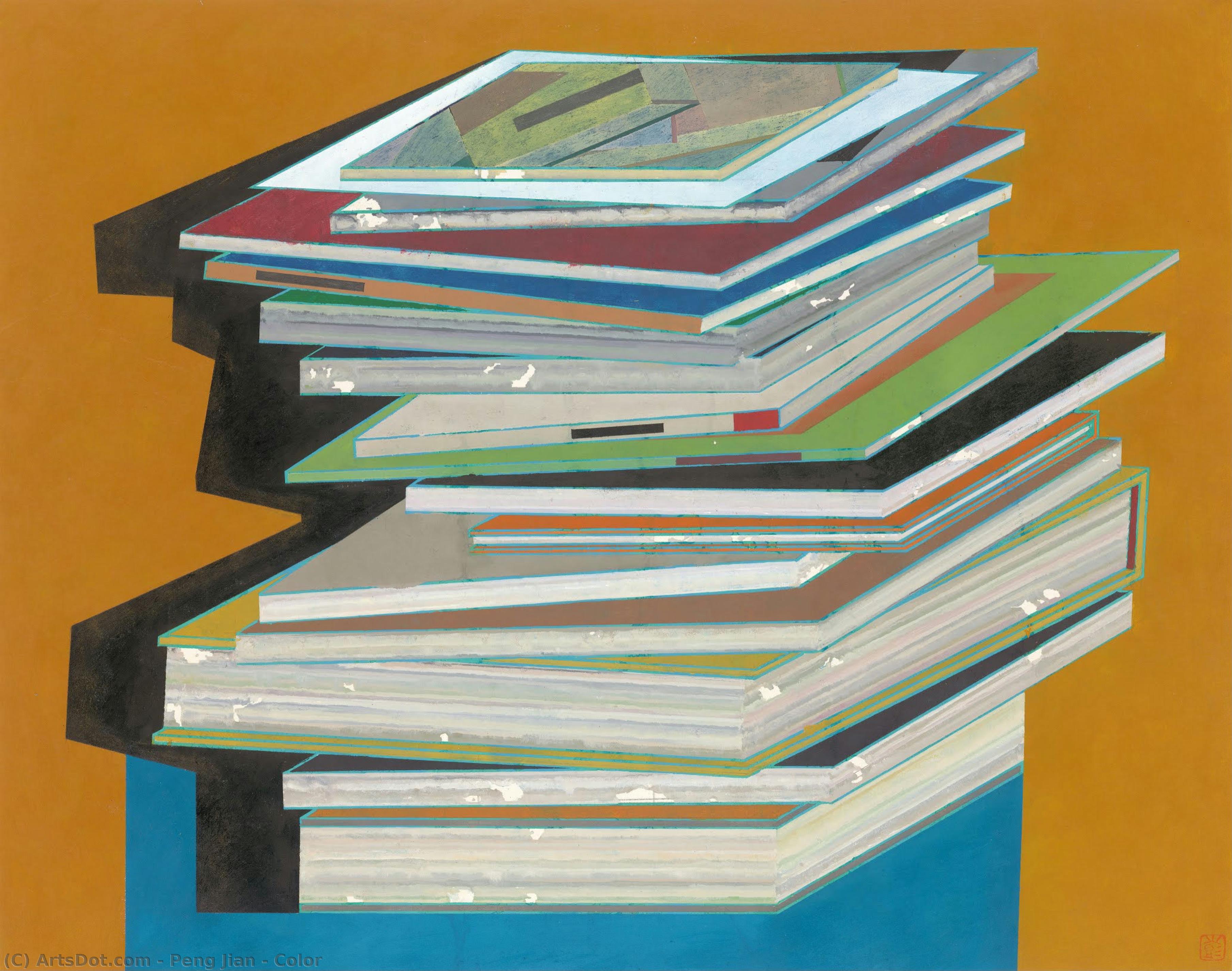
In the mesmerizing painting Color, created in 2016, the artist Peng Jian invites us into a world where the mundane becomes extraordinary through the lens of contemporary abstraction. At first glance, the viewer is met with a captivating arrangement of stacked books, yet this is far from a mere still life. The work functions as a vibrant exploration of depth, weight, and chromatic harmony. Each book, rendered with meticulous attention to detail, serves as a building block in a larger architectural composition. As the eye wanders across the various layers, one notices how the artist plays with the tension between horizontal stability and vertical aspiration, creating a rhythmic dance of shapes that feels both structured and spontaneous.
The technique employed in this piece is a masterclass in utilizing color to define space. Peng Jian utilizes a palette that is as diverse as it is daring, weaving together intense primary hues with subtle, nuanced tones. The way the light seems to catch the edges of the spines and the textures of the covers suggests a tactile reality, pulling the viewer into the physical presence of the objects. Through careful layering and the strategic use of contrast, the artist achieves a sense of three-dimensionality that transcends the flat surface of the canvas. This interplay of light and shadow does more than just define form; it breathes life into the inanimate, transforming a simple collection of literature into a pulsating, living entity.
The Intersection of Tradition and Modernity
To understand the profound impact of Color, one must consider Peng Jian’s unique position within the lineage of Chinese contemporary art. Trained at the prestigious Central Academy of Fine Arts in Beijing, the artist possesses a deep-seated respect for classical foundations, which he masterfully deconstructs through a modern, geometric lens. In this work, the concept of "composition" takes on a new meaning; it is not merely about the placement of objects, but about the balance of energy and the dialogue between different visual weights. The books, often symbols of knowledge and history, are stripped of their literal text and reimagined as pure geometric units—rectangles, squares, and lines that contribute to a larger, abstract symphony.
For the discerning collector or interior designer, this painting offers much more than aesthetic pleasure; it provides a focal point of intellectual and emotional depth. The piece possesses a versatile energy that can anchor a sophisticated gallery space or add a layer of cultured vibrancy to a modern residential setting. It speaks to the beauty of organized chaos and the joy found in the accumulation of color and form. Owning a high-quality reproduction of this work means bringing into one's environment a fragment of Peng Jian’s profound inquiry into how we perceive the world—not just as a collection of objects, but as a continuous, colorful flow of interconnected experiences.
艺术家简介
Peng Jian: A Symphony of Geometry and Color
Born in Beijing in 1964, Peng Jian’s artistic journey is a fascinating exploration of the intersection between traditional Chinese aesthetics and contemporary abstraction. His work, instantly recognizable for its bold colors, intricate geometric arrangements, and subtle references to classical art, has garnered significant attention within both the domestic Chinese art scene and internationally. From humble beginnings, Peng Jian's career reflects a deliberate evolution, marked by a deep engagement with artistic history while forging a distinctly personal visual language.
Peng Jian’s formal training began at the Central Academy of Fine Arts in Beijing, a prestigious institution that shaped many leading Chinese artists. He graduated with both a Bachelor of Fine Arts degree (1987) and a Master of Fine Arts degree (1990), providing him with a solid foundation in traditional painting techniques while simultaneously exposing him to the burgeoning avant-garde movements within China. This dual influence – the legacy of Song Dynasty landscape painting and the experimentation of later 20th-century abstraction – is central to understanding his artistic approach.
The Language of Geometry
At the heart of Peng Jian’s work lies a fascination with geometry, particularly its capacity to evoke spatial relationships and create dynamic compositions. He frequently employs interlocking grids, repeating patterns, and meticulously arranged shapes—often inspired by the architectural principles found in traditional Chinese art – to construct his paintings. These geometric forms aren't merely decorative; they function as a visual vocabulary, conveying ideas of balance, harmony, and even tension. His early works often featured simple cubes and boxes, gradually incorporating more complex elements like books, bottles, and other everyday objects, creating a layered dialogue between the familiar and the abstract.
A key element in Peng Jian’s process is his deliberate use of color. He eschews bright, saturated hues in favor of a restrained palette—primarily grays, blues, and whites—that lends a sense of quiet contemplation to his paintings. These muted tones are juxtaposed with the sharp angles and precise lines of the geometric forms, creating a compelling visual contrast. This careful orchestration of color and form is not simply aesthetic; it’s deeply rooted in Chinese ink painting traditions, where tonal variations and subtle gradations of value were used to create depth and atmosphere.
Influences and Artistic Development
Peng Jian's artistic development has been shaped by a diverse range of influences. He cites the work of Japanese Mono-ha artists—a movement that emphasized the materiality of objects—as a significant inspiration, particularly their focus on direct observation and the inherent qualities of materials. Furthermore, his engagement with Song Dynasty landscape painting – characterized by its meticulous detail, atmospheric perspective, and emphasis on capturing the essence of nature – is evident in his use of line and space.
His work has evolved considerably over time. Early pieces were largely focused on simple geometric forms, while more recent works incorporate a wider range of subjects—including books, bottles, and other everyday objects—creating a richer and more complex visual narrative. The “Seven Falling Color Pieces” series, for example, demonstrates his willingness to experiment with new techniques and approaches, pushing the boundaries of his established style.
Recognition and Legacy
Peng Jian’s work has been exhibited extensively both in China and abroad, including at prestigious institutions such as the National Art Museum of China, the Today Art Museum in Beijing, and the Museum of Contemporary Art in Shanghai. His paintings are held in numerous private and public collections, reflecting his growing recognition within the art world.
Peng Jian’s contribution to contemporary Chinese art lies in his ability to synthesize traditional aesthetics with modern abstraction. He has created a unique visual language that is both intellectually stimulating and emotionally resonant, inviting viewers to contemplate the relationship between form, color, and meaning. As an artist deeply rooted in Chinese artistic history while simultaneously embracing innovation, Peng Jian continues to be a significant voice within the evolving landscape of contemporary art.

Peng Jian
1964 - , China
艺术家简介
- Artistic Movement Or Style: Contemporary abstraction and geometry
- Artists Who Influenced This Artist: ['Song Dynasty landscape painters']
- Full Name: Peng Jian
- Nationality: Chinese
- Notable Artworks:
- Color
- Balance
- Place Of Birth: Beijing, China
- Date Of Birth: 1964
相关文章

Neo-Abstract Art: The High-Impact Evolution of Modern Visual Energy and Geometric Sophistication
Discover the power of Neo-Abstract art. Explore how bold geometric forms and high-impact visual energy are redefining modern design. Learn to curate sophisticated, high-energy spaces with the latest trends in contemporary abstraction and structural color.
Beyond Form & Color: Geometric Abstraction's Enduring Legacy in Art History
Explore the captivating world of geometric abstraction! Discover its origins, key artists like Malevich & Mondrian, and why this movement remains highly valued by art collectors today. Expert insights at OriginalUniqueArt.

Beyond Form & Color: Geometric Abstraction's Evolution in 20th/21st Century Art
Explore the evolution of geometric abstraction from Cubism to contemporary art. Discover key artists like Malevich & Mondrian, investment insights, and expert collecting advice at OriginalUniqueArt.

Mastering Abstraction: The 25 Most Iconic Works by Wassily Kandinsky
Explore 25 iconic Kandinsky masterpieces and the birth of abstraction. Discover the full collection online at OriginalUniqueArt.com.

几何抽象艺术十大杰作:定义现代家居装饰的经典之作
探索几何抽象艺术的十大杰作!康定斯基、蒙德里安等大师作品,色彩构成与非具象之美。OriginalUniqueArt.com提供博物馆级艺术复制品,为您的家居带来现代艺术灵感。立即在线探索完整系列!