切换至版画销售渠道
 展开全文
展开全文







































 对于任何边长超过 105 厘米(约 41 英寸)的艺术品或复制品,画框将以拆解后的组件形式发货。此方法可确保安全送达并防止运输过程中的损坏。


A Universe in Miniature: Paul Klee’s ‘Structural I’
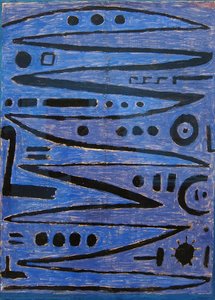
Paul Klee's “Structural I,” painted in 1924, isn’t merely a depiction of stars; it’s an invitation to contemplate the very architecture of perception. Created during a period of intense experimentation within his oeuvre, this gouache on cardboard piece exemplifies Klee’s masterful synthesis of musical and visual ideas – a core tenet of his artistic philosophy. The painting immediately draws the eye with its vibrant constellation of shapes, each meticulously rendered in a palette of black, red, green, yellow, and blue. These aren't random splashes; they are carefully constructed elements, echoing the principles of musical composition where individual notes contribute to a larger harmonic whole.
The Language of Geometry and Emotion
Klee’s approach during this period was deeply rooted in geometric abstraction, influenced by movements like Cubism, yet infused with his uniquely personal sensibility. “Structural I” showcases this brilliantly. The overlapping circles, squares, and triangles aren't simply decorative; they represent a deliberate exploration of spatial relationships – mirroring the way musical intervals create depth and resonance. Notice how the varying sizes and orientations of these forms generate a dynamic tension, suggesting movement and energy within the seemingly static composition. This technique reflects Klee’s belief that art should be both intellectually stimulating and emotionally resonant.
Historical Context: A Moment of Artistic Revolution
1924 was a pivotal year for Klee, coinciding with his work on the mural for the Bauhaus Dessau, a project that profoundly shaped his artistic trajectory. The Bauhaus, with its emphasis on functional design and universal principles, encouraged artists to explore abstraction as a means of communicating fundamental truths. “Structural I” embodies this spirit – it’s a distillation of these ideas, stripped down to their essential components. The painting also reflects the broader European fascination with mythology and symbolism during the early 20th century, particularly the exploration of celestial imagery.
Decoding the Symbolism: Stars as Building Blocks
While abstract in its overall design, “Structural I” is rich with symbolic meaning. The stars themselves are not simply representations of distant suns; they function as building blocks – fundamental units within Klee’s visual language. Their arrangement suggests a network, a complex system of interconnectedness, reflecting the artist's interest in exploring order and chaos simultaneously. Some scholars interpret the varying sizes and colors of the stars as representing different musical notes or harmonies, further reinforcing Klee’s belief in the inherent connection between art forms.
A Timeless Appeal: For Collector and Interior Designer
"Structural I" remains a captivating work, offering a glimpse into the mind of one of 20th-century's most innovative artists. Its vibrant colors, intricate composition, and profound symbolism make it an ideal addition to any art collection or interior space. A hand-painted reproduction captures the essence of this masterpiece, allowing you to bring its contemplative beauty into your home – a reminder that even in abstraction, there is a universe waiting to be discovered.
常见问题与解答
克莱 的《Structural I》 是运用了强烈的对比,还是呈现出柔和的和谐?
克莱 的《Structural I》 的色彩构成将 Balanced 的对比与 Softly Mixed Palette 的和谐融为一体。
克莱 的《Structural I》 在艺术史上的地位如何?
克莱 的《Structural I》 在艺术史上的分类属于 Abstract Expressionism 运动,创作于 Modern 时期。
"Structural I" 属于哪种艺术风格?
“Structural I”是一件Abstract Expressionism时期的作品。该艺术流派体现了作品所属的艺术传统。
 实景预览
实景预览
 分享
分享 分享
分享
 详情
详情 指南
指南

 下载作品
下载作品
 相似作品
相似作品 X射线
X射线 幻灯片播放
幻灯片播放 问答
问答 统计数据
统计数据