切换至版画销售渠道
 展开全文
展开全文







































 对于任何边长超过 105 厘米(约 41 英寸)的艺术品或复制品,画框将以拆解后的组件形式发货。此方法可确保安全送达并防止运输过程中的损坏。


A Dance of Grey and Blue: Unveiling “Summertime: Number 9A”
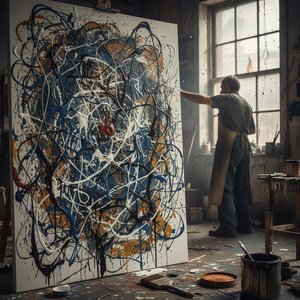
Jackson Pollock’s “Summertime: Number 9A,” painted in 1948, isn't merely a canvas splashed with color; it’s an immersive experience, a visceral representation of the artist’s state of mind captured in a whirlwind of dynamic energy. This seminal work from the heart of Abstract Expressionism embodies Pollock’s revolutionary approach to painting – abandoning traditional form and composition for a process-oriented exploration of gesture, movement, and pure feeling. The piece immediately commands attention with its dense field of interwoven lines and shapes, a chaotic yet strangely harmonious tapestry woven from layers of grey, white, blue, and subtle yellows. It's a visual embodiment of the artist’s “drip technique,” where paint is flung, dripped, and splattered onto the canvas laid flat on the floor, allowing gravity and chance to dictate the final arrangement – a deliberate rejection of control in favor of spontaneous expression.
The Pollock Method: Action Painting Unleashed
Pollock’s method was radical for its time. He wasn't seeking to depict a recognizable subject; instead, he aimed to translate the energy of his subconscious directly onto the canvas. “Summertime: Number 9A” exemplifies this perfectly. The seemingly random application of paint is, in fact, meticulously considered. Notice how the lines build and recede, creating a sense of depth and movement despite the lack of traditional perspective. The layering of colors – often applied with minimal blending – contributes to the painting’s tactile quality, inviting viewers to reach out and almost feel the texture of the paint itself. The use of enamel paints, combined with oil, created a durable surface capable of withstanding the vigorous application techniques Pollock employed.
Symbolism in Chaos: Bicycle Dreams and the American Psyche
While the painting resists straightforward interpretation, whispers suggest that the recurring motif of bicycles – as described in the provided information – might hold symbolic weight. For Pollock, who spent his early years traveling with his father across the vast landscapes of the American West, the bicycle represented freedom, exploration, and a connection to the open road. It’s possible these images were subconsciously embedded within his creative process, manifesting as fleeting shapes amidst the broader abstraction. More broadly, “Summertime: Number 9A” can be seen as a reflection of the anxieties and uncertainties of post-war America – a period marked by rapid social change, technological advancements, and a growing sense of alienation. The painting’s chaotic energy mirrors this feeling of disorientation, while its vibrant colors offer a glimmer of hope amidst the turmoil.
A Legacy of Innovation: Pollock's Enduring Influence
“Summertime: Number 9A” stands as a pivotal work in the development of Abstract Expressionism and profoundly influenced generations of artists. Pollock’s rejection of traditional artistic conventions paved the way for new approaches to painting, emphasizing process over product and prioritizing personal expression above all else. His technique—the “drip” method—became instantly recognizable and continues to inspire artists today. Reproductions of this piece offer a tangible connection to this groundbreaking era in art history, allowing viewers to experience Pollock’s revolutionary vision firsthand. It's a powerful reminder that art can be both visually stimulating and emotionally resonant, inviting us to contemplate the complexities of human experience.
常见问题与解答
杰克逊·波洛克 (Jié K逊·Bōluòkè) 的《Summertime: Number 9A》 的图像可以自由转载吗?
杰克逊·波洛克 (Jié K逊·Bōluòkè) 的《Summertime: Number 9A》 属于 属于公有领域 —— 其版权已过期。此版权状态决定了该作品图像的复制方式。
《Summertime: Number 9A》的创作者 杰克逊·波洛克 (Jié K逊·Bōluòkè) 是否还有其他艺名?
关于《Summertime: Number 9A》的创作者 杰克逊·波洛克 (Jié K逊·Bōluòkè),其记录在案的其他名称包括 保罗·杰克逊·波洛克 (Bǎo Luó·Jié K逊·Bōluòkè), 波洛克 (Bōluòkè)。
杰克逊·波洛克 (Jié K逊·Bōluòkè) 的《Summertime: Number 9A》 的色彩构图是如何构建的?
杰克逊·波洛克 (Jié K逊·Bōluòkè) 的《Summertime: Number 9A》 的色彩构成将 Gentle 的对比与 Softly Mixed Palette 的和谐融为一体。
 实景预览
实景预览
 分享
分享 分享
分享
 详情
详情 指南
指南

 下载作品
下载作品
 相似作品
相似作品 X射线
X射线 幻灯片播放
幻灯片播放 问答
问答 统计数据
统计数据