切换至版画销售渠道
 展开全文
展开全文







































 对于任何边长超过 105 厘米(约 41 英寸)的艺术品或复制品,画框将以拆解后的组件形式发货。此方法可确保安全送达并防止运输过程中的损坏。


A Dance of Chaos and Transformation: Exploring Jackson Pollock’s Alchemy
- The Genesis of Spontaneity
- Decoding the Drip Technique
- Historical Resonance and Symbolic Weight
- A Legacy of Innovation
Decoding the Drip Technique
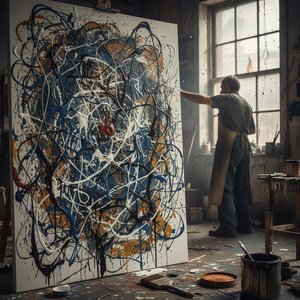
Pollock’s method was anything but conventional. He eschewed the easel and brush entirely, laying the canvas directly on the floor and moving around it with cans of paint, dripping and pouring the wet enamel onto the surface. This process, meticulously documented in photographs and videos, reveals a deeply physical engagement – Pollock wasn't simply applying color; he was wrestling with it, channeling his energy and emotions into every movement. The inclusion of unexpected materials—sand, pebbles, broken wood sticks, and fibers—further complicates the narrative, adding textural layers and hinting at a subconscious desire to incorporate elements from the natural world into his work. These additions aren't accidental; they contribute to the painting’s overall sense of dynamism and reinforce the idea that *Alchemy* is less about representing a specific subject and more about capturing a state of being – a moment of intense creative flux. The glossy finish of the enamel paint, reflecting light in myriad directions, amplifies this effect, creating an almost luminous quality within the composition.Historical Resonance and Symbolic Weight
The title itself, *Alchemy*, is laden with significance. Given to the painting by Pollock’s neighbors, Ralph Manheim and his wife, it speaks to the transformative nature of the work – a metaphor for the artist's process and perhaps even for life itself. Born in 1912 in Cody, Wyoming, Pollock’s early exposure to the vast landscapes and diverse cultures of the American West undoubtedly shaped his artistic sensibility. His formative years spent traveling with his father, a land surveyor, instilled in him a deep appreciation for natural forms and an understanding of spatial relationships – qualities that would later inform his groundbreaking approach to painting. The painting's creation coincided with a period of intense experimentation within the art world, as artists sought to break free from representational constraints and explore new ways of expressing themselves. *Alchemy* stands as a powerful example of this shift, embodying the core tenets of Abstract Expressionism: spontaneity, emotional intensity, and a focus on the act of painting itself. The nineteen-color palette, revealed after meticulous restoration at the Opificio delle Pietre Dure in Florence, adds another layer of complexity to the work, suggesting a deliberate exploration of color theory and its potential to evoke specific emotions and sensations.A Legacy of Innovation
Ultimately, *Alchemy* is more than just a beautiful painting; it’s a landmark achievement that continues to inspire artists and captivate audiences today. Pollock's influence on modern art is undeniable, and his work remains a cornerstone of American Abstract Expressionism. The piece’s open-endedness invites endless interpretation – there is no single “correct” reading, encouraging viewers to engage with the artwork on a deeply personal level. Its scale—114 x 195 cm—further enhances this immersive experience, demanding attention and inviting contemplation. A reproduction of *Alchemy* offers a unique opportunity to bring this iconic work into your space, allowing you to appreciate Pollock’s genius and contribute to the ongoing dialogue surrounding one of the most important paintings of the 20th century.常见问题与解答
"Alchemy" 有艺术版画出售吗?
您可以在杰克逊·波洛克 (Jié K逊·Bōluòkè) 的《Alchemy》的艺术版画页面直接订购其版画:采用棉质帆布或档案级画布纸制作的艺术版画。
杰克逊·波洛克 (Jié K逊·Bōluòkè) 是否还有其他别名或曾用名?
杰克逊·波洛克 (Jié K逊·Bōluòkè) 也被称为 保罗·杰克逊·波洛克 (Bǎo Luó·Jié K逊·Bōluòkè), 波洛克 (Bōluòkè)。
“Alchemy”背后的艺术家与艺术风格是哪些?
"Alchemy" 的背后是 杰克逊·波洛克 (Jié K逊·Bōluòkè) 及其所属的 Abstract Expressionism 流派。
 实景预览
实景预览
 分享
分享 分享
分享
 详情
详情 指南
指南

 下载作品
下载作品
 相似作品
相似作品 X射线
X射线 幻灯片播放
幻灯片播放 问答
问答 统计数据
统计数据