切换至版画销售渠道
 展开全文
展开全文







































 对于任何边长超过 105 厘米(约 41 英寸)的艺术品或复制品,画框将以拆解后的组件形式发货。此方法可确保安全送达并防止运输过程中的损坏。


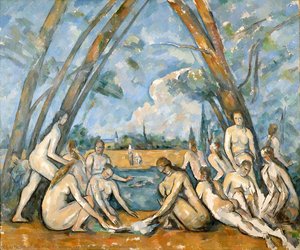
A Moment Frozen in Time: Cézanne’s “The Harvesters”
Paul Cézanne's "The Harvesters," painted in 1878, stands as a pivotal work within the Impressionist movement, yet simultaneously foreshadows the radical stylistic innovations that would define Cubism. It’s more than just a depiction of rural labor; it’s an exploration of perception itself—a deliberate attempt to capture not what the eye sees directly, but how memory and emotion transform visual experience. The painting depicts three figures standing amidst rocks and sand, their gaze directed towards an unseen point beyond the frame. This seemingly simple composition is imbued with layers of significance that resonate deeply within Cézanne’s artistic vision.Impressionistic Roots: Capturing Light and Atmosphere
Cézanne's stylistic approach firmly anchors itself in Impressionism, albeit with a crucial divergence from its contemporaries. Like Monet and Renoir, he sought to convey the fleeting effects of light on surfaces—the dappled sunlight filtering through foliage, the shimmering heat haze over the landscape. However, Cézanne eschewed the optical blending characteristic of Impressionist technique. Instead, he employed visible brushstrokes—thick, textured marks that disrupt the illusion of smoothness—to build up form and volume. This deliberate rejection of optical realism is evident in the rendering of the rocks and sand; they aren’t blended into a seamless expanse but presented as individual masses of pigment, conveying their materiality with remarkable accuracy. The muted palette – predominantly earthy tones punctuated by hints of ochre and umber – reinforces this sense of solidity and contributes to the painting's contemplative mood.Symbolism Within Simplicity: Gestures and Spatial Illusion
Beyond its technical prowess, “The Harvesters” possesses a subtle symbolic dimension that elevates it beyond mere representation. The figures themselves are positioned in a manner that suggests a profound connection—a shared awareness of something larger than their immediate surroundings. Cézanne’s masterful use of perspective creates an unsettling spatial illusion; the horizon line appears to recede further back than it should, compressing the space and emphasizing the figures' isolation within this expansive landscape. The outstretched hands of one harvester – particularly prominent in the central figure – gesture outwards, hinting at a yearning for connection and perhaps representing the universal human desire for sustenance and fulfillment. These gestures are not merely descriptive; they embody an emotional resonance that speaks to the fundamental concerns of Cézanne’s artistic philosophy.A Bridge Between Eras: Anticipating Cubism
“The Harvesters” is considered a transitional piece, marking Cézanne's move away from Impressionistic conventions toward the geometric abstraction that would characterize Cubism. The fragmented forms—particularly noticeable in the depiction of the rocks—prefigure Picasso and Braque’s groundbreaking experiments with multiple viewpoints and flattened planes. Cézanne wasn’t aiming for a literal portrayal of reality; he was striving to distill it down to its essential elements, capturing not just what is seen but how it feels. This pioneering spirit continues to inspire artists today, cementing Cézanne's place as one of the most influential figures in modern art history.常见问题与解答
塞尚 的《The Harvesters》 的图像可以自由转载吗?
塞尚 的《The Harvesters》 的版权说明:该作品属于 属于公有领域 —— 其版权已过期。这决定了是否可以自由进行图像复制。
我可以在全屏幻灯片模式下观看“The Harvesters”吗?
可进行幻灯片浏览:查看 塞尚 的《The Harvesters》 的 幻灯片展示 页面。
塞尚 的《The Harvesters》 的主导色是什么?
在“The Harvesters”中,最引人注目的颜色是Rosy Brown (#a99e95)。了解作品的主色调有助于将其与室内装饰进行搭配。
 实景预览
实景预览
 分享
分享 分享
分享
 详情
详情 指南
指南

 下载作品
下载作品
 相似作品
相似作品 X射线
X射线 幻灯片播放
幻灯片播放 问答
问答 统计数据
统计数据