切换至版画销售渠道
 展开全文
展开全文







































 对于任何边长超过 105 厘米(约 41 英寸)的艺术品或复制品,画框将以拆解后的组件形式发货。此方法可确保安全送达并防止运输过程中的损坏。


A Dreamy Tableau: Unpacking the Subtleties of Picasso’s Still Life with Melon
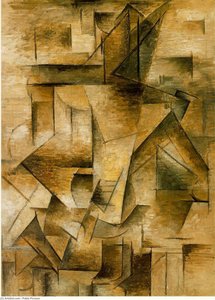
Pablo Picasso's “Still Life with Melon,” a deceptively simple composition rendered in pastel tones, is far more than a mere arrangement of fruit and objects. It’s a carefully constructed meditation on form, perception, and perhaps even the fleeting nature of reality – hallmarks of the artist’s evolving Cubist vision. Created around 1920, this work exemplifies Picasso's shift towards a more lyrical and emotionally resonant style following his intensely productive period. The piece immediately captivates with its airy freshness; the palette—a delicate dance between pinks, blues, pale greens, and yellows—evokes a sense of summer’s bounty and quiet contemplation. Yet, beneath this surface tranquility lies a complex interplay of geometric shapes and fragmented forms, characteristic of his groundbreaking Cubist approach.
The central focus is undeniably the large yellow melon, its rounded form rendered with confident, almost childlike simplicity. However, it's not just the melon that commands attention; surrounding it are a series of enigmatic figures—a blue figure resembling a mask or perhaps even a mournful face, a bird with outstretched wings suggesting both aspiration and fragility, and a fish-like shape hinting at aquatic realms. These aren’t merely decorative elements; they seem to engage in an unspoken dialogue with the melon, creating a dynamic tension within the composition. The raw edges of the canvas, visible along the frame, contribute to the work's immediate intimacy and sense of immediacy—as if Picasso intended this piece to be a spontaneous expression rather than a meticulously finished product.
Cubism’s Fragmented Reality
Picasso’s “Still Life with Melon” is firmly rooted in the principles of Cubism, an artistic movement he co-founded alongside Georges Braque. Unlike traditional representational art that strives for a single, fixed viewpoint, Cubism sought to depict objects from multiple perspectives simultaneously. This is achieved through fracturing forms into geometric shapes and presenting them in a flattened space—a technique evident here in the melon’s rounded form, which is subtly broken down into angular planes. The background, rendered in stark white, serves as a neutral canvas that amplifies the vibrancy of the foreground objects and further emphasizes their fragmented nature. The tilted table adds another layer of disorientation, suggesting an impossible perspective—as if we are viewing the scene from above or below.
Interestingly, this work predates Picasso’s most famous Cubist works like “Les Demoiselles d'Avignon,” demonstrating a more restrained and intimate approach to the movement. While retaining the core principles of multiple viewpoints and geometric abstraction, it possesses a softer, dreamier quality than some of his later, more overtly analytical pieces. The influence of Paul Cézanne is also palpable; Picasso admired Cézanne’s exploration of form and space, and this still life echoes Cézanne's interest in capturing the essence of objects rather than their literal appearance.
Symbolism and Emotional Resonance
Beyond its formal innovations, “Still Life with Melon” is rich in symbolic potential. The melon itself has long been associated with fertility, abundance, and even death—a duality reflected in the work’s overall mood. The blue figure, with its mournful expression, could represent loss or remembrance, while the bird suggests a yearning for freedom or transcendence. The fish evokes both nourishment and the mysteries of the deep, hinting at hidden depths within the human psyche. Picasso rarely offered explicit explanations for his symbolism, preferring to allow viewers to interpret the work through their own experiences and emotions.
Ultimately, “Still Life with Melon” is a testament to Picasso’s genius—a deceptively simple yet profoundly complex artwork that invites contemplation and rewards repeated viewing. It's a poignant reminder of the power of art to capture not just what we see, but also what we feel.
常见问题与解答
在“Still life with melon”中,对比与和谐是如何交织融合的?
毕加索 的《Still life with melon》 的色彩构成将 Serene 的对比与 Strong Color Unity 的和谐融为一体。
“Still life with melon”中的色彩呈现出多少光泽感?
毕加索 的《Still life with melon》 的亮度为 Bright Balance。亮度描述了色彩呈现出的反射光量。
我能否更详细地查看“Still life with melon”?
毕加索 的《Still life with melon》 的 X 光视图可在作品的 X射线透视 页面查看:通过十一层光学图层对图像进行交互式深度解析。
 实景预览
实景预览
 分享
分享 分享
分享
 详情
详情 指南
指南

 下载作品
下载作品
 相似作品
相似作品 X射线
X射线 幻灯片播放
幻灯片播放 Q&A
Q&A 统计数据
统计数据