

 效果预览
效果预览
 购买印刷品
购买印刷品 分享
分享 分享
分享
 详情
详情

 下载
下载
 相似作品
相似作品 X射线
X射线 幻灯片播放
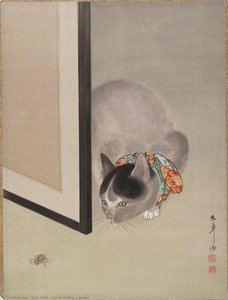
幻灯片播放Cat Watching a Spider
 1888
1888 38.0 x 28.0 cm
 展开详情
展开详情




































从与原作比例一致的预设尺寸中进行选择。

您可以输入自定义尺寸,以适配特定的画框或空间。如果所选尺寸与原图比例不符,我们将通过裁剪作品或添加手绘元素来扩展画面。数字样稿将在制作开始前发送给您确认。
请注意,屏幕预览无法准确反映实际的裁剪或扩展效果,只有样稿才能真实呈现最终的构图。
虽然我们提供定制尺寸服务,但为了保留原作比例,建议您从预设列表中选择尺寸。
下单后,OriginalUniqueArt.com 团队将通过电子邮件联系客户获取具体要求,并提供效果预览图。


 玻璃选项仅适用于110厘米以下的尺寸。

Cat Watching a Spider
复制材质
复制品尺寸
-


最终总价
$ 300
艺术家简介
Oide Tōkō: A Master of Subtle Emotion in the Meiji Era
Born in Tokyo in 1841, Oide Tōkō (also known as Ōide Aya) emerged during a pivotal period in Japanese history – the Meiji Restoration (1868-1912). This era witnessed rapid modernization and Westernization alongside a fervent desire to preserve traditional Japanese aesthetics. Tōkō’s work stands as a compelling testament to this complex interplay, offering intimate glimpses into daily life and profound explorations of human emotion within a distinctly Japanese framework.
Early biographical details about Tōkō are somewhat sparse, though he was recognized as a skilled painter from an early age. His formal training remains largely undocumented, suggesting he may have been part of a guild system or learned through apprenticeship – common practices for artists at the time. The name “Kagyu-zuruya” (蝸牛窟), often associated with his work, translates to "snail shell cave," hinting at a secluded and contemplative artistic practice. His courtesy name, Sōkyō 素巧, meaning “simple skill,” reflects a dedication to understated elegance and naturalism in his compositions.
A Palette of Quiet Observation
Tōkō’s style is characterized by its remarkable subtlety and psychological depth. He primarily worked in ink and color on silk or paper, employing a delicate brushwork that prioritized capturing fleeting moments and nuanced expressions. Unlike the grand narratives often favored during the Meiji period, Tōkō's paintings frequently depict solitary figures engaged in quiet activities – a woman tending to her garden, a child playing with a toy, or a man gazing pensively into the distance. These scenes are not dramatic; rather, they convey a sense of serene contemplation and understated emotion.
His most famous work, “Cat Watching a Spider” (猫と蜘蛛), exemplifies this approach perfectly. The painting isn’t about action or spectacle but about the quiet observation of two creatures sharing a space. The cat's expression is ambiguous – curiosity, boredom, perhaps even a touch of melancholy – inviting viewers to project their own emotions onto the scene. This ability to evoke such complex feelings with minimal visual elements was a hallmark of Tōkō’s artistry.
Influences and Artistic Context
Tōkō's work is deeply rooted in traditional Japanese painting techniques, particularly those associated with the yamato-e style – a school emphasizing naturalism and emotional expression. However, he also absorbed influences from Western art, notably Impressionism’s focus on capturing light and atmosphere. The subtle gradations of color in his paintings, reminiscent of Monet or Renoir, demonstrate this assimilation without sacrificing the core tenets of Japanese aesthetics.
During the Meiji period, there was a conscious effort to promote both Western and Eastern art forms. Tōkō’s work gained recognition as Japan sought to establish its own unique artistic identity. His paintings were exhibited in Japan and internationally, contributing to a growing appreciation for Japanese art abroad.
Legacy and Market Value
Oide Tōkō died in 1905, leaving behind a relatively small but highly valued body of work. His paintings have been offered at auction multiple times, with prices ranging from $1,000 to $5,000, reflecting their increasing recognition as significant examples of Meiji-era Japanese art. His ability to capture the quiet dignity and emotional resonance of everyday life continues to resonate with collectors and viewers today.
His work is a poignant reminder that beauty and profound meaning can be found not in grand gestures but in the subtle details of human experience – a lesson beautifully articulated by Oide Tōkō through his evocative paintings. The Dictionary of Artists in Japan (DAJ) highlights his birthdate as May 24, 1841, and his death date as March 14, 1905, solidifying his place within the historical record of Japanese art.
oide tōkō
1841 - 1905 , Japan
艺术家简介
- Artistic Movement Or Style: Meiji period art
- Date Of Birth: 1841-05-24
- Date Of Death: 1905-03-14
- Full Name: oide tōkō
- Nationality: Japanese
- Notable Artworks: ['Cat Watching a Spider']
- Place Of Birth: Tokyo, Japan

