
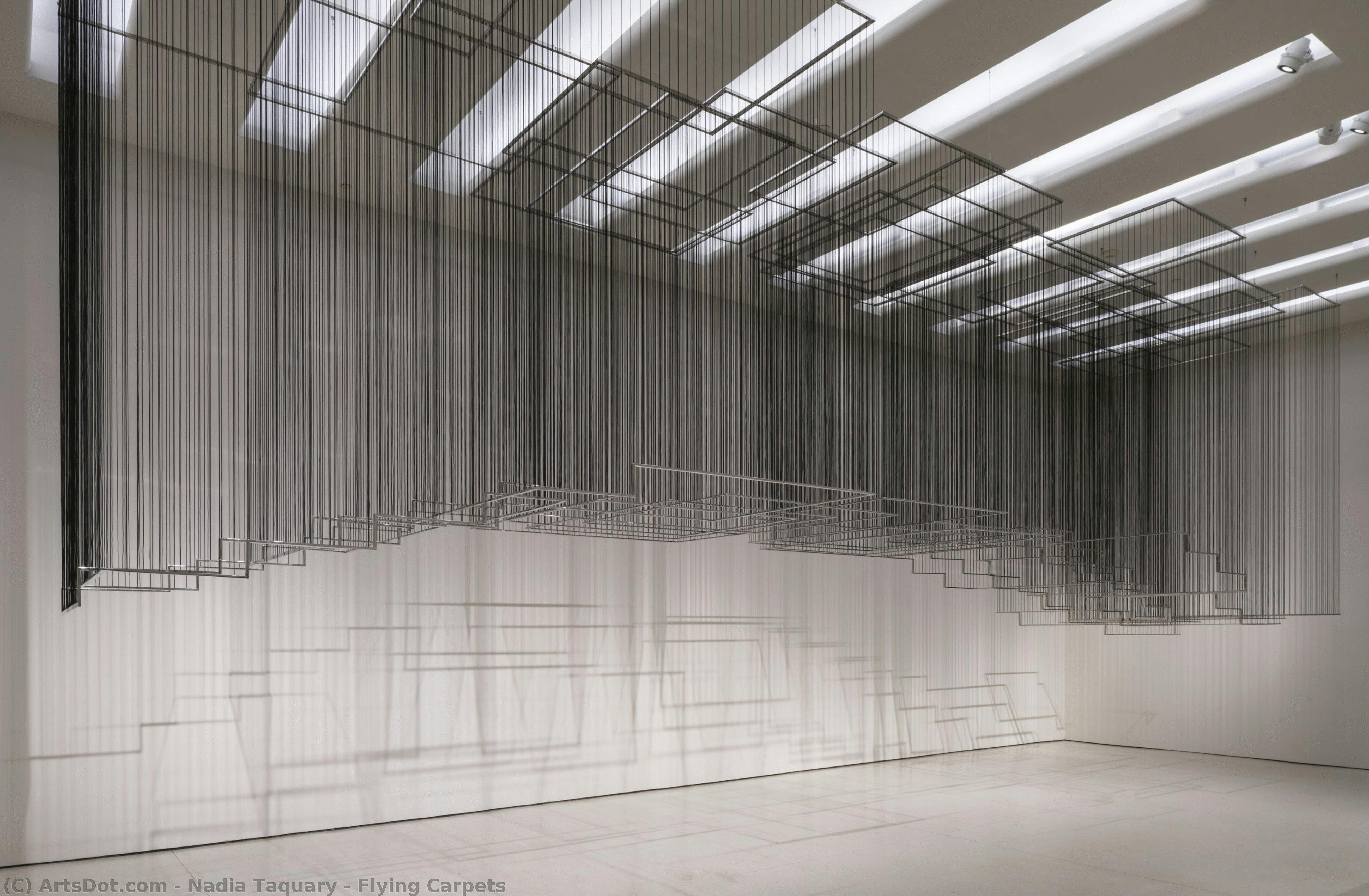
 效果预览
效果预览
 购买手绘画作
 分享
分享 分享
分享
 详情
详情

 下载
下载
 相似作品
相似作品 X射线
X射线 幻灯片播放
幻灯片播放Flying Carpets

 展开详情
展开详情




































从与原作比例一致的预设尺寸中进行选择。

您可以输入自定义尺寸,以适配特定的画框或空间。如果您选择的尺寸与原图比例不符,我们将对作品进行裁剪,或通过镜像填充/纯色填充边缘的方式来扩展图像。在开始制作之前,我们会向您发送一份数字效果图供您确认。
请注意,屏幕上的预览并不能反映实际的裁剪或扩展效果。只有效果图才能准确展示最终的构图。
虽然我们提供定制尺寸,但为了保持原图比例,我们建议您从预设列表中选择尺寸。


 玻璃选项仅适用于110厘米以下的尺寸。

Flying Carpets
艺术微喷/版画
复制品尺寸
-


最终总价
$ 80
藏品详情
艺术家简介
Nádia Taquary: Echoes of the Sacred and Ancestral
Born in Salvador, Brazil, in 1967, Nádia Taquary’s artistic journey is deeply rooted in her Afro-Brazilian heritage. Her upbringing within Bahia, a region pulsating with the legacy of African traditions and colonial history, profoundly shaped her creative vision. Initially pursuing studies in literature and education – a seemingly disparate path that ultimately converged to inform her unique approach – Taquary's artistic practice emerged from a profound engagement with the sacred, ancestral narratives, and the enduring strength of Black women within Brazilian culture.
Taquary’s formal training included a postgraduate degree in Education, Aesthetics, Semiotics, and Culture from the Universidade Federal da Bahia (UFBA), providing her with a sophisticated theoretical framework for exploring the complex intersections of identity, religion, and artistic expression. This academic grounding, combined with her lived experience within Salvador's vibrant cultural landscape—a city renowned for its rich Afro-Brazilian traditions, including Candomblé religion and the legacy of enslaved Africans—forms the bedrock of her work.
The Language of Form: Materials and Symbolism
Taquary’s artistic language is characterized by a deliberate and evocative use of materials. She frequently employs bronze casting, drawing upon ancient African metalworking techniques while simultaneously imbuing her sculptures with a contemporary sensibility. Alongside bronze, she incorporates elements such as gold, silver, shells, straw, beads, and repurposed wood – often salvaged from demolished colonial structures—each carrying layers of historical and cultural significance. These materials aren’t merely chosen for their aesthetic qualities; they are carefully selected to resonate with the narratives she seeks to convey.
Central to Taquary's work is a deep engagement with symbolism, particularly that derived from Afro-Brazilian religious traditions, specifically Candomblé. She frequently references *orixás* – the deities of Yoruba origin—and their associated iconography. Her sculptures often depict these divine figures in dynamic poses, imbued with power and grace, while simultaneously referencing traditional adornments like *balangandãs*, elaborate waist ornaments worn by Black women during the colonial period. These pieces served as symbols of strength, fertility, and spiritual connection, reflecting the agency and resilience of enslaved African women.
Exploring Afro-Brazilian Heritage & Ancestral Connections
Taquary’s artistic exploration extends beyond mere representation; it's a deliberate act of reclamation and reinterpretation. Her work seeks to honor the often-silenced histories of Black women within Brazilian society, highlighting their pivotal roles in shaping religious traditions, preserving cultural knowledge, and maintaining spiritual connections to ancestral roots. She investigates the complex interplay between African cosmology and Brazilian syncretism, revealing how these diverse influences have converged to create a uniquely vibrant artistic and spiritual landscape.
Influenced by her family’s heritage—specifically the jewelry inherited from her grandmother—Taquary began researching the history of Afro-Brazilian adornments. This research led her to delve into the semiotics of West African and Brazilian religious culture, as well as Diaspora aesthetics, agency, and *orixá* legends. Her work speaks to a profound understanding of cultural memory, challenging colonial narratives and celebrating the enduring strength of Black identity.
Recognition & Legacy
Nádia Taquary’s artistic vision has garnered significant recognition both within Brazil and internationally. Her works have been exhibited in prestigious galleries and museums such as Galeria Leme and Galerie Agnès Monplaisir, solidifying her position as a leading voice in contemporary Afro-Brazilian art. Notably, her pieces are permanently held in the collections of institutions like the Museum of Modern Art of Bahia (MAM-BA), the Pinacoteca de São Paulo, Pérez Art Museum Miami – PAAM, and the Rio Art Museum – MAR, demonstrating the enduring value and impact of her artistic contributions.
Recent exhibitions further underscore Taquary’s continued engagement with her subject matter. She was featured in the 24th Sydney Biennial (2024), presented a solo exhibition “Ònà Irin: caminho de ferro” at the Rio Art Museum (MAR) in 2024, and continues to be recognized for her powerful exploration of Afro-Brazilian sacred traditions and ancestral heritage. Her work serves as a vital reminder of the richness and complexity of Brazilian culture, honoring its past while simultaneously forging a path toward a more equitable and inclusive future.

nadia taquary
1967 - , Brazil
艺术家简介
- Artistic Movement Or Style: Afro-Brazilian art
- Date Of Birth: 1967
- Full Name: Nádia Taquary
- Nationality: Brazilian
- Notable Artworks:
- Roque José Florêncio...
- Flying Carpets
- Place Of Birth: Salvador, Brazil

