

 效果预览
效果预览
 购买印刷品
购买印刷品 分享
分享 分享
分享
 详情
详情

 下载
下载
 相似作品
相似作品 X射线
X射线 幻灯片播放
幻灯片播放Page from Meriwether Lewis

 展开详情
展开详情




































从与原作比例一致的预设尺寸中进行选择。

您可以输入自定义尺寸,以适配特定的画框或空间。如果所选尺寸与原图比例不符,我们将通过裁剪作品或添加手绘元素来扩展画面。数字样稿将在制作开始前发送给您确认。
请注意,屏幕预览无法准确反映实际的裁剪或扩展效果,只有样稿才能真实呈现最终的构图。
虽然我们提供定制尺寸服务,但为了保留原作比例,建议您从预设列表中选择尺寸。
下单后,OriginalUniqueArt.com 团队将通过电子邮件联系客户获取具体要求,并提供效果预览图。


 玻璃选项仅适用于110厘米以下的尺寸。

Page from Meriwether Lewis
复制材质
复制品尺寸
-


最终总价
$ 300
艺术家简介
A Life Forged on the Frontier: Meriwether Lewis and the American West
Meriwether Lewis, born in 1774 amidst the burgeoning spirit of a new nation, was more than simply an explorer; he embodied the ambition, curiosity, and inherent contradictions of early America. His story isn’t one solely of charting unknown territories but also of a complex individual grappling with duty, scientific pursuit, and ultimately, a tragic fate. Growing up on Locust Hill Plantation in Virginia, Lewis's childhood was marked by both privilege and loss. The death of his father when he was just five years old propelled the family to Georgia, where young Meriwether honed skills crucial for survival – hunting, foraging, and an intimate understanding of the natural world. This formative period instilled a deep connection to the wilderness that would define his later life, even as formal education beckoned him back to Virginia at age thirteen. Though he briefly embraced the role of plantation owner, Lewis’s true calling lay beyond the cultivated fields, in the untamed expanses of the continent.From Soldier to Secretary: Preparing for Discovery
Lewis's path took a decidedly military turn with his enlistment in the Virginia militia and subsequent commission into the U.S. Army. His rise through the ranks was swift, culminating in the rank of captain by 1800. It was during this period that he forged a crucial bond with William Clark, a relationship that would prove instrumental to the success of the monumental expedition ahead. However, it was Lewis’s appointment as personal secretary to President Thomas Jefferson in 1801 that truly set the stage for his destiny. This position afforded him access to the highest echelons of power and, more importantly, immersed him in Jefferson's vision for a continental America – a nation stretching westward, fueled by scientific inquiry and economic opportunity. Jefferson, captivated by the possibilities presented by the Louisiana Purchase, entrusted Lewis with leading an expedition to explore this vast new territory, map its resources, establish trade relations with Native American tribes, and assert U.S. sovereignty over the region before European powers could stake their claim.The Corps of Discovery: A Journey into the Unknown
In 1803, Congress authorized funding for what would become known as the Lewis and Clark Expedition, or the Corps of Discovery. Lewis meticulously prepared for the journey, studying botany, zoology, cartography, and medicine in Philadelphia, laying the groundwork for the scientific rigor that characterized the expedition. He then recruited his trusted friend William Clark to co-lead the venture, creating a partnership built on mutual respect and complementary skills. On May 14, 1804, the Corps of Discovery departed from Camp Dubois near St. Louis, Missouri, embarking on an arduous two-and-a-half-year odyssey that would forever alter the map of North America. The expedition faced immense challenges – treacherous terrain, harsh weather conditions, encounters with hostile tribes, and the constant threat of starvation and disease. Yet, Lewis’s leadership, coupled with Clark's practical expertise, guided them through the Continental Divide, down the Columbia River, and ultimately to the Pacific Ocean in 1805. They meticulously documented their findings – over 140 maps were created, hundreds of plant and animal species identified, and peaceful relations established with nearly seventy Native American tribes.Legacy and a Tragic End
The success of the Lewis and Clark Expedition solidified America’s claim to the West and opened up new avenues for trade and expansion. Upon their return, both Lewis and Clark were hailed as heroes. In 1806, Jefferson appointed Lewis Governor of Upper Louisiana Territory, a position that proved far more challenging than exploring uncharted lands. He struggled with bureaucratic complexities, political infighting, and the logistical difficulties of governing a vast and sparsely populated region. The weight of responsibility, coupled with personal demons and accusations of financial impropriety, took its toll on Lewis. In 1809, while traveling to Washington D.C. to defend his actions, he died under mysterious circumstances near Nashville, Tennessee. The official ruling was suicide, though questions surrounding his death persist to this day, fueling speculation about murder or foul play. Despite the tragic end, Meriwether Lewis’s legacy remains firmly etched in American history as a symbol of courage, exploration, and the relentless pursuit of knowledge. His detailed journals and scientific observations continue to provide invaluable insights into the natural world and the cultures of the Native American tribes he encountered, ensuring his place among the most significant figures in the nation's westward expansion.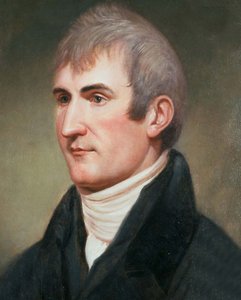
meriwether lewis
1774 - 1809 , United States of America
艺术家简介
- Artistic Movement Or Style: Frontier History
- Date Of Birth: August 18, 1774
- Date Of Death: October 11, 1809
- Full Name: Meriwether Lewis
- Nationality: American
- Place Of Birth: Locust Hill, USA

