切换至版画销售渠道
 展开全文
展开全文







































 对于任何边长超过 105 厘米(约 41 英寸)的艺术品或复制品,画框将以拆解后的组件形式发货。此方法可确保安全送达并防止运输过程中的损坏。


Unveiling the Enigma: Max Ernst’s “Untitled (4426)”
Max Ernst's "Untitled (4426)" is not merely a painting; it’s an immersion into the subconscious, a meticulously crafted exploration of the surreal that speaks to the anxieties and fascinations of the early 20th century. This arresting image, dominated by a solitary yellow figure with a startling red face, immediately commands attention, drawing the viewer into a world where logic yields to dreamlike imagery. The stark black background amplifies the vibrancy of the central form, creating an almost unsettling isolation that is characteristic of Ernst’s approach.
- Subject Matter: The painting presents a fragmented scene – a seated figure, a wooden chair or stool, and diminutive secondary figures – elements seemingly detached from any recognizable reality.
- Style & Technique: Executed in a style deeply rooted within the Surrealist movement, Ernst employs bold color contrasts and distorted forms to evoke emotional responses rather than depict objective truth. The application of paint suggests a deliberate layering, hinting at multiple iterations and a process driven by intuition as much as conscious control.
A Mind Shaped by Disillusionment
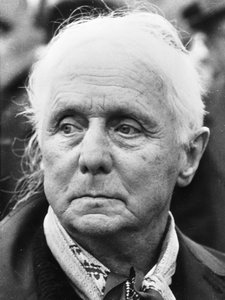
Born in Brühl, Germany, in 1891, Max Ernst’s artistic trajectory was profoundly shaped by his intellectual pursuits and a deep-seated skepticism towards established norms. His education – encompassing philosophy, art history, psychology, and psychiatry at the University of Bonn – wasn't simply academic; it fueled a relentless questioning of reality itself. This intellectual rigor is palpable in "Untitled (4426)," where the seemingly simple composition belies a complex layering of symbolic meaning. Ernst’s early life, marked by his father’s work with deaf children and his own rebellious spirit, instilled within him a fascination with the hidden dimensions of human experience – a theme that would become central to his artistic output.
Symbolism and the Surrealist Landscape
The painting's symbolism is deliberately ambiguous, inviting multiple interpretations. The yellow figure, often associated with intellect and enlightenment, is rendered unsettling by its red face, suggesting suppressed emotions or perhaps a confrontation with primal instincts. The small figures flanking it could represent anxieties or observers within the dreamer’s mind. The object resembling a hat – a recurring motif in Ernst's work – may symbolize protection, concealment, or even the head itself as a vessel for thought and emotion. Within the context of Surrealism, this piece embodies the movement’s core tenets: exploring the irrational, the unconscious, and the power of dreams to reveal hidden truths.
Historical Context & Emotional Resonance
"Untitled (4426)" was created during a period of immense social and political upheaval – the aftermath of World War I and the rise of new ideologies. Ernst’s work reflects this atmosphere of uncertainty and disillusionment, capturing a sense of disorientation and psychological strain. The painting's unsettling beauty evokes a powerful emotional response, prompting viewers to confront their own anxieties and perceptions of reality. This reproduction offers an opportunity to possess a piece of art that embodies the spirit of a pivotal moment in artistic history – a testament to Max Ernst’s genius and his enduring exploration of the human psyche.
常见问题与解答
马克·恩斯特 的《untitled (4426)》 传达了怎样的情感?
“untitled (4426)” 传达出一种 Mysterious 的情感。这种情感基调描述了作品给人的印象。
我可以在这里订购"untitled (4426)"的油画复制品吗?
您可以在马克·恩斯特 的《untitled (4426)》的手工油画复刻页面直接订购其手绘复制品:亚麻画布手工油画复制品,按需定制。
在“untitled (4426)”中,对比与和谐是如何交织融合的?
马克·恩斯特 的《untitled (4426)》 的色彩构成将 Statement 的对比与 Softly Mixed Palette 的和谐融为一体。
 实景预览
实景预览
 分享
分享 分享
分享
 详情
详情 指南
指南

 下载作品
下载作品
 相似作品
相似作品 X射线
X射线 幻灯片播放
幻灯片播放 Q&A
Q&A 统计数据
统计数据