切换至版画销售渠道
 展开全文
展开全文







































 对于任何边长超过 105 厘米(约 41 英寸)的艺术品或复制品,画框将以拆解后的组件形式发货。此方法可确保安全送达并防止运输过程中的损坏。


A Cosmic Microcosm: Exploring Mario Merz’s “Senza Titolo (Triplo Igloo)”
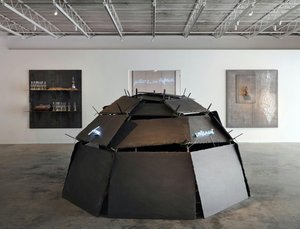
Mario Merz's "Senza Titolo (Triplo Igloo)" isn’t merely a sculpture; it’s an invitation to contemplate the intricate dance between humanity and the cosmos. Created in 1984, this monumental installation—a trio of interconnected glass domes—represents far more than their physical form suggests. It's a distillation of Merz’s lifelong fascination with geometry, nature, and the underlying mathematical principles governing existence, all rendered through a strikingly tactile and profoundly evocative material: glass.
Born in Milan during the tumultuous years of World War II, Mario Merz’s artistic journey was deeply intertwined with resistance and a yearning for connection. Imprisoned for his involvement with antifascist groups, he began drawing as an act of defiance—a way to reclaim agency within oppressive circumstances. This early impulse toward self-expression evolved into a sustained exploration of form, ultimately leading him to the igloo – a structure that, for Merz, embodied not just shelter but also a symbolic representation of the universe itself. The choice of glass was deliberate; its transparency mirrors the vastness of space while simultaneously highlighting the fragility and preciousness of human existence.
The Geometry of Creation: Fibonacci and Beyond
At the heart of “Senza Titolo (Triplo Igloo)” lies a subtle yet powerful mathematical framework. Merz’s work is deeply rooted in the Fibonacci sequence – a series of numbers where each number is the sum of the two preceding ones (1, 1, 2, 3, 5, 8…). This sequence, found throughout nature from the spirals of seashells to the branching patterns of trees, represents the fundamental principles of growth and proportion. The artist meticulously incorporated these numerical relationships into the structure of the igloos themselves, embedding them in neon lights that cast a luminous glow upon the glass panels. This isn’t simply an aesthetic choice; it's a visual representation of the inherent order underlying the apparent chaos of the universe – a concept central to Merz’s artistic philosophy.
Beyond the Fibonacci sequence, the igloos themselves are constructed with a deliberate architectural logic. The three domes, varying in size and positioned one within the other, create a layered effect that evokes a sense of depth and complexity. The use of clamps and blocks of clay adds an earthy counterpoint to the sleekness of the glass, grounding the installation in the natural world while simultaneously elevating it to a realm of abstract contemplation.
Light, Shadow, and the Human Presence
The lighting within “Senza Titolo (Triplo Igloo)” is crucial to its overall impact. Diffused light filters through the translucent glass, creating an interplay of highlights and shadows that dramatically alters the perception of space. The neon lights, strategically placed, not only illuminate the numerical sequences but also cast a warm, ethereal glow throughout the interior, inviting viewers to step inside and become immersed in the artwork’s atmosphere.
The inclusion of furniture – chairs and a bench – further emphasizes the human element within this cosmic microcosm. These familiar objects, placed deliberately within the glass enclosure, serve as reminders of our everyday lives and our need for connection and comfort. The juxtaposition of the natural world (represented by the igloo) with the domestic sphere creates a compelling dialogue about the relationship between humanity and its environment.
A Legacy of Cosmic Reflection
“Senza Titolo (Triplo Igloo)” stands as a testament to Mario Merz’s unique artistic vision – a synthesis of geometry, nature, and human experience. It's an artwork that invites viewers to contemplate the mysteries of the universe while simultaneously acknowledging our place within it. More than just a beautiful object, it is a profound meditation on life, death, and the enduring power of art to transform our understanding of the world around us. Reproductions capture only a fraction of this immersive experience, but offer a tangible connection to Merz’s extraordinary legacy.
常见问题与解答
"Senza titolo (Triplo igloo)" 的材质是什么,采用了哪种风格?
“Senza titolo (Triplo igloo)”采用 Installation Art 创作,呈现出 Arte Povera 风格。
马里奥·梅茨 的《Senza titolo (Triplo igloo)》 在艺术史上的地位如何?
马里奥·梅茨 的《Senza titolo (Triplo igloo)》 在艺术史上的分类属于 Arte Povera 运动,创作于 Modern 时期。
在购买之前,我可以在自己的墙上预览 马里奥·梅茨 的《Senza titolo (Triplo igloo)》 吗?
通过作品的 AR 效果预览 页面,您可以在兼容设备上使用增强现实技术,在自己的墙面上预览 马里奥·梅茨 的《Senza titolo (Triplo igloo)》。
 分享
分享 分享
分享
 详情
详情 指南
指南

 下载作品
下载作品
 相似作品
相似作品 幻灯片播放
幻灯片播放 问答
问答 统计数据
统计数据