

 实景预览
实景预览
 切换至版画销售渠道
 分享
分享 分享
分享
 详情
详情 指南
指南

 下载作品
下载作品
 相似作品
相似作品 X射线
X射线 幻灯片播放
幻灯片播放 Q&A
Q&A 统计数据
统计数据St Jerome
 Oil On Panel
- WallArt
- Northern Renaissance
 81.0 x 109.0 cm
 国家博物馆 (Rijksmuseum)
 展开全文
展开全文
获取远超网页预览效果的印刷级文件。我们销售的每一张数字图像均源自库存数据库中的高分辨率母版——宽度通常在 5,000 至 15,000 像素之间——因此您可以放心地进行大幅打印、局部裁剪或还原细腻的细节。
每一件作品在离开我们的工作室前都经过了精心的处理。数字影像专家会对照原作核对色彩,并在必要时进行校正,随后利用专业修图工具提升清晰度与细节表现——且始终忠实于艺术家的笔触与风格。最终呈现的图像宛如原作本身,而非仅仅是一张加了滤镜的扫描件。
您可以在最终定稿前进行审核:我们的专家将在 72 小时内通过电子邮件向您发送图像以供审阅。如果不满意?您可以要求改进或修正;若质量未达预期,亦可申请退款。
这也是出版商、设计工作室、画廊及印刷厂所信赖的品质。
每份数字图像订单均包含的内容
专业级数字交付,品质保障
选择 OriginalUniqueArt.com,您获得的不仅仅是一张图像——您收到的是经过专业级增强、精雕细琢的数字艺术作品,并享有满意保证。以下是您的订单中自动包含的所有内容:

邮件即时送达
您的高分辨率数字图像文件将在下单后 72 小时内通过电子邮件发送给您 —— 即可立即使用。

AI 增强型数字文件
您的艺术品经过专业优化,结合先进的 AI 技术与人工修饰,确保呈现极致的细节、清晰度与色彩准确度。

终身免费重发服务
不小心删除了文件或找不到了?没关系——我们将随时为您免费重发。

无需进口税费,始终如一
即刻拥有您的艺术作品,无需支付任何关税、税费或运费——数字下载始终免税。

色彩精准保障
我们通过专业工具与色彩管理技术,确保您的数字图像尽可能真实地还原原作色彩。

100天满意保证
如果您对所购数字图像不满意,我们将在100天内为您进行修改或提供100%的全额退款——无需任何理由。

100% 退款保证
不满意?在收到数字文件后的100天内,您可以申请全额退款——无需任何理由。

批量订购优惠
购买 3 张享 10% 折扣 - 购买 5 张享 15% 折扣 - 购买 10 张以上享 20% 折扣。非常适合创意项目、画廊及机构使用。
The Scholar’s Sanctuary: Marinus van Reymerswaele's St. Jerome
Marinus van Reymerswaele’s “St. Jerome in His Study,” housed within the venerable halls of the Museo Nacional del Prado, is more than a mere depiction of a biblical figure; it’s a meticulously crafted window into the mind and world of a 16th-century Dutch artist grappling with faith, scholarship, and mortality. Painted around 1545, this oil-on-panel masterpiece offers a profound glimpse into the contemplative life of the saint, revealing a complex interplay of religious devotion, humanist learning, and the ever-present awareness of human frailty.
The scene unfolds within a modestly appointed study—a space deliberately devoid of ostentation. Jerome, rendered with remarkable realism for his time, is seated at a sturdy wooden desk, its surface laden with the paraphernalia of intellectual pursuit: open books, scattered parchment, and a meticulously crafted quill pen. His posture suggests both diligence and weariness, reflecting the arduous task of translating scripture and engaging in theological reflection. The artist’s choice to portray Jerome not as an ascetic hermit but as a learned scholar subtly shifts the focus from monastic seclusion to the intellectual life of faith – a prevalent theme within Northern Renaissance art.
A Symphony of Detail: Technique and Materials
Reymerswaele's mastery lies in his ability to imbue this seemingly simple scene with an astonishing level of detail. The artist’s meticulous observation is evident in the textures of the fabrics, the worn wood of the desk, and the subtle nuances of Jerome’s face—the furrowed brow, the deep-set eyes, and the carefully rendered lines of his beard. The use of oil paint allowed for a remarkable degree of luminosity and depth, capturing the play of light across the surfaces and creating a sense of tangible reality within the painted space.
Notably, the panel itself—oak wood treated with multiple layers of gesso and primer—contributes to the painting’s rich texture and durability. The artist skillfully employed glazing techniques to build up layers of color, achieving a remarkable depth and richness of tone. The careful attention to detail extends even to the background, where a partially drawn curtain reveals a glimpse of daylight filtering through a window, suggesting both the natural world and the potential for divine illumination.
Symbolism and Mortality
Beyond its technical brilliance, “St. Jerome in His Study” is laden with symbolic meaning. The prominent skull positioned beside the quill—a direct reference to mortality—serves as a constant reminder of the fleeting nature of earthly existence. It’s a stark contrast to the saint's intellectual pursuits, highlighting the tension between worldly concerns and spiritual aspirations. The inclusion of spectacles further emphasizes Jerome’s role as a scholar, while the open book suggests his dedication to biblical study.
Furthermore, the statue of Christ on the cross visible in the background—a deliberate inclusion by Reymerswaele—underscores the saint's devotion and his connection to the broader Christian narrative. It elevates the scene beyond a mere portrait of an individual, transforming it into a meditation on faith, knowledge, and redemption. The placement of the statue is carefully considered, drawing the viewer’s eye towards the central theme of sacrifice and salvation.
A Window into a Renaissance Mind
“St. Jerome in His Study” offers a compelling glimpse into the intellectual and spiritual landscape of 16th-century Europe. It reflects the burgeoning interest in classical learning, the rise of humanism, and the ongoing debate between faith and reason. Reymerswaele’s masterful execution—his meticulous attention to detail, his skillful use of color and light, and his profound understanding of symbolism—elevates this painting beyond a simple depiction of a biblical figure; it becomes a timeless meditation on the complexities of the human condition.
Reproductions of this captivating artwork capture much of its original power. Consider commissioning a high-quality hand-painted reproduction to bring this evocative scene into your home or office—a testament to the enduring legacy of Marinus van Reymerswaele and his profound exploration of faith, knowledge, and mortality.
常见问题与解答
《St Jerome》属于 马里努斯·范·雷默斯瓦埃尔 艺术生涯中的哪个时期?
“St Jerome”创作于马里努斯·范·雷默斯瓦埃尔艺术生涯的Mature Period时期。这一时期标志着该作品与艺术家艺术风格演进的紧密关联。
马里努斯·范·雷默斯瓦埃尔 的《St Jerome》 是运用了强烈的对比,还是呈现出柔和的和谐?
马里努斯·范·雷默斯瓦埃尔 的《St Jerome》 的色彩分析呈现出一种 Bold 的对比与 Balanced Harmony 的和谐。
是否可以下载"St Jerome"的高分辨率版本?
若想获取 马里努斯·范·雷默斯瓦埃尔 的《St Jerome》 的数字版文件,请前往其 高分辨率数字图像 页面进行 高分辨率数字图像下载。
艺术家简介
The Enigmatic Master of Antwerp's Shadows
In the bustling, mercantile heart of the sixteenth-century Low Countries, a painter emerged whose brush captured the profound tension between spiritual devotion and worldly greed. Marinus van Reymerswaele, an artist whose very name evokes the coastal town of Reimerswaal where he was born, remains one of the most fascinating enigmas of the Dutch Renaissance. His life followed the typical trajectory of a skilled craftsman; after studying in Leuven, he found professional footing within the prestigious Antwerp Guild of Saint Luke. Registered as a pupil of the glass painter Symon van Daele, Reymerswaele possessed an eye for detail and light that would later define his mastery of texture and atmosphere.
As he established himself in Antwerp, the epicenter of European trade, his work began to mirror the city's own complex identity. He operated a prolific workshop, a bustling studio capable of producing numerous versions of his most celebrated themes. This industriousness allowed his specific visual language—a blend of meticulous realism and biting social commentary—to permeate the collections of the era. His paintings did not merely depict scenes; they staged moral dramas that reflected the anxieties of an era caught between medieval piety and the rising tide of capitalism.
A Gallery of Greed and Grace
To look upon a work attributed to Reymerswaele is to enter a space where the sacred and the profane collide. He was a master of a very specific, recurring iconography that captured the imagination of the sixteenth-century public. His compositions often centered on four pivotal themes that explored the human condition through various lenses:
- The intense study of St. Jerome, representing scholarly devotion and religious contemplation.
- The bustling activity of tax collectors, serving as a satirical commentary on greed and corruption.
- A money changer and his wife, capturing the intersection of domestic life and commerce.
- The legal world, such as a lawyer in his office, reflecting the growing complexity of civic bureaucracy.
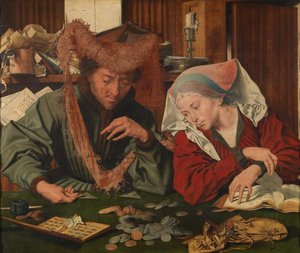
His masterpiece, Two Tax Gatherers, stands as a striking example of Northern Renaissance art. Through the use of oil on oak wood, he achieved a sense of depth and texture that brought his subjects to life. The painting serves as a vivid commentary on the corruption of tax officials, using the detailed depiction of clothing and surroundings to ground his satire in a recognizable reality. In these works, the heavy, old-fashioned garments of his characters add a layer of social critique, reminding the viewer of the era's shifting moral landscape.
Legacy and Artistic Influence
The stylistic development of Marinus van Reymerswaele shows the profound influence of the Antwerp painter Quentin Matsys. This connection helped shape his ability to blend elements of realism with a sharp, often caricatural sense of humor. His work is characterized by an attention to detail that allows the viewer to witness the minute textures of manuscripts, legal documents, and coins, all of which serve as symbols of the era's preoccupation with wealth and law.
While he worked extensively in Antwerp, his journey eventually led him back to the Northern Netherlands. After working in Antwerp until at least 1540, he moved to Goes, where his life reached its conclusion. Though many of his panels are known through attribution rather than signature, his impact on the genre scene remains undeniable. He left behind a visual legacy that continues to captivate, offering a profound glimpse into the mind of an artist grappling with faith, scholarship, and the ever-present shadows of human avarice.
马里努斯·范·雷默斯瓦埃尔
1490 - 1546 , 荷兰