切换至版画销售渠道
 展开全文
展开全文







































 对于任何边长超过 105 厘米(约 41 英寸)的艺术品或复制品,画框将以拆解后的组件形式发货。此方法可确保安全送达并防止运输过程中的损坏。


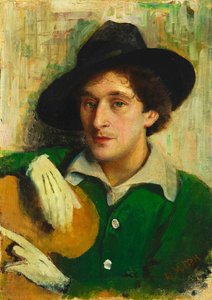
Marc Chagall's "David" – A Symphony of Memory and Flight
Marc Chagall’s “David,” painted in 1914, is not merely a depiction of a man with a guitar; it’s an immersion into the artist’s deeply personal world, a realm where reality dissolves into dream and memory. Born Moishe Shagal in 1887 in Liozna, Belarus – a town that would forever haunt his artistic imagination – Chagall established himself as one of the most distinctive voices of the early 20th century. This particular work exemplifies his signature style: a vibrant, almost hallucinatory blend of Cubist influences with deeply rooted Jewish folklore and a profound yearning for home. The painting immediately draws the eye to the central figure, a man seemingly lost in contemplation, cradling a guitar as if it were a precious relic. The bird perched upon the instrument adds another layer of symbolic richness, representing freedom, spirituality, and perhaps even the artist’s own restless spirit.
Cubist Echoes and Belarusian Roots
- Chagall's "David" is firmly rooted in the artistic currents of its time. While undeniably influenced by the burgeoning Cubist movement – evident in the fragmented forms and multiple perspectives – he transcends mere stylistic imitation.
- The painting’s genesis lies within Chagall’s formative years in Liozna, a town steeped in Orthodox religious tradition and Jewish cultural heritage. This duality—the juxtaposition of sacred and secular, ancient and modern—is a recurring theme throughout his oeuvre.
- The use of oil on canvas allows for the rich, saturated colors characteristic of Chagall’s work, creating an almost tactile quality that invites the viewer to step into the scene.
Symbolism: Flight, Faith, and Remembrance
Beyond its formal qualities, “David” is laden with potent symbolism. The guitar itself represents music, a universal language of emotion and memory, but also perhaps a longing for connection to the past. The bird, frequently appearing in Chagall’s work, symbolizes freedom, spiritual aspiration, and the ability to transcend earthly limitations. The posture of the figure – gazing downwards, lost in thought – suggests introspection and a desire to recapture vanished moments. It's a scene that evokes a sense of melancholy beauty, reminiscent of biblical narratives and folk tales.
A Window into Chagall’s Vision
Painted in 1914, just as Europe was teetering on the brink of war, “David” reflects a world grappling with uncertainty. Chagall's art offered an escape from the anxieties of the era, transporting viewers to a realm of heightened emotion and imaginative possibility. This reproduction captures not only the visual impact of the original but also the profound emotional resonance that continues to captivate audiences today. It’s a testament to Chagall’s ability to transform personal memory into universal symbols, inviting us to contemplate our own place in time and the enduring power of dreams.
常见问题与解答
“David”代表了马尔克·夏加尔艺术生涯的哪个阶段?
"David" 展现了 马尔克·夏加尔 在 Early Cubist 时期的艺术风格。
马尔克·夏加尔 的《David》 创作于哪一年?
"David"创作于1914年。这一时期将该作品置于马尔克·夏加尔的艺术生涯及其所处时代之中。
"David" 描绘了怎样的内容,又营造了怎样的氛围?
马尔克·夏加尔 的《David》 将 guitar player, marc chagall, cubist style, bird motif, jewish folklore, dreamlike scene, oil on canvas 与 Nostalgic 的氛围完美融合。
 实景预览
实景预览
 分享
分享 分享
分享
 详情
详情 指南
指南

 下载作品
下载作品
 相似作品
相似作品 X射线
X射线 幻灯片播放
幻灯片播放 Q&A
Q&A 统计数据
统计数据