

 发送
发送 分享
分享
 详情
详情 指南
指南

 下载图片
下载图片
 相似作品
相似作品 幻灯片播放
幻灯片播放 统计数据
统计数据Standing Figures (Thirty Figures)


 阅读全文
阅读全文
手工油画复制品
由我们的艺术家按需定制,为您提供您所选尺寸及画框的布面手工油画。 ( 切换至版画销售渠道 切换至数字图像销售渠道)




































您可以从与原作比例一致的预设尺寸中进行选择。

请输入您需要的宽度和高度,以适配您的画框或墙面。由于作品为手工绘制,若您选择不同的尺寸比例,艺术家可能会在画面边缘多画一些或稍作裁剪 —— 由您决定。在开始绘画之前,我们会为您发送一份数字效果图供您确认。本页面上展示的图片并非最终实物 —— 只有效果图才能反映真实结果。
下单后,OriginalUniqueArt.com 团队将通过电子邮件联系客户获取具体要求,并提供效果预览图


 玻璃选项仅适用于110厘米以下的尺寸。

Standing Figures (Thirty Figures)
复制品材质
复刻品尺寸说明
-


总计金额
¥ 2016
The Silent Procession: A Study in Human Vulnerability
In the evocative installation Standing Figures (Thirty Figures), the late Polish master Magdalena Abakanowicz invites us into a profound dialogue with the collective human experience. Created in 1998, this monumental work transcends the boundaries of traditional sculpture, presenting a rhythmic procession of thirty distinct figures that seem to emerge from the very pavement upon which they stand. Each figure, though part of a unified group, possesses a hauntingly unique silhouette, capturing a spectrum of poses and expressions that suggest a shared journey through time and existence. As one moves along the arrangement, the interplay of foreground and background creates a cinematic depth, pulling the viewer into a landscape where the line between the individual and the multitude begins to blur.
The power of this piece lies in its ability to evoke a sense of both profound isolation and inescapable connection. Abakanowicz, a pioneer who revolutionized the use of fiber and organic textures, utilizes a sculptural language that feels deeply rooted in the earth. The figures do not merely sit upon the landscape; they inhabit it with a heavy, somber grace. For the discerning collector or interior designer, this work offers a commanding presence, acting as a focal point that commands contemplation. It is a piece that does not demand attention through bright colors or grandiosity, but rather through its quiet, undeniable gravity and its ability to anchor a space with its historical and emotional weight.
A Legacy of Resilience and Texture
To understand the soul of Standing Figures, one must look toward the turbulent history that shaped Abakanowicz’s vision. Growing up in Poland under the shadows of Nazi occupation and later navigating the rigid constraints of Socialist Realism, the artist developed a profound sensitivity to themes of anonymity and the fragility of life. Her technique, often characterized by a rugged, tactile quality, serves as a metaphor for the scars left by history upon the human spirit. In this work, the repetition of forms creates a rhythmic cadence—a visual heartbeat that speaks to the endurance of humanity amidst the chaos of the twentieth century.
The symbolism within the thirty figures is layered and complex. While each sculpture stands as an individual entity, their collective arrangement suggests a societal movement, perhaps a migration or a silent protest against the erasure of identity. For those seeking to incorporate art into a sophisticated interior, a high-quality reproduction of this masterpiece brings with it a sense of intellectual depth and timelessness. The work serves as a bridge between the visceral reality of the physical form and the abstract concepts of memory and loss, making it an incomparable choice for spaces dedicated to reflection, culture, and the celebration of the human condition.
问答详情
Magdalena Abakanowicz 的《Standing Figures (Thirty Figures)》 是人像、风景还是方形构图?
Magdalena Abakanowicz 的《Standing Figures (Thirty Figures)》 采用 Panoramic 格式。该格式描述了构图的比例。
Magdalena Abakanowicz 的《Standing Figures (Thirty Figures)》 的色调是明亮还是深沉?
Magdalena Abakanowicz 的《Standing Figures (Thirty Figures)》 的记录数值为:亮度 shadow,亮度感 Soft Shadow。
"Standing Figures (Thirty Figures)" 的色调倾向于哪一种?
“Standing Figures (Thirty Figures)”倾向于Green to Violet Spectrum色调。
艺术家简介
The Weaver of Human Shadows: The Life and Legacy of Magdalena Abakanowicz
To encounter the work of Magdalena Abakanowicz is to step into a visceral landscape where the boundaries between organic matter and human emotion dissolve. Born Marta Magdalena Abakanowicz in 1930 in the quiet, noble estate of Falenty, Poland, her early life was shadowed by the profound traumas of the twentieth century. The Nazi occupation of her homeland during World War II was not merely a historical backdrop but a formative crucible; witnessing the resilience and resistance of her family instilled in her a lifelong preoccupation with the themes of survival, vulnerability, and the collective struggle of the human spirit. This early exposure to the fragility of existence would later manifest in sculptures that feel as though they are breathing, decaying, and enduring all at once.
Her artistic education took place within the rigid confines of the Academy of Fine Arts in Sopot and Warsaw during the 1950s, a period dominated by the suffocating aesthetic of Socialist Realism. This state-imposed doctrine demanded art that served as propaganda, yet Abakanowicz found a way to subvert these constraints through the medium of fiber. By turning away from the hard, didactic lines of traditional sculpture and toward the soft, tactile world of textiles, she began to develop a language that was entirely her own. She moved beyond the decorative, transforming woven strands into monumental, three-scale entities that challenged the very definition of what sculpture could be.
The Revolution of the Abakans
In the 1960s, Abakanowicz achieved international renown through the creation of her "abakans"—massive, organic forms crafted from interwoven jute and hessian. These were not mere tapestries hung upon a wall; they were woven forms that descended from ceilings like heavy, biological organisms. These works pioneered a new form of installation art, creating immersive environments that functioned as both objects and spaces. The texture of the coarse fibers, combined with their ambiguous, hollow shapes, evoked a sense of primordial life and existential dread. To walk among the abakans was to navigate a forest of textile shadows, reflecting the anxieties of a generation living under the watchful eye of communist surveillance.
As her career progressed into the 1970s, Abakanowicz’s focus shifted from the purely abstract toward the figurative, though never without maintaining her signature sense of ambiguity. She began to create fragmented, headless, and limb-less human forms that appeared as if they were emerging from—or being consumed by—the earth itself. These sculptures, often cast in bronze, wood, or clay, spoke to the loss of individuality within a mass society. Her ability to use materials like stone and metal to mimic the softness of flesh or the roughness of bark allowed her to explore the human condition with an unflinching, almost haunting honesty.
A Monumental Legacy
The significance of Abakanowicz’s contribution to contemporary art cannot be overstated. She bridged the gap between the traditional craft of weaving and the avant-garde movements of Postminimalism, proving that "soft" materials could carry the weight of profound political and philosophical inquiry. Her influence stretched far beyond the borders of Poland, as she served as a professor in Poznań and later as a visiting professor at UCLA, sharing her radical vision with a global audience.
Her achievements are marked by numerous prestigious accolades, including:
- The Herder Prize (1979), recognizing her cultural impact.
- The Leonardo da Vinci World Award of Arts (1999), celebrating her mastery of form.
- The Lifetime Achievement Award from the International Sculpture Center (2005), cementing her status as a titan of the medium.
Today, her work remains a haunting presence in the world's most esteemed institutions, from the Tate Modern to the National Museum of Women in the Arts. Whether through the towering, hollowed-out figures of her public installations or the intimate, textured surfaces of her early textiles, Magdalena Abakanowicz continues to remind us of our shared capacity for both immense strength and profound fragility. She remains an artist who did not merely represent the human form, but captured its very essence—the struggle to remain whole in a world that seeks to fragment us.

Magdalena Abakanowicz
1930 - 2017 , Poland
快速概览
- Full Name: Marta Magdalena Abakanowicz
- Nationality: Polish
- Date Of Birth: 1930
- Date Of Death: 2017
- Place Of Birth: Falenty, Poland
- Notable Artworks:
- Agora
- Birds of Knowledge
- Artistic Movement Or Style: Constructivism & Socialist Realism
- Artists Who Influenced This Artist: ['Minimalism']
- Artists Or Movements Influenced By This Artist: ['Contemporary Fiber Art']
相关文章

The Enduring Form: Sculpture Across History, Technique & Emotional Resonance
Explore the rich history of sculpture with OriginalUniqueArt. Discover key techniques, influential artists & investment potential for discerning collectors. Expert insights into valuing and collecting timeless masterpieces.

Bronze Age to Modern Masters: 10 Sculptures That Redefined Art | OriginalUniqueArt
Journey through art history with 10 legendary bronze sculptures – from Michelangelo's David to Rodin’s Thinker. Explore the stories, techniques & timeless beauty of these masterpieces. Find museum-quality reproductions & elevate your home decor on OriginalUniqueArt.com.

The Enduring Form: Exploring Themes & Techniques in Sculpture Across Historical Periods
Explore the rich history of sculpture from ancient masterpieces to contemporary innovations. Discover key techniques, influential artists & investment potential for discerning art collectors.

Bronze Sculptures That Defined Art History | OriginalUniqueArt
Journey through art history with our Top 10 bronze sculptures! Explore masterpieces by Rodin, Michelangelo & more. Discover stories behind iconic statues and find museum-quality reproductions for your home decor at OriginalUniqueArt.com.
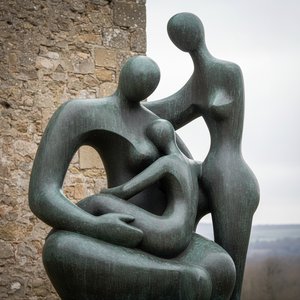
Henry Moore: Sculpting Modernity – Form, Emotion & the Human Condition
Explore the revolutionary sculptures of Henry Moore – abstract forms, reclining figures & powerful expressions of the human condition. Discover his legacy & artistic process with OriginalUniqueArt.