

 实景预览
实景预览
 发送
发送 分享
分享
 详情
详情 指南
指南

 下载图片
下载图片
 相似作品
相似作品 X射线
X射线 幻灯片播放
幻灯片播放 统计数据
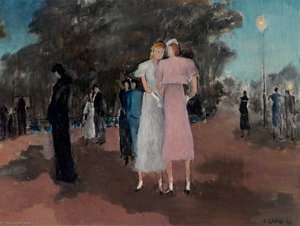
统计数据Park Scene
 1933
1933 44.0 x 60.0 cm
 米德尔斯堡现代艺术学院
 阅读全文
阅读全文
手工油画复制品
由我们的艺术家按需定制,为您提供您所选尺寸及画框的布面手工油画。 ( 切换至版画销售渠道 切换至数字图像销售渠道)




































您可以从与原作比例一致的预设尺寸中进行选择。

请输入您需要的宽度和高度,以适配您的画框或墙面。由于作品为手工绘制,若您选择不同的尺寸比例,艺术家可能会在画面边缘多画一些或稍作裁剪 —— 由您决定。在开始绘画之前,我们会为您发送一份数字效果图供您确认。本页面上展示的图片并非最终实物 —— 只有效果图才能反映真实结果。
下单后,OriginalUniqueArt.com 团队将通过电子邮件联系客户获取具体要求,并提供效果预览图


 玻璃选项仅适用于110厘米以下的尺寸。

Park Scene
复制品材质
复刻品尺寸说明
-


总计金额
¥ 2015
A Glimpse into Everyday Life
The painting depicts a group of people walking down the street in a park setting, with a total of 12 individuals visible. The scene is filled with a sense of community and social interaction, as people engage in conversations or simply enjoy the surroundings. The woman wearing a pink dress is a notable figure, adding a pop of color to the overall scene. Key Elements of the painting include the benches placed along the street, providing seating for those who wish to relax and take in the park's atmosphere. The artist's use of oil on panel creates a sense of depth and texture, drawing the viewer into the scene.Similar Artworks
Other notable artworks that showcase everyday life scenes include People in the Park by Frederick Carl Frieseke, available on OriginalUniqueArt.com. This painting, created in 1900, is a vibrant scene of individuals enjoying their time outdoors.- MaestÓ (front, predella), The Flight into Egypt by Duccio Di Buoninsegna is another notable artwork, showcasing the artist's skill in Gothic Art.
- James Hutcheon (d.c.1933) (study) by James Mcbey is a study of an individual, created using oil on panel.
For more information on Lynton Harold Lamb and his artwork, visit OriginalUniqueArt.com. The website provides a comprehensive overview of the artist's life and work, as well as similar artworks by other notable artists.
问答详情
"Park Scene" 的色调饱和度如何?
"Park Scene" 的色调饱和度为 Muted。
哪些色调与主导色彩定义了“Park Scene”?
Lynton Harold Lamb 的《Park Scene》 采用了 Earthy 色调,并以 Quinacridone Magenta (#68534c) 作为主导色。
Lynton Harold Lamb 在创作《Park Scene》时多大年纪?
Lynton Harold Lamb 在 1933 年创作《Park Scene》时,年龄为 26 岁。该年龄是根据艺术家的出生年份 1907 计算得出的。
艺术家简介
Lynton Harold Lamb: A Londoner’s Eye for the Everyday
Lynton Harold Lamb, a name perhaps less familiar than many of his contemporaries in early 20th-century British art, nevertheless possessed a remarkable talent for capturing the essence of urban life. Born in Hyderabad, India, in 1907 – a detail often overlooked – and returning to England as a young boy, Lamb’s artistic journey was deeply intertwined with London itself. His work isn't grand landscapes or heroic portraits; instead, he offered intimate glimpses into the city’s streets, its people, and the quiet moments that defined daily existence. This unassuming approach, coupled with his meticulous attention to detail and a subtly evocative style, has earned him recognition as a significant chronicler of London’s Victorian and Edwardian periods.
Lamb's early life was shaped by his father’s role as a Wesleyan Methodist minister. This upbringing instilled in him a keen observation of human nature and a respect for the ordinary – qualities that would profoundly influence his artistic vision. After his father’s death, Lamb moved to London and pursued formal training at Camberwell School of Arts and Crafts, studying under influential figures like Noel Rooke and Bernard Meninsky. It was here he honed his skills in lithography and illustration, disciplines that proved crucial to his later career. Notably, during World War II, Lamb’s artistic abilities were put to a different purpose – designing camouflage patterns for the military, demonstrating a versatility often underestimated by those who only knew him for his civilian work.
The Book Jacket and Beyond
Lamb's most enduring legacy lies in his contributions to the world of book design. He quickly established himself as a sought-after illustrator for publishers like Oxford University Press, creating striking and memorable book jackets that became instantly recognizable. His style was characterized by a precise realism, often employing a limited palette of muted tones – browns, greys, and ochres – to create a sense of understated elegance and atmosphere. He wasn’t interested in flamboyant displays; rather, he aimed for an almost photographic quality, capturing the subtle nuances of light and shadow, and the expressions on people's faces.
Beyond book jackets, Lamb expanded his repertoire into posters, architectural decoration, and postage stamp designs. His work for Orient Lines ships, particularly during the 1930s and 40s, showcased his ability to translate complex visual information into engaging and aesthetically pleasing compositions. The ‘Queen Elizabeth II Castle series’ stamps, designed in 1953-54, are a testament to his skill – each stamp depicting a majestic castle framed by an evocative stone wall, a design that quickly became iconic.
A Portrait of London Life
While book jackets and posters often represent the breadth of Lamb’s work, it's in his portraits that he truly shines. His depiction of Professor Sir Percy Nunn, commissioned in 1937, offers a particularly compelling example of his talent. The portrait captures not just the subject’s likeness but also his character – a sense of dignity and quiet reflection conveyed through subtle details like the arrangement of his hands and the expression in his eyes. Lamb's portraits are often set against London backdrops, subtly anchoring them to the city’s atmosphere and history.
His work frequently featured scenes from everyday London life – street corners bustling with activity, market stalls overflowing with goods, and individuals engaged in their daily routines. He wasn’t interested in romanticizing or idealizing these scenes; instead, he presented them with a frankness and honesty that revealed the beauty and complexity of urban existence. Consider his depiction of Sandon Place, a poignant image capturing a moment frozen in time – a scene of quiet domesticity amidst the city's relentless energy.
Legacy and Influence
Lynton Harold Lamb’s career spanned several decades, during which he consistently produced work of remarkable quality and enduring appeal. He was recognized with numerous awards, including the Royal Designer for Industry in 1974, a testament to his significant contribution to British design. While he may not be as widely celebrated as some of his contemporaries, Lamb’s meticulous observation, understated elegance, and profound understanding of London's character have secured his place as a vital chronicler of a bygone era. His work continues to resonate with viewers today, offering a valuable glimpse into the heart and soul of Victorian and Edwardian London – a city he captured with an artist’s eye and a poet’s sensibility.
Lynton Harold Lamb
1907 - 1977
快速概览
- Full Name: Lynton Harold Lamb
- Nationality: British
- Date Of Birth: 1907
- Date Of Death: 1977
- Place Of Birth: Nizambabad, India
- Notable Artworks:
- Sandon Place
- Professor Nunn (1937)
- Artistic Movement Or Style: Urban art UK, Victorian realism
- Artists Who Influenced This Artist: ['Noel Rooke']
- Artists Or Movements Influenced By This Artist: ['Book jackets']