
 效果预览
效果预览
 购买手绘画作
 分享
分享 分享
分享
 详情
详情

 下载
下载
 相似作品
相似作品 X射线
X射线 幻灯片播放
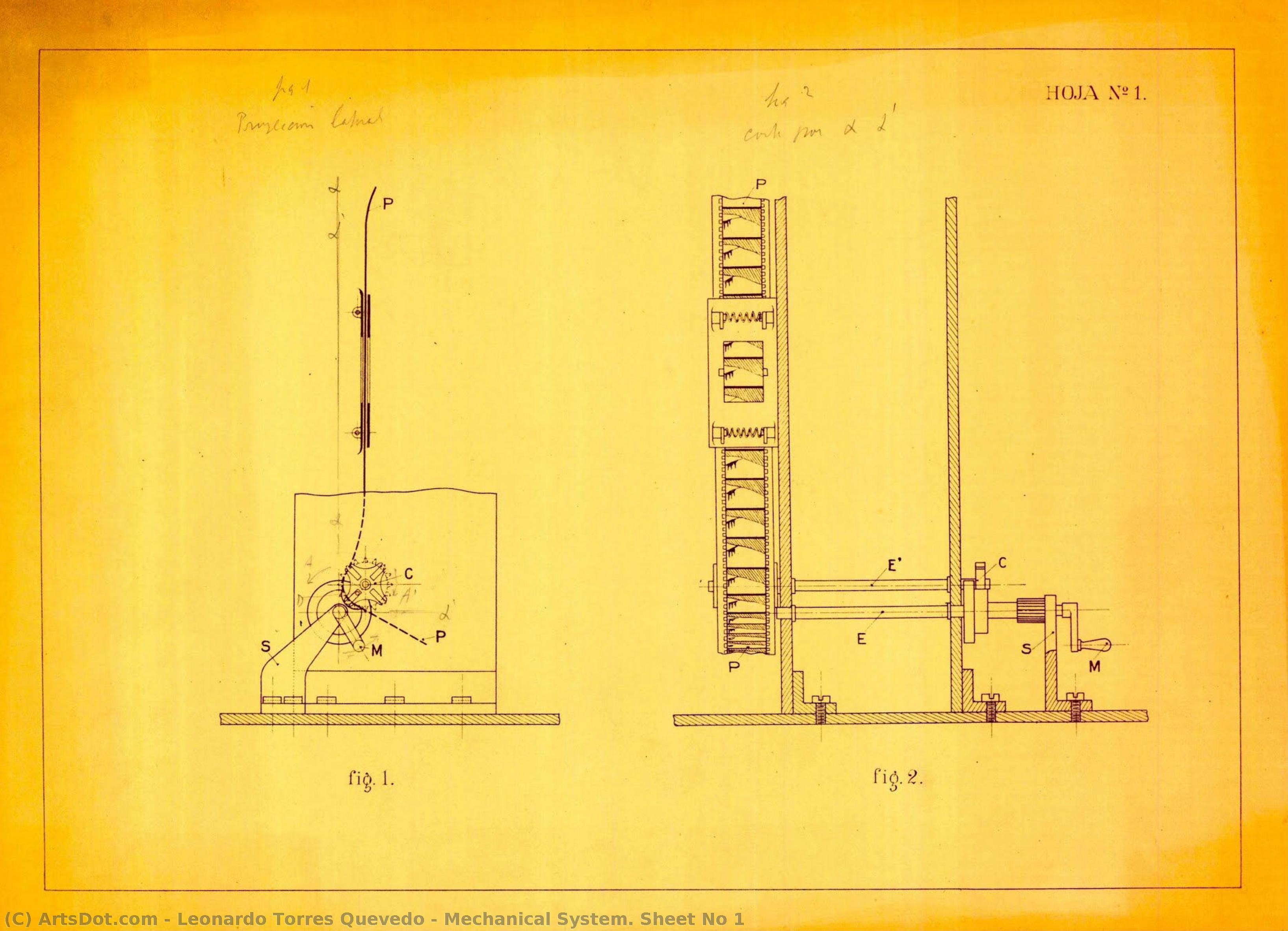
幻灯片播放Mechanical System. Sheet No 1

 展开详情
展开详情




































从与原作比例一致的预设尺寸中进行选择。

您可以输入自定义尺寸,以适配特定的画框或空间。如果您选择的尺寸与原图比例不符,我们将对作品进行裁剪,或通过镜像填充/纯色填充边缘的方式来扩展图像。在开始制作之前,我们会向您发送一份数字效果图供您确认。
请注意,屏幕上的预览并不能反映实际的裁剪或扩展效果。只有效果图才能准确展示最终的构图。
虽然我们提供定制尺寸,但为了保持原图比例,我们建议您从预设列表中选择尺寸。


 玻璃选项仅适用于110厘米以下的尺寸。

Mechanical System. Sheet No 1
艺术微喷/版画
复制品尺寸
-


最终总价
$ 80
艺术家简介
Leonardo Torres Quevedo: A Pioneer of Automation
Early Life and Education
- Born: December 28, 1852, in Spain.
- Leonardo Torres Quevedo was a remarkably versatile individual, excelling as a civil engineer, mathematician, and inventor.
- Details regarding his formal education are somewhat scarce, but he demonstrated an early aptitude for technical subjects and problem-solving.
Engineering Innovations and Early Career
- Torres Quevedo’s initial work focused on practical engineering solutions. He quickly gained recognition for his innovative designs.
- Aerial Trams: One of his first groundbreaking inventions was a cable car system patented in 1887, designed for safe and efficient transportation. This culminated in the Niagara Falls Aero Car in 1916.
- He also made significant contributions to naval architecture, designing innovative vessels like the *buque campamento* (camp-vessel) – a balloon carrier.
Pioneering Work in Computing and Automation
- In the 1890s, Torres Quevedo turned his attention to analog computation. He published influential papers like *Sur les machines algébriques* (1895) and *Machines à calculer* (1901).
- El Ajedrecista (The Chess Player): Created in 1912, this electromagnetic device was capable of playing a limited form of chess. It’s considered an early example of artificial intelligence and programmable machines.
- Essays on Automatics (1914): This work speculated about thinking machines and introduced concepts like floating-point arithmetic, anticipating modern computing principles.
Remote Control and Aeronautics
- Torres Quevedo was a pioneer in remote control technology. He developed the Telekino (1901-1905), laying down the principles of modern wireless remote operation.
- Astra-Torres Airships: During World War I, he invented non-rigid airships that aided British and French forces in countering German submarine warfare. These trilobed structures were a significant aeronautical achievement.
Later Life and Legacy
- Torres Quevedo held important positions, including seat N of the Real Academia Española (1920-1936) and presidency of the Spanish Royal Academy of Sciences (1928-1934).
- He retired in 1930 and passed away on December 18, 1936.
- Historical Significance: Torres Quevedo’s work foreshadowed many developments in robotics, artificial intelligence, and automation. He is now recognized as a visionary inventor whose ideas were far ahead of his time.
Influences and Impact
- Influenced By: While specific influences are not extensively documented, Torres Quevedo’s work demonstrates an understanding of 19th-century mechanical engineering principles and mathematical theory.
- Influenced: His inventions and theoretical contributions influenced subsequent generations of engineers and computer scientists. He laid the groundwork for many technologies we rely on today.

Leonardo Torres Quevedo
1852 - 1936 , Spain
艺术家简介
- Birth Date: December 28, 1852
- Birth Place: Spain
- Death Date: December 18, 1936
- Name: Leonardo Torres Quevedo
- Nationality: Spanish
- Notable Works:
- Telekino
- El Ajedrecista
- Astra-Torres airships
- Aerial trams

