
 切换至版画销售渠道
 展开全文
展开全文







































 对于任何边长超过 105 厘米(约 41 英寸)的艺术品或复制品,画框将以拆解后的组件形式发货。此方法可确保安全送达并防止运输过程中的损坏。


Suprematism: A Radical Departure From Representation
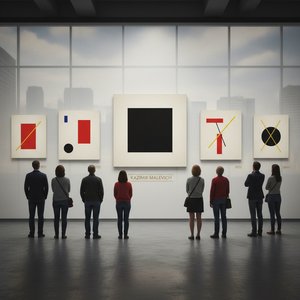
Kazimir Severinovich Malevich’s *Suprematism*, specifically *Nonobjective Composition*, stands as a cornerstone of abstract art, representing not merely an aesthetic innovation but a profound philosophical assertion about the nature of artistic expression. Born in Kyiv Oblast, Ukraine in 1879 to Polish parents steeped in cultural traditions—a heritage that subtly influenced his artistic sensibilities—Malevich embarked on a journey toward redefining visual language itself. His formative years instilled within him an appreciation for symbolic imagery and folk art forms which would later coalesce into the core tenets of his groundbreaking movement. Early Artistic Explorations & Influences Before establishing Suprematism, Malevich traversed diverse stylistic landscapes, immersing himself in Impressionism, Symbolism, Fauvism, and Cubism. These engagements served as crucial stepping stones, exposing him to the prevailing artistic currents of Europe and equipping him with a toolkit of techniques—albeit one he would ultimately dismantle. A pivotal trip to Paris in 1912 proved transformative, catapulting him into direct contact with the vanguard of European art and fostering an unwavering conviction that art should transcend mere imitation of reality. This belief fueled his relentless pursuit of pure artistic feeling, prioritizing conceptual primacy over visual accuracy. The Birth of Suprematism & Its Theoretical Framework Malevich formally founded Suprematism in 1913—a movement predicated on the audacious declaration that “art must be free from any objective representation.” Rejecting the conventions of Cubism and Futurism, he championed a radically simplified aesthetic characterized by geometric forms—primarily squares, circles, and rectangles—rendered in limited color palettes. This uncompromising stance wasn’t merely stylistic; it stemmed from Malevich's engagement with philosophical ideas propagated by Nikolai Alexandrovich Berdyaev and Vladimir Mikhailovich Solovyov, who argued that art should serve as a conduit for spiritual transcendence. As Malevich eloquently articulated in his manifesto “From Cubism and Futurism to Suprematism,” the artist’s task was to liberate himself from the constraints of the observable world—to confront “the zero of form” and embrace “pure feeling.” Iconic Composition & Symbolic Resonance The painting *Nonobjective Composition* exemplifies Malevich's uncompromising vision. Featuring a dominant large circle positioned at the upper left corner alongside a smaller circle near the center-left area, punctuated by a central cross—a deliberate allusion to Christian iconography—the artwork eschews any discernible depiction of external objects. Instead, it presents an arrangement of shapes and colors—primarily red, black, yellow, blue, and white—that generate a mesmerizing visual experience for the viewer. The geometric forms themselves are imbued with symbolic significance: the circle represents wholeness and unity, mirroring Malevich’s belief in the interconnectedness of all things; the cross symbolizes spiritual aspiration and transcendence. Legacy & Influence Beyond Art History Malevich's Suprematism irrevocably altered the trajectory of art history, establishing a precedent for conceptual abstraction that continues to inspire artists today. His uncompromising commitment to pure feeling—his rejection of representational illusion—resonates powerfully across disciplines, informing approaches to design, architecture, and even music. Reproductions of *Nonobjective Composition*, skillfully crafted by OriginalUniqueArt.com, offer an unparalleled opportunity to engage with this seminal artwork and its enduring legacy—a testament to Malevich’s unwavering conviction that art could achieve a higher purpose beyond mere visual gratification.常见问题与解答
针对 卡西米尔·马列维奇 的《Suprematism. Nonobjective Composition》 的版画,推荐的尺寸和方向是什么?
建议打印尺寸为 Large,构图采用 Square:这是为 卡西米尔·马列维奇 的《Suprematism. Nonobjective Composition》 推荐的打印设置。
卡西米尔·马列维奇 的《Suprematism. Nonobjective Composition》 传达了怎样的情感?
《卡西米尔·马列维奇 的《Suprematism. Nonobjective Composition》》所传达的意境为Serene,其情感基调为Tranquil。
卡西米尔·马列维奇 的《Suprematism. Nonobjective Composition》 的技法与风格具有哪些特征?
卡西米尔·马列维奇 的《Suprematism. Nonobjective Composition》 将 Acrylic On Canvas 技法与 Geometric Abstract Art 流派风格完美融合。技法与流派分别描述了作品的创作手法及其艺术风格。
 实景预览
实景预览
 分享
分享 分享
分享
 详情
详情 指南
指南

 下载作品
下载作品
 相似作品
相似作品 X射线
X射线 幻灯片播放
幻灯片播放 问答
问答 统计数据
统计数据





![黑圆 [1913] 俄罗斯国家博物馆](/media/artworks/images-thumb/62/67/6267e452b0c8476772a6511e19ce1616.jpg)


