切换至版画销售渠道
 展开全文
展开全文







































 对于任何边长超过 105 厘米(约 41 英寸)的艺术品或复制品,画框将以拆解后的组件形式发货。此方法可确保安全送达并防止运输过程中的损坏。


The Essence of Pure Form
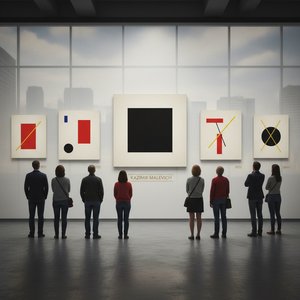
In the vast landscape of modern art, few works possess the radical, arresting power of Kazimir Malevich’s Red Square. Created in 1915, this masterpiece serves as a profound manifesto for Suprematism, an avant-garde movement that sought to liberate painting from the burden of representing the physical world. At first glance, the composition appears deceptively simple: a vibrant, scarlet quadrilateral set against a stark, infinite white field. Yet, beneath this minimalist surface lies a complex architectural feat of visual tension. The shape is not a perfect square but rather a dynamic, tilting parallelogram that seems to pulse with life, leaning forward as if caught in a moment of eternal motion. For the discerning collector or interior designer, this piece offers more than mere decoration; it provides a focal point of intense intellectual and aesthetic energy that can anchor a contemporary space with its uncompromising clarity.
The technique employed by Malevich is a masterclass in painterly realism—a term he used to describe the pursuit of pure sensation through non-objective forms. By stripping away all recognizable subjects, shadows, and perspectives, Malevich directs the viewer's entire attention to the raw interaction between color and space. The brilliant red does not merely sit upon the canvas; it vibrates against the surrounding void, creating a sense of depth that defies its two-dimensional nature. This reductionist approach was revolutionary, moving away from the decorative flourishes of previous eras toward a spiritualized abstraction. When rendered as a high-quality reproduction, the interplay between the saturated pigment and the clean white background maintains this striking contrast, making it an ideal selection for those looking to introduce a bold, sophisticated edge to minimalist or modern architectural settings.
A Revolution in Color and Spirit
To understand the historical weight of Red Square, one must look back to the turbulent era of the Russian avant-garde. Malevich’s work emerged from a period of profound social and political upheaval, mirroring the desire for a new world order that rejected old traditions. While the painting is famously abstract, it carries deep symbolic echoes; some scholars note its connection to the traditional Russian religious icons, reimagined through a lens of modern geometry. The red hue itself evokes a sense of vitality, revolution, and even a certain sacred intensity, while the white expanse represents the "desert" of pure feeling—a space free from the clutter of material existence. It is an art of the infinite, designed to transcend the boundaries of time and geography.
For those seeking to curate an environment of contemplation and strength, this artwork offers a unique emotional resonance. It does not demand attention through narrative or sentimentality; instead, it commands respect through its sheer, unadulterated presence. Whether placed in a professional gallery setting, a high-end corporate office, or a curated residential lounge, Red Square acts as a window into the sublime. It invites the observer to move beyond the superficial and engage with the fundamental building blocks of perception. Owning a reproduction of this seminal work is an opportunity to possess a piece of art history that continues to challenge, inspire, and redefine the very meaning of visual expression.
常见问题与解答
"Red square" 的作者是谁?
"Red square" 的创作者是 卡济米尔·马列维奇。该作品以 卡济米尔·马列维奇 的名义编入目录。
如何以幻灯片形式查看卡济米尔·马列维奇 的《Red square》?
您可以在作品的幻灯片展示页面上观看“Red square”的幻灯片展示。
"Red square" 的画幅比例是多少?
卡济米尔·马列维奇 的《Red square》 是一幅 Square 构图的作品。在选择打印尺寸之前,建议先确认其比例。
 实景预览
实景预览
 分享
分享 分享
分享
 详情
详情 指南
指南

 下载作品
下载作品
 相似作品
相似作品 X射线
X射线 幻灯片播放
幻灯片播放 问答
问答 统计数据
统计数据