
 切换至版画销售渠道
 展开全文
展开全文







































 对于任何边长超过 105 厘米(约 41 英寸)的艺术品或复制品,画框将以拆解后的组件形式发货。此方法可确保安全送达并防止运输过程中的损坏。


A Universe Within a Circle: Exploring Kazimir Malevich’s “Black Circle”
Kazimir Malevich's "Black Circle," painted in 1923, is not merely an image; it is a portal. A stark black form suspended within the infinite expanse of white, it represents a pivotal moment in art history – the culmination of a radical pursuit to distill painting down to its most essential elements. Emerging from the tumultuous years following the Russian Revolution, this work embodies the core tenets of Suprematism, an artistic movement Malevich himself founded, seeking to liberate art from representation and connect with pure feeling. It’s a deceptively simple composition that demands contemplation, inviting viewers to shed preconceived notions about what art *should* be and instead experience it as a direct conduit to spiritual understanding.
The Birth of a New Aesthetic: Suprematism and its Roots
To understand “Black Circle,” one must grasp the context of its creation. Malevich’s journey began with explorations in Impressionism, Cubism, and Futurism, but he ultimately rejected these styles as being too tethered to the visible world. He yearned for an art that transcended imitation, an art capable of expressing a higher reality. This led him to Suprematism – from the Russian word “supremus,” meaning supreme – which prioritized pure geometric forms floating in limitless space. The circle, square, rectangle, and line became his vocabulary, devoid of any symbolic reference beyond themselves. "Black Circle" isn’t *about* something; it *is*. It's a manifestation of this belief, pushing abstraction to its absolute limit. The painting wasn’t created as an isolated event but was part of a series of explorations with basic geometric shapes, each one representing a step further into the realm of non-objectivity and pure sensation.
Technique and Texture: A Minimalist Masterpiece
The power of “Black Circle” lies not only in its conceptual weight but also in Malevich’s masterful execution. While seemingly straightforward, the painting reveals subtle nuances upon closer inspection. The black circle isn't a flat, uniform void; instead, it possesses a delicate internal texture, built up through layers of oil paint. This layering creates tonal variations within the form, preventing it from appearing static and lending it a sense of depth and presence. The crispness of the circle’s circumference, though not perfectly precise, contributes to a feeling of controlled order. The surrounding white ground isn't simply blank space; its subtly textured surface adds another layer of visual interest, grounding the floating form and enhancing its impact. Malevich wasn’t striving for technical virtuosity in the traditional sense; rather, he used his skill to create an image that was both visually arresting and conceptually profound.
Symbolism and Emotional Resonance: Beyond the Form
Despite its deliberate rejection of representational symbolism, “Black Circle” resonates with deep emotional and spiritual undertones. The circle itself is a universal symbol – representing wholeness, eternity, the cosmos, and divine perfection. Its placement within the white square creates a dynamic tension between the infinite and the finite, the boundless and the contained. The stark contrast evokes feelings of quietude, contemplation, and even a sense of mystery. It’s an emptiness that invites introspection, allowing viewers to project their own thoughts and emotions onto its surface. Some interpret it as a representation of a black hole, others as a symbol of spiritual awakening, while still others see it simply as a pure expression of form and color. Ultimately, the meaning of “Black Circle” is subjective, residing in the eye – and the soul – of the beholder.
A Timeless Presence: Integrating "Black Circle" into Contemporary Spaces
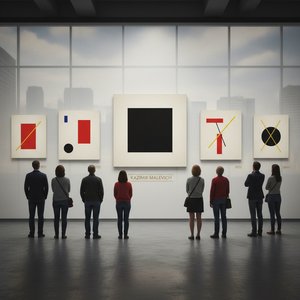
The enduring appeal of “Black Circle” makes it an exceptional addition to modern and contemporary interiors. Its monochromatic palette offers remarkable versatility, complementing a wide range of color schemes and design styles. Whether displayed as a focal point in a minimalist living space or incorporated into a more eclectic collection, this reproduction brings a touch of art historical significance and sophisticated elegance to any environment. It’s not merely a decorative object; it's a conversation starter, a source of inspiration, and a testament to the power of abstract thought – a reminder that sometimes, less truly is more.
常见问题与解答
卡济米尔·马列维奇 的《Black circle》 的色彩浓郁度如何?
卡济米尔·马列维奇 的《Black circle》 中的色彩呈现出 单色调 的强度。
卡济米尔·马列维奇 的《Black circle》 在艺术史上的地位如何?
卡济米尔·马列维奇 的《Black circle》 在艺术史上的分类属于 Suprematism 运动,创作于 中世纪盛期 时期。
卡济米尔·马列维奇 的《Black circle》中的主导色调是什么?
“Black circle”呈现出从绿色到紫色的色谱范围色调。
 实景预览
实景预览
 分享
分享 分享
分享
 详情
详情 指南
指南

 下载作品
下载作品
 相似作品
相似作品 X射线
X射线 幻灯片播放
幻灯片播放 问答
问答 统计数据
统计数据





![黑圆 [1913] 俄罗斯国家博物馆](/media/artworks/images-thumb/62/67/6267e452b0c8476772a6511e19ce1616.jpg)


