

 效果预览
效果预览
 切换至手工绘画版
 分享
分享 分享
分享
 详情
详情

 下载
下载
 相似作品
相似作品 X射线
X射线 幻灯片播放
幻灯片播放Mountain Scene
 Oil On Canvas
- WallArt
- Romanticism
 1796
1796 110.0 x 161.0 cm
 羅爾富萊茨博物館
 展开详情
展开详情




P118B $10

P118H $10

P118W $10

P438Z $10

P508JH $12

P508YH $12

P805H $10

P805Z $10

P919BZ $10

P919G $10

P919XJ $10

P959ZH $10

P968JZ $12

W106C $8

W218G $10

W218JH $8

W218Y $10

W307PJ $10

W316G $10

W316PJ $8

W316Y $10

W398PJ $8

W4111J $10

W500HY $15

W500JH $15

W692G $12

W849H $8

W940BG $15

W953PJ $8




从与原作比例一致的预设尺寸中进行选择。

您可以输入自定义尺寸,以适配特定的画框或空间。如果您选择的尺寸与原图比例不符,我们将对作品进行裁剪,或通过镜像填充/纯色填充边缘的方式来扩展图像。在开始制作之前,我们会向您发送一份数字效果图供您确认。
请注意,屏幕上的预览并不能反映实际的裁剪或扩展效果。只有效果图才能准确展示最终的构图。
虽然我们提供定制尺寸,但为了保持原图比例,我们建议您从预设列表中选择尺寸。


 玻璃选项仅适用于110厘米以下的尺寸。

Mountain Scene
艺术微喷/版画
复制品尺寸
-


最终总价
$ 80
藏品详情
Mountain Scene by Joseph Anton Koch
Joseph Anton Koch’s “Mountain Scene,” completed in 1796, stands as a cornerstone of Romantic landscape painting—a testament to the movement's fascination with untamed nature and its yearning for sublime beauty. More than just a depiction of Alpine grandeur, it embodies the philosophical spirit of its time, reflecting a profound shift away from Neoclassical restraint towards expressive emotion and imaginative vision.
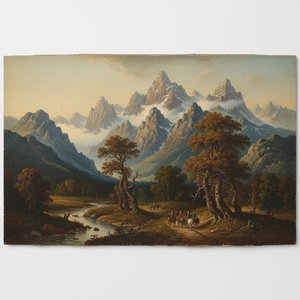
Composition and Style: The painting unfolds with breathtaking precision. Koch meticulously captures the majesty of the Erzgebirge mountain range dominating the background—peaks piercing through swirling clouds—a deliberate contrast to the serene stillness of the valley below. A dramatic waterfall cascades down one of these mountains, injecting dynamism into the scene while simultaneously emphasizing the immensity of the natural world. Foreground figures – a small group of travelers – are rendered with remarkable realism, yet they appear dwarfed by the overwhelming scale of their surroundings; this juxtaposition serves to underscore the insignificance of human endeavor against the backdrop of geological time.
Technique: Koch’s mastery lies in his masterful use of oil paint on canvas. He employs a technique characterized by subtle gradations of color and meticulous attention to detail—particularly evident in the rendering of rock formations and foliage. The artist skillfully utilizes chiaroscuro – dramatic contrasts between light and shadow – to sculpt the mountain peaks, creating an illusion of depth and solidity that draws the viewer’s eye into the scene. Furthermore, Koch's palette leans heavily on earthy tones—ochres, siennas, umbers—reflecting the Romantic preoccupation with capturing the raw essence of nature.
Historical Context: “Mountain Scene” emerged during a pivotal moment in European art history – the ascendancy of German Romanticism. Influenced by thinkers like Friedrich Schlegel and Johann Wolfgang Goethe, Koch’s work responded to the intellectual currents of the era, rejecting the idealized forms of Neoclassicism for a more visceral engagement with emotion and imagination. The painting reflects the Romantic belief that nature possessed inherent spiritual significance—a realm untouched by reason or morality where individuals could experience profound awe and wonder.
Symbolism: Beyond its aesthetic beauty, “Mountain Scene” carries symbolic weight. The mountain range represents permanence and stability amidst the transient concerns of human life; it embodies the sublime – a feeling of terror mingled with reverence—that Romantic artists sought to evoke in their audiences. Koch’s depiction of the waterfall symbolizes purification and renewal, mirroring the spiritual aspirations of the time. Ultimately, the painting invites contemplation on humanity's relationship with the natural world and its capacity for experiencing moments of transcendent beauty.
Emotional Impact: Viewing “Mountain Scene” is akin to stepping into a realm of profound tranquility and grandeur. Koch’s masterful rendering captures not merely what the eye sees but also what the soul feels—a sense of humility before the immensity of creation, coupled with an appreciation for its sublime splendor. It remains a powerful reminder of the Romantic ideal that art should inspire emotion and elevate the spirit.
艺术家简介
The Architect of the Heroic Landscape
Joseph Anton Koch stands as a singular figure in Austrian art history—a painter who deftly navigated the shifting currents of Neoclassicism into the burgeoning fervor of German Romanticism. Born in 1768 in Elbigenalp, Austria, his early life was marked by a pastoral simplicity that would profoundly shape his artistic vision; tending cattle in his youth instilled in him an intimate appreciation for the natural world, a connection that later manifested in his monumental depictions of earth and sky. A fortuitous recommendation from Bishop Umgelder secured him a prestigious academic education at Stuttgart’s Karlsschule, a rigorous military academy where discipline and intellectual pursuit converged. However, Koch's youthful spirit rebelled against such constraints, leading to a brief but formative wanderlust through France and Switzerland before he finally established himself in the artistic crucible of Rome in 1795.
In the heart of Italy, Koch found kinship with fellow painter Asmus Jacob Carstens, adopting a style often referred to as the heroic aesthetic. This approach initially mirrored Carstens’ literal interpretations of mythological narratives, characterized by a certain sculptural clarity and formal rigor. Koch demonstrated his technical prowess not only through paint but also through the meticulous art of printmaking, notably etching the pages of Carrend's Les Argonautes. This period of his life was defined by a mastery of detail and a command over line that would serve as the foundation for his later, more expansive compositions.
A Visionary Evolution: From Myth to Mountain
As his career progressed, Koch underwent a profound artistic evolution, transitioning from the structured narratives of Neoclassicism toward the sweeping grandeur of landscape painting. He began to reimagine classical ideals through the lens of the Austrian Alps and the Italian countryside, producing works that felt both timeless and intensely visceral. Influenced by the monumental compositions of masters like Nicolas Poussin and Claude Lorrain, Koch developed a unique way of organizing space, where dramatic lighting and vast, rugged terrains created a sense of awe. His landscapes were never merely topographical records; they were emotional journeys through heroic scenery.
His ability to blend the classical with the romantic is perhaps best seen in his treatment of light and atmosphere. In works such as Heroic Landscape with Rainbow, he utilizes a Baroque sensibility to introduce dramatic weather elements that punctuate the stillness of the mountains. This technique allowed him to bridge two eras: the ordered, rational world of the Enlightenment and the emotive, untamed spirit of Romanticism. Even when depicting serene scenes, such as the Monastery of San Francesco di Civitella in the Sabine Mountains, there remains an underlying sense of the sublime—a realization of nature's immense power and scale.
Legacy and Historical Significance
The later years of Koch's life were marked by both movement and resilience. Facing financial hardships exacerbated by Napoleon’s invasions, he relocated to Vienna in 1812. In this new setting, he flourished under the patronage of influential intellectuals like Friedrich Schlegel and became a central figure in the Germanic artistic tradition. His work during this period began to reflect a shift toward harsher, more dramatic elements, further cementing his role as a pioneer of the landscape genre.
The historical significance of Joseph Anton Koch lies in his ability to transform the landscape from a secondary, decorative element into a primary vehicle for philosophical and emotional expression. His contributions can be summarized through several key artistic pillars:
- Synthesis of Styles: He successfully merged the formal discipline of Neoclassicism with the emotional depth of German Romanticism.
- The Heroic Aesthetic: He redefined landscape painting by introducing a sense of monumental scale and dramatic, "heroic" compositions.
- Technical Mastery: His skill spanned from the delicate precision of etching to the sweeping, atmospheric brushwork required for vast mountain vistas.
- Cultural Bridge: He acted as a vital link between the classical traditions of Rome and the emerging nationalistic landscape movements in Austria and Germany.
Today, Koch is remembered not just as an Austrian painter, but as a visionary who taught viewers to look upon the mountains and see within them the very soul of the sublime.

Joseph Anton Koch
1768 - 1839 , Austria
艺术家简介
- Artistic Movement Or Style: Neoclassicism & Romanticism
- Artists Or Movements Influenced By This Artist: ['Romantic painting']
- Artists Who Influenced This Artist: ['Asmus Jacob Carstens']
- Date Of Birth: 1768
- Date Of Death: 1839
- Full Name: Joseph Anton Koch
- Nationality: Austrian
- Notable Artworks:
- The Upland near Bern
- Landscape with Abraham and the Three Angels in the Valley of Mambre
- Heroic Landscape with Rainbow
- Place Of Birth: Elbigenalp, Austria
相关文章

浪漫主义画派的十部巨作:定义风景画的艺术传奇
探索浪漫主义风景画的巅峰!本文精选十部经典名作,带您领略莫奈、库尔贝等大师的艺术魅力。感受色彩与光影的诗意,重温自然风光的震撼。OriginalUniqueArt.com为您提供博物馆级别的艺术复制品和个性化家居装饰方案。尽在OriginalUniqueArt.com!

Beyond the Horizon: 10 Landscape Masterpieces for Your Home Decor
Journey through 10 breathtaking landscape paintings by Monet, Van Gogh & more! Explore iconic artworks, artistic techniques & find inspiration for your home decor. Museum-quality reproductions at OriginalUniqueArt.com. Discover all masterpieces on OriginalUniqueArt.com
Majestic Peaks on Canvas: A Historical & Artistic Exploration of Mountains in Fine Art
Explore the history of mountain painting! Discover Romantic masterpieces & key artists like Dahl & Calame. Learn about the Sublime & Picturesque aesthetics and find your perfect artwork at OriginalUniqueArt.
Evoking Emotion & Transcendence: Romantic Landscape Painting (18th-19th Century)
Explore the emotional depth of Romantic landscape painting (18th-19th century). Discover key artists like Friedrich & Cole, and the concepts of the sublime. Expert insights for art lovers & collectors.

Evocations of Place: A Historical Journey Through Landscape Art
Explore the rich history of landscape art with OriginalUniqueArt. Discover renowned artists, movements like Impressionism & Romanticism, and expert guidance for collecting timeless pieces. Find your perfect serene escape today!

