切换至版画销售渠道
 展开全文
展开全文







































 对于任何边长超过 105 厘米(约 41 英寸)的艺术品或复制品,画框将以拆解后的组件形式发货。此方法可确保安全送达并防止运输过程中的损坏。


A Symphony of Serenity: The Luminous World of Kensett
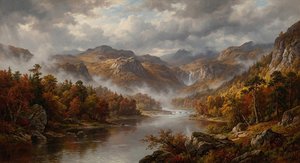
In the quietude of the mid-nineteenth century, a profound movement emerged in the American landscape, one that sought not just to document the wilderness, but to reveal its divine, underlying harmony. At the heart of this transcendental pursuit stood John Frederick Kensett, an artist whose brush possessed the rare ability to capture the very breath of nature. His 1852 masterpiece, Cascade in the Forest, serves as a breathtaking testament to this era. The painting invites the viewer into a secluded sanctuary where the rhythmic descent of water over ancient rocks creates a visual melody. It is a scene that transcends mere topography, offering instead a window into a world defined by stillness and light.
The composition is a masterclass in the Luminist style, a refined evolution of the Hudson River School. Kensett moves away from the dramatic, often turbulent vistas of his contemporaries to embrace a more subtle, atmospheric approach. In Cascade in the Forest, the technique is characterized by smooth, almost invisible brushwork that allows light to appear as if it is emanating from within the canvas itself. The water does not merely fall; it flows with a translucent grace, catching the soft, filtered light of the forest canopy. This meticulous attention to luminosity creates a sense of depth and clarity, making the lush greenery and the rugged textures of the stones feel tangibly present yet ethereally dreamlike.
Symbolism and the Soul of the Landscape
Beyond its technical brilliance, the artwork is rich with the symbolic language of the American Transcendentalist movement. The waterfall, a central motif, acts as a symbol of eternal renewal and the continuous flow of life. As the water cascades through the dense, verdant forest, it represents the untamed yet harmonious pulse of the natural world. A subtle, poignant detail—a single bird perched quietly upon a branch—introduces a moment of living consciousness into the landscape. This small inclusion serves to bridge the gap between the observer and the observed, reminding us that within this vast, tranquil ecosystem, every element is interconnected and vital.
For the discerning collector or interior designer, this piece offers more than just aesthetic beauty; it provides an emotional anchor. The painting’s ability to evoke a sense of profound peace makes it an ideal centerpiece for spaces designed for reflection and repose. Whether placed in a sun-drenched library or a sophisticated contemporary living room, Cascade in the Forest brings with it an aura of timelessness. It is a work that does not demand attention through noise, but rather commands it through a quiet, irresistible magnetism, making it a quintessential choice for those looking to infuse their surroundings with the restorative power of nature.
常见问题与解答
"Cascade in the Forest"创作于何时,属于哪种艺术流派?
"Cascade in the Forest"创作于1852年,属于Hudson River School运动。
约翰·弗雷德里克·肯塞特 是否还有其他别名或曾用名?
约翰·弗雷德里克·肯塞特 也被称为 约翰·肯塞特, J.F. 肯塞特, 约翰·弗雷德里克·肯塞特 (John Frederick Kensett), 肯塞特。
考虑到其色彩搭配,建议将 约翰·弗雷德里克·肯塞特 的《Cascade in the Forest》 悬挂在哪个房间?
考虑到其Earthy的色调,建议将“Cascade in the Forest”布置于Living Room中。
 实景预览
实景预览
 分享
分享 分享
分享
 详情
详情 指南
指南

 下载作品
下载作品
 相似作品
相似作品 X射线
X射线 幻灯片播放
幻灯片播放 Q&A
Q&A 统计数据
统计数据