

 效果预览
效果预览
 购买印刷品
购买印刷品 分享
分享 分享
分享
 详情
详情

 下载
下载
 相似作品
相似作品 X射线
X射线 幻灯片播放
幻灯片播放October Mist


 展开详情
展开详情




P118B $10

P118H $10

P118W $10

P438Z $10

P508JH $12

P508YH $12

P805H $10

P805Z $10

P919BZ $10

P919G $10

P919XJ $10

P959ZH $10

P968JZ $12

W106C $8

W218G $10

W218JH $8

W218Y $10

W307PJ $10

W316G $10

W316PJ $8

W316Y $10

W398PJ $8

W4111J $10

W500HY $15

W500JH $15

W692G $12

W849H $8

W940BG $15

W953PJ $8




从与原作比例一致的预设尺寸中进行选择。

您可以输入自定义尺寸,以适配特定的画框或空间。如果所选尺寸与原图比例不符,我们将通过裁剪作品或添加手绘元素来扩展画面。数字样稿将在制作开始前发送给您确认。
请注意,屏幕预览无法准确反映实际的裁剪或扩展效果,只有样稿才能真实呈现最终的构图。
虽然我们提供定制尺寸服务,但为了保留原作比例,建议您从预设列表中选择尺寸。
下单后,OriginalUniqueArt.com 团队将通过电子邮件联系客户获取具体要求,并提供效果预览图。


 玻璃选项仅适用于110厘米以下的尺寸。

October Mist
复制材质
复制品尺寸
-


最终总价
$ 300
作品详情
A Poetic Vision of Autumn: John Francis Murphy's "October Mist"
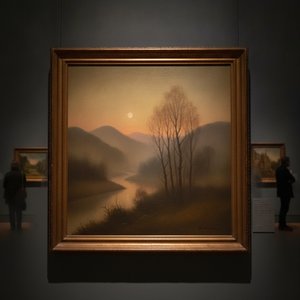
John Francis Murphy’s “October Mist,” painted in 1902, is a captivating example of American Tonalism. This evocative landscape transports the viewer to a serene rural scene, dominated by a solitary tree standing sentinel within a lush field veiled in atmospheric mist. The painting isn't merely a depiction of nature; it's an exploration of mood and feeling, capturing the quiet melancholy inherent in the transition from summer to winter. Murphy masterfully uses subtle color variations and soft edges to create a dreamlike quality, inviting contemplation and introspection.Tonalism and Artistic Influences
Murphy was a key figure within the Tonalist movement, which emerged in the late 19th century as a reaction against the more vibrant and detailed styles of earlier landscape painting. Tonalists sought to convey atmosphere and emotion through muted palettes, diffused light, and simplified forms. Like his contemporaries such as Wyant and Inness (whom he greatly admired), Murphy prioritized tonal harmony over precise representation. This approach is evident in "October Mist," where the focus isn't on meticulously rendering every leaf or blade of grass but rather on creating a unified visual experience that evokes a specific feeling – one of quiet solitude and autumnal introspection. The technique involves layering thin washes of paint to achieve subtle gradations of color, blurring outlines, and softening edges, all contributing to the painting’s ethereal quality.Symbolism and Interpretation
The bare tree at the center of "October Mist" is particularly striking. Its lack of foliage can be interpreted in several ways. It symbolizes the end of a cycle, representing the dormancy of nature as winter approaches. It could also represent resilience – standing strong despite the harshness of the season. The surrounding green field provides a poignant contrast to the tree's starkness, highlighting the beauty that persists even amidst decline. The pervasive mist further enhances the painting’s symbolic depth; it obscures details, suggesting the passage of time and the impermanence of things. The clouds in the sky add a sense of vastness and mystery, hinting at forces beyond human comprehension.Emotional Impact and Legacy
"October Mist" is more than just a landscape painting; it's an emotional experience. The subdued colors and atmospheric perspective create a feeling of tranquility and quiet contemplation. The scene invites the viewer to pause, reflect, and connect with nature on a deeper level. Murphy’s ability to evoke such profound emotion through subtle means is what makes his work so enduringly appealing. His paintings continue to resonate with audiences today, offering a timeless vision of rural America and a poignant meditation on the cycles of life and death. The painting's serene mood and masterful use of light make it an ideal addition to any space seeking a touch of quiet elegance and artistic depth.艺术家简介
A Poet of the American Landscape: The Life and Art of John Francis Murphy
John Francis Murphy, born in Oswego, New York, in 1853, emerged as a pivotal figure in American landscape painting during a period of profound artistic transition. His name is inextricably linked with Tonalism, yet to define his work solely by this movement would be to diminish the subtle evolution and quiet innovation that characterized his career. Murphy’s journey began not amidst palettes and easels, but as a sign painter in Chicago – a practical trade that ultimately proved unsatisfying for a spirit yearning for more expressive pursuits. This early experience, however, instilled a foundational understanding of form and color which would later inform his delicate compositions. Dissatisfied with commercial art, he bravely relocated to New York City in 1875, embarking on a path of largely self-directed artistic education. He immersed himself in the study of the masters, frequenting museums and honing his skills through dedicated practice.From Barbizon Influences to Tonalist Mastery
Murphy’s initial forays into landscape painting were deeply influenced by the Barbizon school – a group of French painters who championed realism and direct observation of nature. He quickly gained recognition, exhibiting at the National Academy of Design as early as 1876. However, it was through his engagement with artists like Alexander Wyant and George Inness that Murphy truly found his artistic voice. These figures emphasized tonal values – the subtle gradations of light and shadow – and atmospheric effects, principles which resonated profoundly with Murphy’s own sensibilities. He wasn't merely replicating what he saw; he sought to capture the *feeling* of a place, the mood evoked by the interplay of light, air, and form. Around 1900, his style began to shift, incorporating more modern approaches to depicting light and atmosphere while retaining the core tenets of Tonalism. This period witnessed a refinement of his technique, marked by increasingly sparse compositions and a masterful use of muted colors – browns, grays, and greens that lent his paintings an air of serene contemplation.The Pakatakan Artist Colony and Artistic Recognition
In 1887, Murphy established the Pakatakan Artist Colony in Arkville, New York, nestled within the picturesque Catskill Mountains. This haven became a gathering place for artists seeking inspiration from the natural beauty of the region and fostering a collaborative artistic environment. The colony’s influence on Murphy's work is undeniable; the landscapes he produced during his time there are imbued with a sense of quiet intimacy and profound connection to the land. His dedication and talent did not go unnoticed. He was elected an associate of the National Academy of Design in 1885, becoming a full academician just two years later. Further accolades followed, including membership in the Society of American Artists and the American Watercolor Society, as well as prestigious awards like a gold medal at Charleston (1902) and the Inness Medal in 1910. These honors cemented his position as a leading figure in the American art world.A Legacy of Atmospheric Depth and Poetic Sentiment
Murphy’s paintings are not grand statements or dramatic narratives; they are subtle meditations on the beauty and tranquility of the natural world. Works like October, held by the Corcoran Gallery of Art, and The Path to the Village and Indian Summer, both residing in the National Gallery of Art, exemplify his mastery of atmospheric perspective – creating a convincing illusion of depth and distance through subtle shifts in tone and color. His canvases often depict rural scenes – weathered barns, quiet fields, and winding paths – imbued with a sense of poetic sentiment. He wasn’t simply painting landscapes; he was evoking emotions, inviting viewers to share in his experience of the natural world. His ability to capture the essence of a place, rather than merely its appearance, is what sets him apart. His influence extended beyond his immediate circle, inspiring subsequent generations of artists to explore the expressive possibilities of Tonalism and atmospheric landscape painting. Though he passed away in New York City in 1921 from pneumonia, John Francis Murphy’s legacy endures through the enduring appeal of his paintings – a testament to the power of quiet observation, subtle technique, and profound artistic vision.
John Francis Murphy
1853 - 1921 , United States of America
艺术家简介
- Artistic Movement Or Style: Tonalism
- Artists Or Movements Influenced By This Artist: Later landscape painters
- Artists Who Influenced This Artist:
- Wyant
- Inness
- Date Of Birth: December 11, 1853
- Date Of Death: January 30, 1921
- Full Name: John Francis Murphy
- Nationality: American
- Notable Artworks:
- October
- The Path to the Village
- Indian Summer
- Golden Autumn
- The Old Barn
- Place Of Birth: Oswego, USA
相关文章

康斯塔布尔大师之作:25幅传世风景画赏析 | OriginalUniqueArt
探索康斯塔布尔的25幅传世杰作!沉浸于英国田园风光,感受浪漫主义绘画大师的光影与色彩。高清油画复制、艺术品购买尽在OriginalUniqueArt.com,为您的家居增添经典之美。立即在线探索完整系列!

弗朗西斯·培根:25幅震撼人心的杰作,重塑艺术与家居空间 | Francis Bacon's 25 Masterpieces
探索弗朗西斯·培根25幅震撼人心的杰作,深入了解这位现代艺术大师的创作故事与情感世界。从《三幅习作》到肖像画,感受抽象表现主义的魅力。OriginalUniqueArt.com提供高品质艺术品复制,为您的家居空间增添艺术气息!立即探索完整系列。

约翰·辛格·萨金特:25幅大师级杰作,点亮您的艺术生活 | OriginalUniqueArt
探索约翰·辛格·萨金特25幅传世杰作!深入了解这位美国印象派大师的肖像画技巧、金色时代风格与艺术故事。OriginalUniqueArt.com提供高品质油画复制品,点亮您的室内设计,打造奢华艺术空间。立即在线探索完整系列!
Tonalism Explained: The Art of Mood, Mist, and Masterful Color in Landscape Painting
Discover the evocative world of Tonalism. Explore how masters like Whistler and Tryon used mist, shadow, and subtle color to capture profound mood and atmosphere in landscape art. An expert guide for fine art enthusiasts and collectors.

浪漫主义画派的十部巨作:定义风景画的艺术传奇
探索浪漫主义风景画的巅峰!本文精选十部经典名作,带您领略莫奈、库尔贝等大师的艺术魅力。感受色彩与光影的诗意,重温自然风光的震撼。OriginalUniqueArt.com为您提供博物馆级别的艺术复制品和个性化家居装饰方案。尽在OriginalUniqueArt.com!

