

 效果预览
效果预览
 购买手绘画作
 分享
分享 分享
分享
 详情
详情

 下载
下载
 相似作品
相似作品 X射线
X射线 幻灯片播放
幻灯片播放Fruit

 展开详情
展开详情




































从与原作比例一致的预设尺寸中进行选择。

您可以输入自定义尺寸,以适配特定的画框或空间。如果您选择的尺寸与原图比例不符,我们将对作品进行裁剪,或通过镜像填充/纯色填充边缘的方式来扩展图像。在开始制作之前,我们会向您发送一份数字效果图供您确认。
请注意,屏幕上的预览并不能反映实际的裁剪或扩展效果。只有效果图才能准确展示最终的构图。
虽然我们提供定制尺寸,但为了保持原图比例,我们建议您从预设列表中选择尺寸。


 玻璃选项仅适用于110厘米以下的尺寸。

Fruit
艺术微喷/版画
复制品尺寸
-


最终总价
$ 80
艺术家简介
Johann Wilhelm Preyer: Life and Legacy
Early Life and Education
- Born in Düsseldorf, Germany, in 1803, Johann Wilhelm Preyer emerged from a family with artistic inclinations. His father was a merchant, and his brother, Gustav, also pursued a career as a painter.
- Growing up in the old town of Eschweiler, Preyer displayed an early aptitude for art. A playful anecdote recounts how he and his brother, both small in stature, would occasionally disguise themselves as children to play pranks.
- Formal training began at the Düsseldorf Art Academy in 1822, where he studied under Peter von Cornelius. He later became a master student of Wilhelm von Schadow, solidifying his foundation in classical artistic principles.
Artistic Development and Influences
- Preyer’s education extended beyond Düsseldorf; he embarked on extensive travels throughout Europe between 1835 and 1843. These journeys took him to the Netherlands, Munich, Northern Italy, and Switzerland, exposing him to diverse artistic styles and traditions.
- Influences from Dutch still life masters are evident in his meticulous attention to detail and realistic depiction of textures. The Düsseldorf School’s emphasis on precise observation also shaped his approach.
- Upon returning to Düsseldorf in 1844, Preyer dedicated himself primarily to still life painting, establishing a reputation for exceptional skill within the genre.
Major Works and Artistic Style
- Specialization: Preyer became renowned for his exquisitely detailed paintings of flowers and fruit. His works are characterized by their vibrant colors, realistic textures, and careful compositions.
- Notable examples include “Fruit and a Goblet,” “Fruit Still Life with Sculpted Ceramic Bowl,” and numerous depictions of grapes and floral arrangements.
- His style is often associated with the Biedermeier period, reflecting a focus on domesticity, simplicity, and meticulous craftsmanship.
Achievements and Recognition
- Preyer quickly gained recognition as one of the leading still life painters of his time. His works were highly sought after by collectors, with a significant portion eventually finding their way into American collections.
- Founding Member: He was among the founding members of the Association of Düsseldorf Artists in 1844, demonstrating his commitment to fostering artistic community and collaboration.
- Preyer also took on private students, including Helen Searle, an American still life painter who further disseminated his techniques and influence.
Personal Life and Legacy
- Around 1844, Preyer married Emilie Lachenwitz, the sister of painter Siegmund Lachenwitz. They had two children, Emilie and Paul, both of whom also became painters, continuing the family’s artistic legacy.
- Historical Significance: Johann Wilhelm Preyer is considered one of the earliest masters of the Düsseldorf School of Painting and a pivotal figure in 19th-century German still life art.
- In recognition of his contributions, a road in Eschweiler, where he grew up, was renamed Preyerstrasse in 1974.
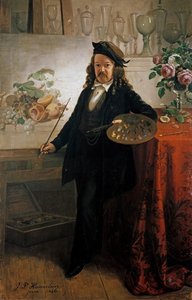
Johann Wilhelm Preyer
1803 - 1889 , Germany
艺术家简介
- Birth Date: 1803
- Birth Place: Düsseldorf, Germany
- Death Date: 1889
- Influenced By:
- Peter von Cornelius
- Wilhelm von Schadow
- Movement: Düsseldorf School of Painting
- Name: Johann Wilhelm Preyer
- Nationality: German
- Notable Works:
- Fruit and a Goblet
- Fruit Still life
- Flowers in a Jug

