
 效果预览
效果预览
 切换至手工绘画版
 分享
分享 分享
分享
 详情
详情

 下载
下载
 相似作品
相似作品 X射线
X射线 幻灯片播放
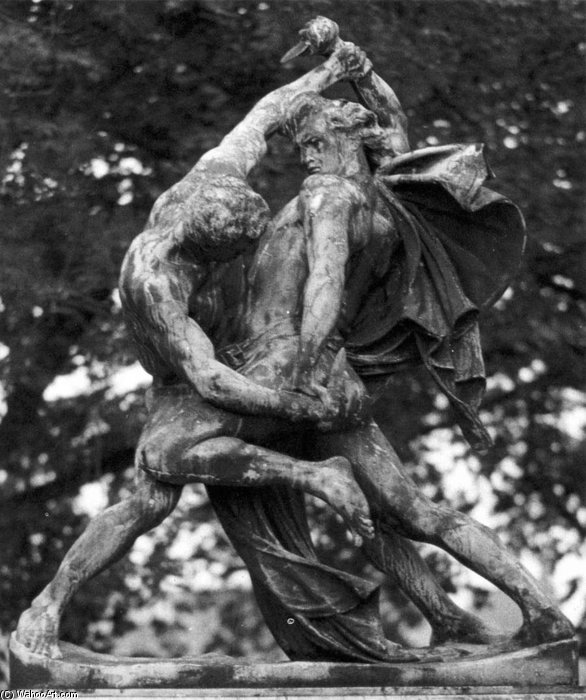
幻灯片播放Knife Fight
 展开详情
展开详情




































从与原作比例一致的预设尺寸中进行选择。

您可以输入自定义尺寸,以适配特定的画框或空间。如果您选择的尺寸与原图比例不符,我们将对作品进行裁剪,或通过镜像填充/纯色填充边缘的方式来扩展图像。在开始制作之前,我们会向您发送一份数字效果图供您确认。
请注意,屏幕上的预览并不能反映实际的裁剪或扩展效果。只有效果图才能准确展示最终的构图。
虽然我们提供定制尺寸,但为了保持原图比例,我们建议您从预设列表中选择尺寸。


 玻璃选项仅适用于110厘米以下的尺寸。

Knife Fight
艺术微喷/版画
复制品尺寸
-


最终总价
$ 80
艺术家简介
A Sculptor of Viking Spirit and Parisian Elegance
Born into the humble warmth of a baker’s family in Gothenburg in 1814, Johann Peter Molin possessed an innate talent that would eventually transcend the flour-dusted streets of his youth to define the monumental landscape of 19th-century Sweden. His journey from the Swedish coast to the artistic epicenters of Europe is a testament to a profound creative drive. In 1843, driven by a burgeoning passion for form and figure, Molin traveled to Copenhagen to study under the esteemed Herman Wilhelm Bissen. This period was foundational, as Bissen’s mastery of national identity and classical narrative provided Molin with the technical vocabulary necessary to translate historical myth into tangible bronze and marble. However, it was his subsequent immersion in the vibrant, pulsating atmosphere of Paris that truly refined his vision, allowing him to absorb the burgeoning naturalism and emotional depth that would later breathe life into his most iconic works.
Molin’s artistic evolution was a delicate dance between the rigorous discipline of classical training and the evocative power of Romanticism. While his roots remained firmly planted in the academic traditions of Copenhagen, his years in Paris exposed him to a world where movement, psychology, and atmosphere were beginning to take precedence over static perfection. This duality created a unique sculptural language—one that could capture the muscular tension of a combatant or the ethereal grace of a mythological figure with equal precision. His work often sought to bridge the gap between the ancient Norse legends and the sophisticated aesthetic of the modern era, creating a dialogue between the rugged spirit of the Viking past and the refined elegance of 19th-century European art.
Masterpieces of Myth and Monarchy
The legacy of Molin is most vibrantly felt in the public squares of Stockholm, where his sculptures serve as silent narrators of Swedish history and folklore. Perhaps his most enduring contribution to the visual identity of his nation is The Knife Wrestlers (Bältespännarna), completed in 1859. This dramatic depiction of Nordic combat, characterized by its intense physical struggle and raw energy, remains a masterpiece of genre sculpture. It captures a moment of visceral tension that resonates with the Romantic fascination for primal human conflict. Similarly, his equestrian statue of King Karl XII, unveiled in 1868 in Kungsträdgården, stands as a powerful symbol of national pride, portraying the monarch in a dynamic battle pose that commands the viewer's attention through its sheer sculptural force.
Beyond the martial and the heroic, Molin demonstrated a remarkable ability to weave elements of folklore into the very fabric of urban design. The Molin Fountain, located in the same Kungsträdgården, serves as a lyrical counterpart to his more aggressive works. Featuring allegorical figures and nods to Swedish legends—such as the elusive Näcken—the fountain celebrates the arts and sciences through a lens of enchantment. His ability to move between the monumental scale of royal monuments and the intimate, storytelling nature of decorative fountains showcases an artist of immense versatility.
A Legacy Carved in Bronze
Molin’s career was marked by significant professional triumphs that solidified his status within the European artistic hierarchy. His appointment as a professor at the Royal Swedish Academy of Fine Arts in 1855 allowed him to shape the next generation of sculptors, ensuring that his technical precision and narrative sensibility would endure. His international acclaim was further cemented by prestigious decorations, including:
- The Order of Vasa
- The Order of the Polar Star
- The Order of St. Olav
- The Prussian Pour le Mérite
Though he passed away in 1873 near Vaxholm, Molin’s influence remains etched into the stone and bronze of the cities he helped beautify. He was more than a mere craftsman; he was a storyteller who used the permanence of sculpture to immortalize the legends, heroes, and cultural identity of his homeland. Through his hands, the rugged myths of the North were transformed into an enduring classical elegance that continues to inspire awe in all who encounter them.

johann peter molin
1814 - 1873 , Sweden
艺术家简介
- Artistic Movement Or Style: Genre painting, Landscape paintings
- Artists Or Movements Influenced By This Artist: ['']
- Artists Who Influenced This Artist: ['']
- Date Of Birth: 1814
- Full Name: Johann Peter Molin
- Nationality: Swedish
- Notable Artworks:
- Fountain
- Knife Fight
- Place Of Death: Ekudden near Vaxholm

