切换至版画销售渠道
 展开全文
展开全文







































 对于任何边长超过 105 厘米(约 41 英寸)的艺术品或复制品,画框将以拆解后的组件形式发货。此方法可确保安全送达并防止运输过程中的损坏。


A Surrealist Echo: Exploring Joan Miró’s ‘Hermitage’
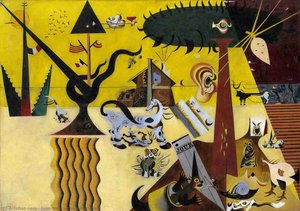
Joan Miró's “Hermitage,” completed in 1924, stands as a cornerstone of Surrealist art—a testament to the artist’s unwavering commitment to unlocking the subconscious and translating dreams into visual form. Painted in oil on canvas, this piece transcends mere representation, inviting viewers into a realm where geometric shapes dance alongside organic forms, creating an atmosphere of profound mystery and imaginative delight.
- Composition & Elements: The painting’s dominant hue is yellow—a color Miró frequently employed to convey warmth and luminosity. Scattered across this canvas are numerous circles, meticulously crafted with a delicate touch, alongside constellations of stars in varying sizes and positions. Two striking red dots punctuate the composition on the right side, injecting bursts of vibrant color that draw the eye.
- Artistic Style: Miró’s Surrealist approach is immediately apparent. He abandons traditional perspective and realism, opting instead for a deliberately fragmented style reminiscent of primitive art—a conscious rejection of academic conventions in favor of unfiltered emotion and intuition. The bold use of color and geometric abstraction reflects his fascination with the primal forces of nature and his desire to liberate painting from constraints.
- Historical Context: Miró’s creation coincided with the burgeoning Surrealist movement, spearheaded by André Breton and fueled by psychoanalytic theories pioneered by Sigmund Freud. Artists like Picasso and Braque were actively experimenting with Cubism and collage—a collective effort to redefine artistic expression in response to the anxieties of the interwar period.
- Symbolic Resonance: The imagery within “Hermitage” is laden with symbolic significance. Circles represent wholeness and unity, mirroring Miró’s belief in the interconnectedness of all things. Stars symbolize aspiration and transcendence—a visual metaphor for reaching beyond earthly limitations. The red dots evoke passion and vitality, injecting energy into the tranquil expanse of yellow.
- Legacy & Influence: Miró's pioneering spirit continues to inspire artists today. His work resides in prestigious institutions worldwide, including The Museum Palau de la Llotja (Barcelona, Spain), where it serves as a beacon of Catalan artistic heritage. Furthermore, “Hermitage” exemplifies the broader trajectory of 20th-century Western painting—a period marked by radical innovation and an unwavering pursuit of aesthetic truth.
For those seeking to immerse themselves in Miró’s oeuvre, “Joan Miró: Tirador in the Arc,” available on OriginalUniqueArt.com, offers another captivating glimpse into his artistic vision—a masterful depiction of Catalan identity imbued with Surrealist sensibilities.
To delve deeper into the history of painting and its transformative movements, explore History of Painting and Western Painting on Wikipedia—resources that illuminate the intellectual currents shaping artistic creativity throughout time.
常见问题与解答
针对 米罗 的《Joan Miró- Hermitage》 的版画,推荐的尺寸和方向是什么?
建议打印尺寸为 Large,构图采用 Landscape:这是为 米罗 的《Joan Miró- Hermitage》 推荐的打印设置。
米罗 的《Joan Miró- Hermitage》 在艺术史上的地位如何?
从历史上看,"Joan Miró- Hermitage" 是广义上 Modern 时期的 Surrealism 时期作品。
"Joan Miró- Hermitage" 属于 米罗 艺术生涯中的哪个时期?
“Joan Miró- Hermitage”创作于米罗艺术生涯的Mature Period时期。这一时期标志着该作品与艺术家艺术风格演进的紧密关联。
 实景预览
实景预览
 分享
分享 分享
分享
 详情
详情 指南
指南

 下载作品
下载作品
 相似作品
相似作品 X射线
X射线 幻灯片播放
幻灯片播放 问答
问答 统计数据
统计数据