
 实景预览
实景预览
 分享
分享 分享
分享
 详情
详情 指南
指南

 下载作品
下载作品
 相似作品
相似作品 X射线
X射线 幻灯片播放
幻灯片播放 问答
问答 统计数据
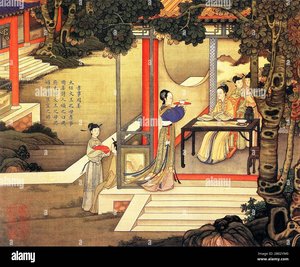
统计数据Lidai tuibei quantu


 展开全文
展开全文
艺术微喷/版画
博物馆级艺术微喷或帆布版画,制作高效,并提供多种饰面选择。 ( 订购纯手工绘制画作 切换至数字图像销售渠道)




































您可以从与原作比例一致的预设尺寸中进行选择。

请输入您所需的宽度和高度,以适配您的画框或墙面。由于印刷品只能进行裁剪,无法超出原图尺寸,因此若比例不一致,画面的一部分将会被裁切。在正式印刷之前,我们会为您发送一份数字效果图供您确认。本页面显示的图片并非最终裁剪后的效果——只有效果图才能展示真实的裁剪情况。


 玻璃选项仅适用于110厘米以下的尺寸。

Lidai tuibei quantu
艺术微喷/版画
复刻品尺寸
-


最终结算价
¥ 544
艺术家简介
A Visionary of the Qing Dynasty: The Life and Legacy of Jiao Bingzhen
In the vibrant tapestry of the early Qing dynasty, few threads shimmered with as much innovative brilliance as that of Jiao Bingzhen. Born in 1689 in Jinan, Shandong, Jiao emerged from a scholarly lineage to become a painter who did not merely observe his world but fundamentally reimagined how it could be captured on silk and paper. His life, though relatively brief, spanned a transformative era in Chinese history—a period marked by the profound intellectual exchange between the Middle Kingdom and the West. Jiao was far more than a traditionalist; he was a daring pioneer who stood at the crossroads of two great artistic worlds, weaving together the delicate elegance of Chinese brushwork with the structural rigor of European realism.
The atmosphere of Jiao’s era was thick with the scent of change, driven largely by the presence of Jesuit missionaries within the imperial court. These travelers brought with them not only scientific advancements but also a revolutionary way of seeing: the concept of linear perspective. For a painter trained in the traditional Chinese style—which often favored a multi-point, atmospheric approach to depth—the introduction of a single vanishing point offered a startling new dimension. Jiao Bingzhen embraced this challenge with unparalleled curiosity. He studied the mechanics of light and shadow and the mathematical precision of Western composition, yet he never abandoned the soulful, rhythmic essence of his heritage. This synthesis allowed him to create works that felt both grounded in physical reality and elevated by poetic symbolism.
The Master of Perspective and the Gengzhitu Series
Jiao’s most enduring contribution to the art world lies in his ability to document the very heartbeat of Chinese civilization through a lens of unprecedented detail. His most celebrated achievement, the Gengzhitu, or "Rice and Silk Culture," stands as a monumental testament to his skill and his role as a chronicler of prosperity. Commissioned by the Kangxi Emperor, this ambitious series consisted of forty-six intricate scenes depicting the essential labors of the empire: the rhythmic tilling of the earth and the delicate, painstaking process of silk weaving. Through these paintings, Jiao did not just illustrate agricultural cycles; he celebrated an idealized vision of a peaceful, industrious society.
In these works, one can witness the breathtaking marriage of styles. While the subjects—the farmers, the looms, and the lush landscapes—are deeply rooted in Chinese tradition, the execution utilizes Western-inspired depth to pull the viewer into the scene. The architectural structures possess a weight and three-dimensionality that were revolutionary for the time, creating an immersive experience that felt almost cinematic. This mastery of detail extended to his portraits and miniatures, where he captured the intricate textures of silk, the subtle glow of skin, and the complex layers of courtyard life with a precision that earned him immense prestige within the imperial circles.
Historical Significance and Artistic Resonance
The historical importance of Jiao Bingzhen transcends the mere aesthetic beauty of his canvases. He served as a vital bridge during a period of intense cultural contact, proving that the boundaries between East and West could be blurred to create something entirely new and transcendent. His work influenced the trajectory of court painting, paving the way for subsequent artists to experiment with hybrid styles. By integrating European scientific observation with Chinese lyrical expression, he helped redefine the visual language of the Qing dynasty.
Today, Jiao’s legacy continues to resonate within the halls of great museums, from the Victoria and Albert Museum to the Art Institute of Chicago. His paintings remain much more than historical documents; they are emotional journeys into a lost era of splendor. When we look upon his depictions of family unity or the industrious spirit of the peasantry, we see a master who understood that true innovation does not require the abandonment of one's roots, but rather the courage to expand them. Jiao Bingzhen remains an eternal symbol of how art can harmonize disparate worlds, creating a vision of beauty that is both profoundly local and universally captivating.
Jiao Bingzhen
1689 - 1726 , China
艺术家简介
- Full Name: jiao bingzhen
- Nationality: Chinese
- Date Of Birth: 1689
- Date Of Death: 1726
- Place Of Birth: Jinan, China
- Notable Artworks:
- Desk Album: Flower and Bird Paintings (Gossiping Sparrows)
- Ten Magnificent Landscapes - View 1
- Artistic Movement Or Style: Qing Dynasty Painting; Western Perspective Blend
- Artists Who Influenced This Artist: ['Traditional Chinese Painting Techniques']
- Artists Or Movements Influenced By This Artist:
- Zhao Ruo'ai
- Ren Xiong