切换至版画销售渠道
 展开全文
展开全文







































 对于任何边长超过 105 厘米(约 41 英寸)的艺术品或复制品,画框将以拆解后的组件形式发货。此方法可确保安全送达并防止运输过程中的损坏。


A Renaissance Reverie: The Soul of Pontormo’s St. Anthony Abbot
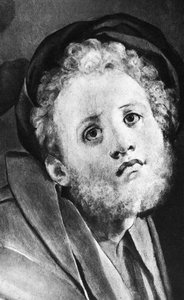
In the quietude of a Florentine studio around 1519, Jacopo Carucci—the master known to history as Pontormo—captured a moment of profound spiritual stillness that continues to resonate centuries later. His depiction of St. Anthony Abbot is far more than a mere portrait of a desert saint; it is a window into the burgeoning Mannerist movement, where the serene balance of the High Renaissance began to yield to a more complex, psychological intensity. As one gazes upon this work, there is an immediate sense of encountering a soul in contemplation, a figure emerging from a muted, greenish-yellow void to offer a glimpse of divine light.
The painting serves as a masterful bridge between eras. While the anatomical precision and sculptural presence of the subject echo the monumental influence of Michelangelo, Pontormo introduces an emotional depth that anticipates the dramatic tension of the Baroque. The saint is rendered with a striking realism; his weathered face, the texture of his long, flowing beard, and the heavy drape of his dark, ascetic robes all speak to a life of rigorous devotion and solitude. This meticulous attention to detail does not merely serve to document the physical form but to ground the spiritual subject in a palpable, human reality.
The Language of Light and Symbolism
Technique and symbolism are inextricably linked in this evocative composition. Pontormo employs chiaroscuro with surgical precision, utilizing a light source that strikes the figure from the left to carve his features out of the shadows. This play of light and dark does more than create a three-dimensional illusion; it acts as a metaphor for the saint's spiritual journey through the darkness of temptation toward the clarity of faith. The subtle use of shadow on the right side of the face adds a layer of mystery, suggesting the internal struggles inherent in the monastic life.
Central to the painting’s narrative is the scroll held firmly in St. Anthony's hand. Upon it, the Latin inscription "EGO SUM LUX MUNDI"—I am the light of the world—serves as a powerful theological anchor. Though these words are attributed to Christ, their presence in the hands of the Abbot connects the saint to the divine essence, reinforcing his role as a beacon of spiritual truth. The muted, atmospheric background, devoid of distracting landscapes, ensures that the viewer’s focus remains locked onto this sacred message and the luminous countenance of the saint himself.
An Enduring Legacy for the Discerning Collector
For the art lover or the interior designer, a reproduction of Pontormo’s St. Anthony Abbot offers much more than aesthetic beauty; it provides an atmosphere of contemplative gravity. The painting's sophisticated palette—dominated by earthy tones, deep shadows, and that singular, haunting greenish-yellow hue—makes it a versatile centerpiece for spaces that value historical depth and intellectual character. It is a piece that invites long periods of study, rewarding the observer with new layers of emotional complexity upon every viewing.
Whether placed in a private library, a formal study, or a curated gallery setting, this work brings with it the weight of Florentine history and the melancholic beauty of the Mannerist vision. To possess such a piece is to invite the spirit of Pontormo into one's environment—a master who dared to look inward and capture the turbulent, beautiful complexity of the human soul through the medium of oil and light.
常见问题与解答
雅科波·蓬托尔莫 (Yǎkèbó Péngtuǒ'Ěrmò) 的《St. Anthony Abbot》 的对比度有多强?
"St. Anthony Abbot" 的明暗对比度记录为 Balanced。对比度描述了亮部与暗部之间的差异强度。
如何描述 雅科波·蓬托尔莫 (Yǎkèbó Péngtuǒ'Ěrmò) 的《St. Anthony Abbot》 的意境?
雅科波·蓬托尔莫 (Yǎkèbó Péngtuǒ'Ěrmò) 的《St. Anthony Abbot》 的整体基调为 Elegant,这种基调传达了作品的整体氛围。
“St. Anthony Abbot”整体色调是偏明亮还是偏暗?
“St. Anthony Abbot”的整体亮度为deep_shadow,其亮度值为Dark。
 实景预览
实景预览
 分享
分享 分享
分享
 详情
详情 指南
指南

 下载作品
下载作品
 相似作品
相似作品 X射线
X射线 幻灯片播放
幻灯片播放 问答
问答 统计数据
统计数据