切换至版画销售渠道
 展开全文
展开全文







































 对于任何边长超过 105 厘米(约 41 英寸)的艺术品或复制品,画框将以拆解后的组件形式发货。此方法可确保安全送达并防止运输过程中的损坏。


A Tempestuous Vision: J.M.W. Turner’s “The Shipwreck”
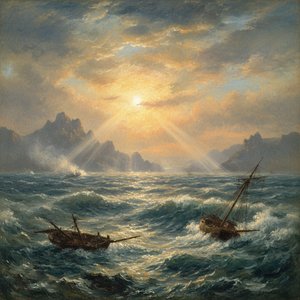
J.M.W. Turner's "The Shipwreck," painted in 1805, isn’t merely a depiction of maritime disaster; it’s a visceral embodiment of Romanticism’s fascination with the sublime—the awe-inspiring and potentially terrifying power of nature. This dramatic seascape captures a moment of profound chaos and vulnerability, drawing the viewer into a swirling vortex of turbulent waves, bruised skies, and desperate figures clinging to fragments of shattered vessels. Turner, a lifelong devotee of the sea, wasn't interested in literal accuracy; instead, he sought to convey an emotional response—the primal fear and humbling respect evoked by confronting forces far greater than ourselves.
The painting’s genesis is often linked to the tragic sinking of the Earl of Abergavenny off the coast of Weymouth. While speculation persists about a direct connection, Turner's genius lies in transforming this specific event into a universal allegory for human fragility against the relentless power of the elements. The composition immediately commands attention with its dynamic arrangement: a chaotic cluster of boats—some capsized, others desperately battling the waves—forms the central focus, while a vast, ominous sky dominates the upper half of the canvas. The horizon line is deliberately obscured by swirling clouds and mist, creating an unsettling sense of disorientation and emphasizing the immense scale of the ocean.
Masterful Technique: Light, Color, and Texture
Turner’s signature technique—a masterful manipulation of light and color—is on full display in “The Shipwreck.” He employs loose, expressive brushstrokes to capture the movement of water with breathtaking dynamism. Thick impasto is strategically applied to represent the crests of the waves, lending them a tangible physicality that seems to surge towards the viewer. The palette is predominantly dark and muted – shades of grey, brown, and black—creating a mood of foreboding and despair. However, flashes of yellow and orange punctuate the gloom, particularly within the churning waves and the clothing of the figures, offering brief moments of intense visual drama and hinting at the destructive potential of the storm.
Crucially, Turner wasn’t simply replicating what he saw; he was translating his *experience* of the sea onto canvas. He utilized a technique known as ‘atmospheric perspective,’ subtly lightening and desaturating distant elements to create an illusion of depth and distance. This layering of color and texture contributes significantly to the painting's overall sense of vastness and instability, mirroring the psychological impact of confronting such overwhelming forces.
Symbolism and Emotional Resonance
Beyond its technical brilliance, “The Shipwreck” is rich in symbolic meaning. The scattered ships represent not just a specific maritime disaster but also the precariousness of human existence. The struggling figures embody our vulnerability in the face of nature’s indifference—a poignant reminder of mortality and the limits of control. The tempestuous sea itself functions as a metaphor for the unpredictable forces that shape our lives, capable of both destruction and renewal.
Furthermore, the painting taps into the Romantic concept of the ‘sublime,’ a feeling of awe mixed with terror experienced when confronted with something overwhelmingly powerful. Turner’s depiction isn't intended to offer comfort or reassurance; rather, it compels us to confront our own insignificance within the grand scheme of nature and to appreciate its untamed beauty—and inherent danger.
A Legacy of Atmospheric Impressionism
“The Shipwreck” stands as a pivotal work in Turner’s oeuvre and a cornerstone of Romantic art. Its innovative use of light, color, and brushwork profoundly influenced subsequent generations of artists, particularly those associated with Impressionism. Turner's willingness to prioritize emotional expression over precise representation paved the way for a more subjective and evocative approach to landscape painting. Reproductions of this powerful image continue to resonate today, offering a timeless meditation on humanity’s relationship with the natural world—a reminder that even in the face of overwhelming adversity, there is an undeniable beauty to be found.
常见问题与解答
"The Shipwreck" 创作于哪个时代?
J.M.W. 透纳 的《The Shipwreck》 创作于 19th Century 时期,这一时期为作品提供了深厚的历史背景。
J.M.W. 透纳 的《The Shipwreck》中的主导色调是什么?
“The Shipwreck”呈现出Green to Violet Spectrum色调。
"The Shipwreck" 是否属于公有领域作品?
J.M.W. 透纳 的《The Shipwreck》 属于 属于公有领域 —— 其版权已过期。此版权状态决定了该作品图像的复制方式。
 实景预览
实景预览
 分享
分享 分享
分享
 详情
详情 指南
指南

 下载作品
下载作品
 相似作品
相似作品 X射线
X射线 幻灯片播放
幻灯片播放 问答
问答 统计数据
统计数据