

 效果预览
效果预览
 购买手绘画作
 分享
分享 分享
分享
 详情
详情

 下载
下载
 相似作品
相似作品 X射线
X射线 幻灯片播放
幻灯片播放St. Augustine
 43.0 x 27.0 cm
 展开详情
展开详情




































从与原作比例一致的预设尺寸中进行选择。

您可以输入自定义尺寸,以适配特定的画框或空间。如果您选择的尺寸与原图比例不符,我们将对作品进行裁剪,或通过镜像填充/纯色填充边缘的方式来扩展图像。在开始制作之前,我们会向您发送一份数字效果图供您确认。
请注意,屏幕上的预览并不能反映实际的裁剪或扩展效果。只有效果图才能准确展示最终的构图。
虽然我们提供定制尺寸,但为了保持原图比例,我们建议您从预设列表中选择尺寸。


 玻璃选项仅适用于110厘米以下的尺寸。

St. Augustine
艺术微喷/版画
复制品尺寸
-


最终总价
$ 80
艺术家简介
Howard Russell Butler: Life and Legacy
Early Life and Education
- Born: March 3, 1856, in New York City.
- Family Background: Butler was the son of William Allen Butler, a renowned lawyer and satirist, and Harriet Allen. His uncle, William Stanley Haseltine, was also an artist.
- Early Training: He received initial artistic training from William Shannon and benefited from exposure to the National Academy of Design, where his parents were fellows, as well as his uncle’s studio.
- Academic Pursuits: Butler attended Princeton University, earning a degree in Science in 1876. He briefly served as an assistant professor of physics there before pursuing legal studies at Columbia University, graduating in 1881.
From Law to Art: A Career Transition
- Early Career: Initially practicing patent law, Butler ultimately decided to dedicate himself entirely to painting in 1884.
- Further Studies: He studied under Frederic Edwin Church in Mexico and later with J. Carroll Beckwith and George de Forest Brush at the Art Students League in New York.
- European Influence: From 1885 to 1887, Butler lived in France, specifically Paris and Concarneau, immersing himself in the American artistic colony there.
Artistic Development and Style
- Diverse Subjects: Butler’s work encompassed seascapes, landscapes, portraits, and notably, depictions of solar eclipses.
- Influences: His style reflects influences from Realism and Impressionism, blending detailed observation with atmospheric effects.
- Unique Focus on Eclipses: He developed a unique approach to capturing the transient colors and phenomena of solar eclipses, utilizing his scientific background.
Major Achievements and Contributions
- American Fine Arts Society: Butler founded the American Fine Arts Society in 1889 and led it for its first seventeen years, promoting American art.
- Carnegie Lake: He persuaded Andrew Carnegie to fund the construction of Carnegie Lake near Princeton University, a significant contribution to the university’s rowing program.
- Architectural Projects: Butler designed Carnegie's mansion on Fifth Avenue (now the Cooper-Hewitt Museum) and an astronomy hall for the American Museum of Natural History.
- Solar Eclipse Paintings: His paintings documenting solar eclipses were displayed at the Hayden Planetarium for many years, showcasing his unique artistic and scientific perspective.
Historical Significance and Legacy
- Bridging Art and Science: Butler’s life exemplifies a rare combination of artistic talent and scientific understanding.
- Patronage and Philanthropy: His relationship with Andrew Carnegie highlights the role of patronage in supporting the arts during the Gilded Age.
- Lasting Impact: Butler’s work continues to be exhibited in prominent museums, including the Metropolitan Museum of Art and the National Museum of American Art, preserving his legacy as a notable American artist.
- Death: Howard Russell Butler passed away on May 20, 1934, near Carnegie Lake, leaving behind a diverse body of work that reflects his multifaceted talents and interests.
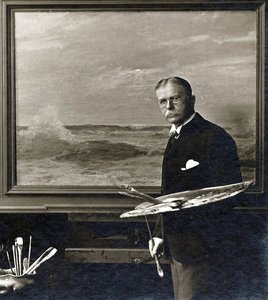
howard russell butler
1856 - 1934
艺术家简介
- Birth Date: March 3, 1856
- Birth Place: New York City
- Death Date: May 20, 1934
- Influenced By:
- William Shannon
- Frederic Edwin Church
- J. Carroll Beckwith
- George de Forest Brush
- Movement:
- Realism
- Impressionism
- Name: Howard Russell Butler
- Nationality: American
- Notable Works:
- Paintings of solar eclipses
- Seascapes
- Landscapes
- Carnegie Lake design
- Carnegie Mansion design

