
 效果预览
效果预览
 购买手绘画作
 分享
分享 分享
分享
 详情
详情

 下载
下载
 相似作品
相似作品 X射线
X射线 幻灯片播放
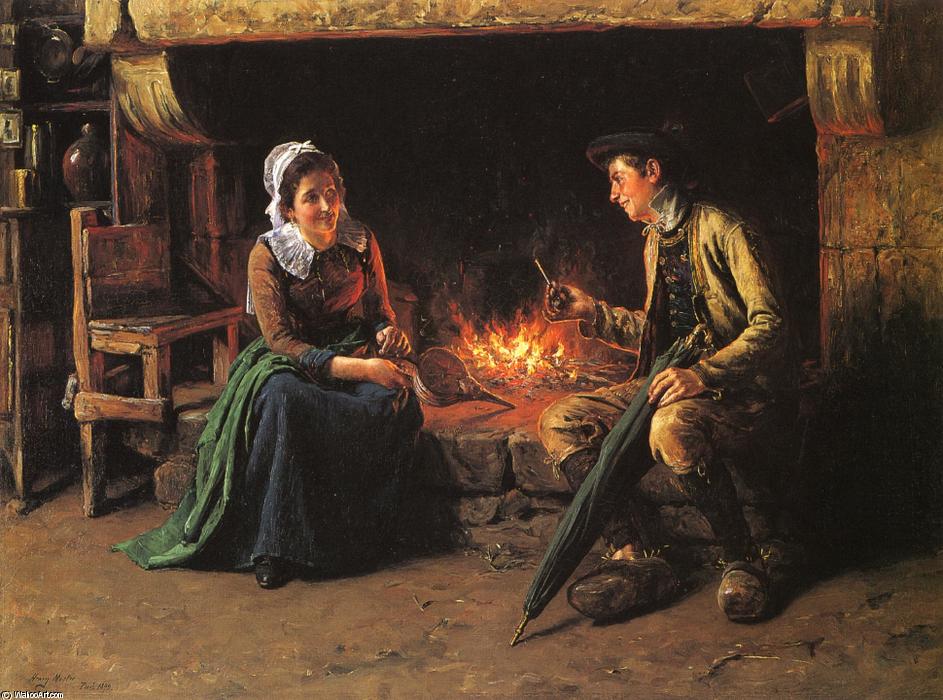
幻灯片播放The Chimney Corner

 展开详情
展开详情




































从与原作比例一致的预设尺寸中进行选择。

您可以输入自定义尺寸,以适配特定的画框或空间。如果您选择的尺寸与原图比例不符,我们将对作品进行裁剪,或通过镜像填充/纯色填充边缘的方式来扩展图像。在开始制作之前,我们会向您发送一份数字效果图供您确认。
请注意,屏幕上的预览并不能反映实际的裁剪或扩展效果。只有效果图才能准确展示最终的构图。
虽然我们提供定制尺寸,但为了保持原图比例,我们建议您从预设列表中选择尺寸。


 玻璃选项仅适用于110厘米以下的尺寸。

The Chimney Corner
艺术微喷/版画
复制品尺寸
-


最终总价
$ 80
艺术家简介
Early Life and Artistic Foundations
Henry Mosler, born in Tropplowitz, Silesia (present-day Poland) in 1841, embarked on a journey that would establish him as a significant figure in American art. His family’s emigration to the United States in 1849, settling first in New York and then Cincinnati, Ohio, proved pivotal. This move placed young Henry within a thriving German-Jewish community known for its commitment to education and cultural pursuits—a nurturing environment that undoubtedly fostered his early artistic inclinations. While his father pursued work as a cigar maker and tobacconist, Henry received an apprenticeship with a wood engraver, Horace C. Grosvenor, simultaneously learning the fundamentals of painting from an amateur landscape artist named George Kerr. These formative experiences laid the groundwork for a career deeply rooted in observation, technical skill, and a burgeoning passion for visual storytelling. Even as a young man, Mosler demonstrated a natural talent, sketching portraits of family members and local scenes that hinted at the detailed realism he would later become renowned for.From Civil War Correspondent to European Refinement
The outbreak of the American Civil War dramatically altered the course of Mosler’s artistic development. Serving as an art correspondent for Harper's Weekly from 1862 to 1863, he documented the conflict with a keen eye and unwavering commitment to visual accuracy. This experience wasn’t merely reportage; it was an immersive education in human drama, suffering, and resilience—themes that would subtly permeate his later work. He served as an aide-de-camp with the Army of the Ohio, creating 34 drawings for Harper's Weekly, including depictions of key campaigns in Kentucky and Ohio, alongside portraits of Union generals. Following the war, Mosler sought formal training abroad, a common pursuit for ambitious American artists of the time. He studied in Düsseldorf under Heinrich Mücke and Albert Kindler, then spent six months with Ernest Hébert in Paris. This European sojourn was transformative, exposing him to classical techniques and the prevailing artistic currents of the day. It instilled within him a dedication to craftsmanship and a refined aesthetic sensibility that would define his mature style.A Transatlantic Career and the Pursuit of Realism
Mosler’s career unfolded across continents, reflecting a deliberate pursuit of artistic excellence. He returned to Cincinnati in 1866, establishing himself as a sought-after portraitist, but the allure of Europe proved irresistible. In 1874, he relocated his family to France, initially studying with Carl Theodor von Piloty in Munich before settling into an extended period in Brittany. It was here that Mosler truly found his voice. He became captivated by the lives of Breton peasants, depicting their daily routines and quiet dignity with remarkable sensitivity and detail. His paintings from this period—such as The Quadroon Girl and Early Cares—gained recognition at the Paris Salon, a prestigious platform for showcasing artistic talent. A pivotal moment arrived in 1879 with Le Retour, which was not only accepted by the Salon but also acquired by the Luxembourg Palace – an unprecedented honor for an American artist. This success solidified Mosler’s international reputation and underscored his mastery of realism, a movement that emphasized accurate representation and emotional depth.Legacy and Lasting Influence
In 1894, Henry Mosler returned to the United States, establishing a studio in Carnegie Hall, New York City. He continued to paint prolifically, shifting his focus towards historical genre scenes while maintaining his signature attention to detail and psychological insight. His work resonated with an American audience eager for narratives that celebrated both national heritage and universal human experiences. Beyond his individual achievements, Mosler’s influence extended through his family; his son, Gustave Henry Mosler, also pursued a career in painting, and another son, Arthur Rembrandt Mosler, became an engineer who married the renowned vocal coach Estelle Liebling. His artistic contributions are preserved in major museum collections worldwide—the Smithsonian American Art Museum, the Cincinnati Art Museum, the Huntington Library, and many others—ensuring that his legacy endures for generations to come. He provided valuable visual documentation of both a tumultuous period in American history – the Civil War – and the everyday lives of people across cultures. Henry Mosler stands as a testament to the power of dedication, observation, and artistic skill, leaving an indelible mark on the landscape of 19th-century art.
Henry Mosler
1841 - 1920 , Poland
艺术家简介
- Artistic Movement Or Style: Realism
- Artists Or Movements Influenced By This Artist: ['Subsequent Artists']
- Artists Who Influenced This Artist: ['European Masters']
- Date Of Birth: June 6, 1841
- Date Of Death: April 21, 1920
- Full Name: Henry Mosler
- Nationality: American
- Notable Artworks:
- Le Retour
- Later Afternoon
- Just Moved
- Place Of Birth: Tropszyno, Poland

